Identify the boundary curve by replacing the inequality with an equation: \(y = \log(x - 1) - 2\). This curve will be the boundary of the region you will graph.
Determine the domain of the function \(y = \log(x - 1) - 2\). Since the logarithm is defined only for positive arguments, set \(x - 1 > 0\), which means \(x > 1\).
Graph the boundary curve \(y = \log(x - 1) - 2\) for \(x > 1\). This is a logarithmic curve shifted 1 unit to the right and 2 units down from the basic \(y = \log x\) graph.
Since the inequality is \(y \leq \log(x - 1) - 2\), shade the region below or on the curve. To confirm which side to shade, pick a test point (for example, \(x=2\)) and check if it satisfies the inequality.
Draw a solid line for the boundary curve because the inequality includes equality (\(\leq\)), indicating points on the curve are part of the solution.
Verified video answer for a similar problem:
This video solution was recommended by our tutors as helpful for the problem above
Video duration:
10m
Play a video:
Was this helpful?
Key Concepts
Here are the essential concepts you must grasp in order to answer the question correctly.
Logarithmic Functions
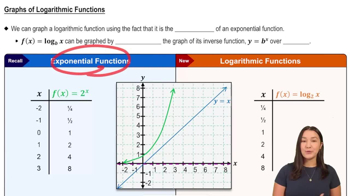
A logarithmic function is the inverse of an exponential function and is defined as y = log_b(x), where b is the base. It is only defined for positive arguments, meaning the input inside the log must be greater than zero. Understanding the shape and domain of logarithmic functions is essential for graphing and interpreting inequalities involving logs.
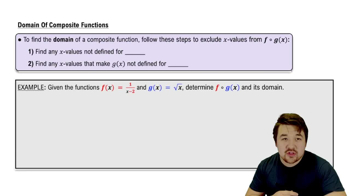
The domain of a function is the set of all input values for which the function is defined. For y ≤ log(x - 1) - 2, the expression inside the logarithm, x - 1, must be greater than zero, so x > 1. Recognizing domain restrictions ensures the graph is drawn only where the function exists.
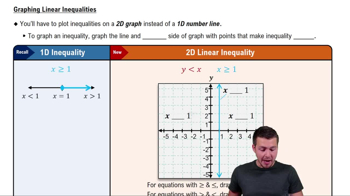
Graphing inequalities involves shading the region of the coordinate plane that satisfies the inequality. For y ≤ log(x - 1) - 2, you first graph the boundary curve y = log(x - 1) - 2, then shade the area below or on this curve. Understanding how to represent inequalities graphically helps visualize solution sets.