Recognize that the inequality \(x^2 + (y + 3)^2 \leq 16\) represents all points \((x, y)\) inside or on the boundary of a circle, because it is in the form of a circle equation \( (x - h)^2 + (y - k)^2 \leq r^2 \).
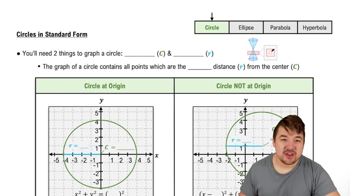
Identify the center \((h, k)\) and radius \(r\) of the circle by comparing \(x^2 + (y + 3)^2 \leq 16\) to the standard form. Here, the center is at \((0, -3)\) and the radius is \(r = \sqrt{16} = 4\).
Draw the circle with center at \((0, -3)\) and radius \$4\( on the coordinate plane. This circle includes all points where the distance from \)(0, -3)\( is exactly \)4$.
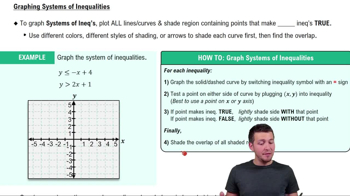
Since the inequality is \(\leq\), shade the region inside the circle, including the boundary, to represent all points \((x, y)\) that satisfy the inequality.
Label the graph clearly with the center point and radius, and ensure the shaded region correctly shows all solutions to the inequality.
Verified video answer for a similar problem:
This video solution was recommended by our tutors as helpful for the problem above
Video duration:
9m
Play a video:
Was this helpful?
Key Concepts
Here are the essential concepts you must grasp in order to answer the question correctly.
Inequalities in Two Variables
An inequality involving two variables, like x and y, represents a region in the coordinate plane. Instead of a single curve, the solution includes all points that satisfy the inequality, often forming an area bounded by a related equation.
The equation x² + (y + 3)² = 16 represents a circle centered at (0, -3) with radius 4. Understanding this helps identify the boundary of the region described by the inequality, as the inequality includes points inside or on this circle.
To graph an inequality like x² + (y + 3)² ≤ 16, first graph the boundary circle. Then, determine which side of the boundary satisfies the inequality by testing points. The solution includes the circle and all points inside it, shaded to show the region.