Identify the boundary curve by rewriting the inequality as an equation: \(y = (x - 1)^2 + 2\). This is a parabola opening upwards with its vertex at the point \((1, 2)\).
Graph the parabola \(y = (x - 1)^2 + 2\) on the coordinate plane. Since the inequality is strict (\(>\)), draw the parabola as a dashed curve to indicate points on the curve are not included in the solution.
Determine which side of the parabola to shade. Choose a test point not on the parabola, such as \((0, 0)\), and substitute into the inequality: check if \$0 > (0 - 1)^2 + 2$ holds true.
If the test point satisfies the inequality, shade the region containing that point; if not, shade the opposite side. This shaded region represents all points \((x, y)\) where \(y\) is greater than \((x - 1)^2 + 2\).
Label the graph clearly, showing the dashed parabola and the shaded region above it, to complete the graph of the inequality \(y > (x - 1)^2 + 2\).
Verified video answer for a similar problem:
This video solution was recommended by our tutors as helpful for the problem above
Video duration:
9m
Play a video:
Was this helpful?
Key Concepts
Here are the essential concepts you must grasp in order to answer the question correctly.
Graphing Quadratic Functions
A quadratic function is a parabola described by an equation like y = (x - h)^2 + k, where (h, k) is the vertex. Understanding how to plot this parabola helps visualize the boundary of the inequality. The graph of y = (x - 1)^2 + 2 is a parabola opening upwards with vertex at (1, 2).
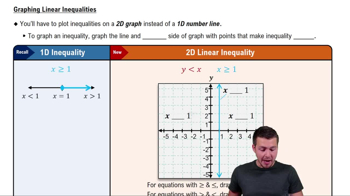
When graphing inequalities, the boundary line or curve is drawn first, often as a solid or dashed line. For y > (x - 1)^2 + 2, the boundary is the parabola y = (x - 1)^2 + 2, drawn as a dashed line because the inequality is strict (greater than, not equal to).
After graphing the boundary, the solution region is shaded to represent all points satisfying the inequality. For y > (x - 1)^2 + 2, shade the area above the parabola, indicating all points where y-values are greater than the parabola's y-values.