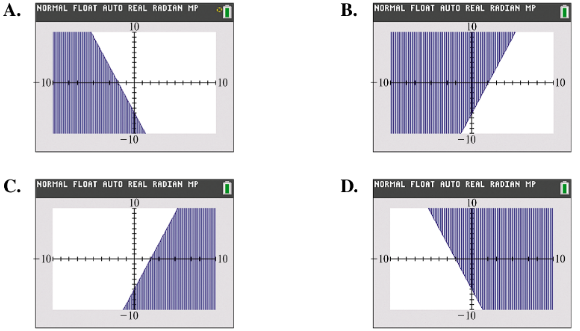
Match each inequality with the appropriate calculator graph in A–D. Do not use a calculator y ≤ -3x - 6
Verified step by step guidance
1
Identify the inequality given: \(y \leq -3x - 6\). This represents all points on or below the line \(y = -3x - 6\).
Rewrite the boundary line equation: \(y = -3x - 6\). This is a straight line with slope \(-3\) and y-intercept \(-6\).
Understand the inequality symbol \(\leq\): it means the solution includes the line itself (solid line) and the region below it.
To determine which graph matches, look for a graph with a solid line having slope \(-3\) and y-intercept \(-6\), and shading below this line.
Exclude graphs with dashed lines (which indicate strict inequalities) or shading above the line, as they do not satisfy \(y \leq -3x - 6\).
Verified video answer for a similar problem:
This video solution was recommended by our tutors as helpful for the problem above
Video duration:
5m
Play a video:
Was this helpful?
Key Concepts
Here are the essential concepts you must grasp in order to answer the question correctly.
Graphing Linear Inequalities
Graphing a linear inequality involves first graphing the related linear equation as a boundary line. The inequality symbol determines whether the boundary is solid (≤ or ≥) or dashed (< or >). The solution region is the half-plane that satisfies the inequality, shaded either above or below the line depending on the inequality direction.
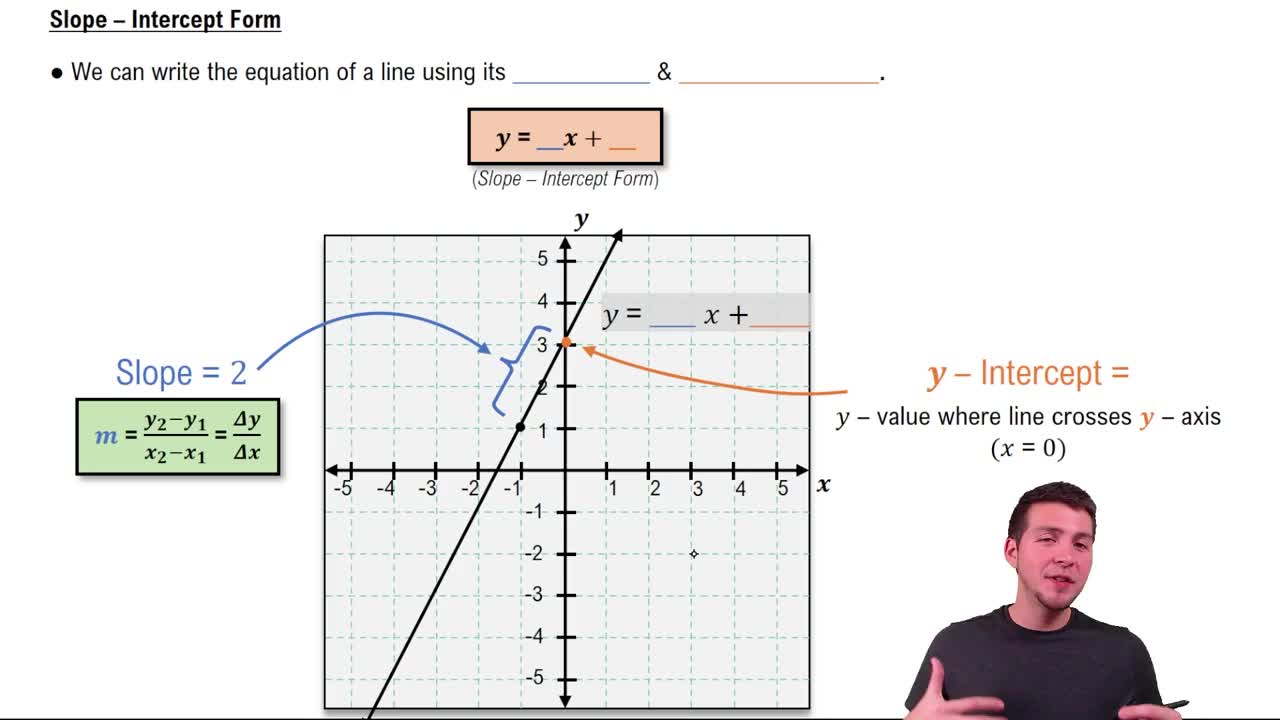
The slope-intercept form y = mx + b expresses a line with slope m and y-intercept b. For y ≤ -3x - 6, the slope is -3, indicating the line falls steeply, and the y-intercept is -6, where the line crosses the y-axis. Understanding this form helps in quickly sketching the boundary line.
The inequality symbol (≤) means the solution includes points on the line and those below it (since y is less than or equal to the expression). This affects shading on the graph, where the region below the line y = -3x - 6 is shaded to represent all solutions satisfying the inequality.