Use the Binomial Theorem to expand the binomial and express the result in simplified form. (2x+1)^3
Table of contents
- 0. Review of Algebra4h 18m
- 1. Equations & Inequalities3h 18m
- 2. Graphs of Equations1h 43m
- 3. Functions2h 17m
- 4. Polynomial Functions1h 44m
- 5. Rational Functions1h 23m
- 6. Exponential & Logarithmic Functions2h 28m
- 7. Systems of Equations & Matrices4h 5m
- 8. Conic Sections2h 23m
- 9. Sequences, Series, & Induction1h 22m
- 10. Combinatorics & Probability1h 45m
10. Combinatorics & Probability
Combinatorics
Problem 89
Textbook Question
Evaluate n!/(n-r)! for n = 20 and r = 3
Verified step by step guidance1
Identify the given values: \( n = 20 \) and \( r = 3 \).
Recall the formula to evaluate: \( \frac{n!}{(n-r)!} \). This expression represents the number of permutations of \( n \) items taken \( r \) at a time.
Substitute the given values into the formula: \( \frac{20!}{(20-3)!} = \frac{20!}{17!} \).
Expand the factorial expressions to simplify the fraction. Since \( 20! = 20 \times 19 \times 18 \times 17! \), the \( 17! \) terms cancel out, leaving \( 20 \times 19 \times 18 \).
Multiply the remaining terms \( 20 \times 19 \times 18 \) to find the value of the expression.
Verified video answer for a similar problem:This video solution was recommended by our tutors as helpful for the problem above
Video duration:
3mPlay a video:
Was this helpful?
Key Concepts
Here are the essential concepts you must grasp in order to answer the question correctly.
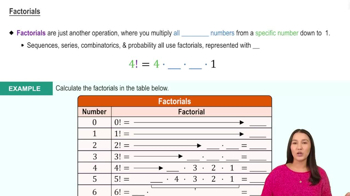
Factorial Notation
Factorial, denoted by n!, is the product of all positive integers from 1 up to n. For example, 5! = 5 × 4 × 3 × 2 × 1 = 120. It is commonly used in permutations and combinations to count arrangements.
Recommended video:
Factorials
Permutation Formula
The expression n!/(n-r)! calculates the number of permutations of r objects chosen from n distinct objects. It counts the ordered arrangements and is essential for problems involving selection and ordering.
Recommended video:
Introduction to Permutations
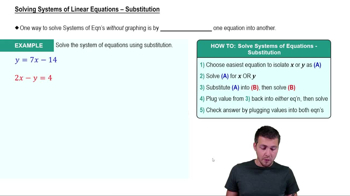
Substitution and Simplification
To evaluate n!/(n-r)!, substitute the given values for n and r, then simplify by canceling common factorial terms. This reduces the calculation to a product of consecutive integers, making it easier to compute.
Recommended video:
Guided course
Solving Systems of Equations - Substitution
Watch next
Master Fundamental Counting Principle with a bite sized video explanation from Patrick
Start learningRelated Videos
Related Practice
Textbook Question
1100
views