Find the term indicated in the expansion. (2x-3)^6; fifth term
Verified step by step guidance
1
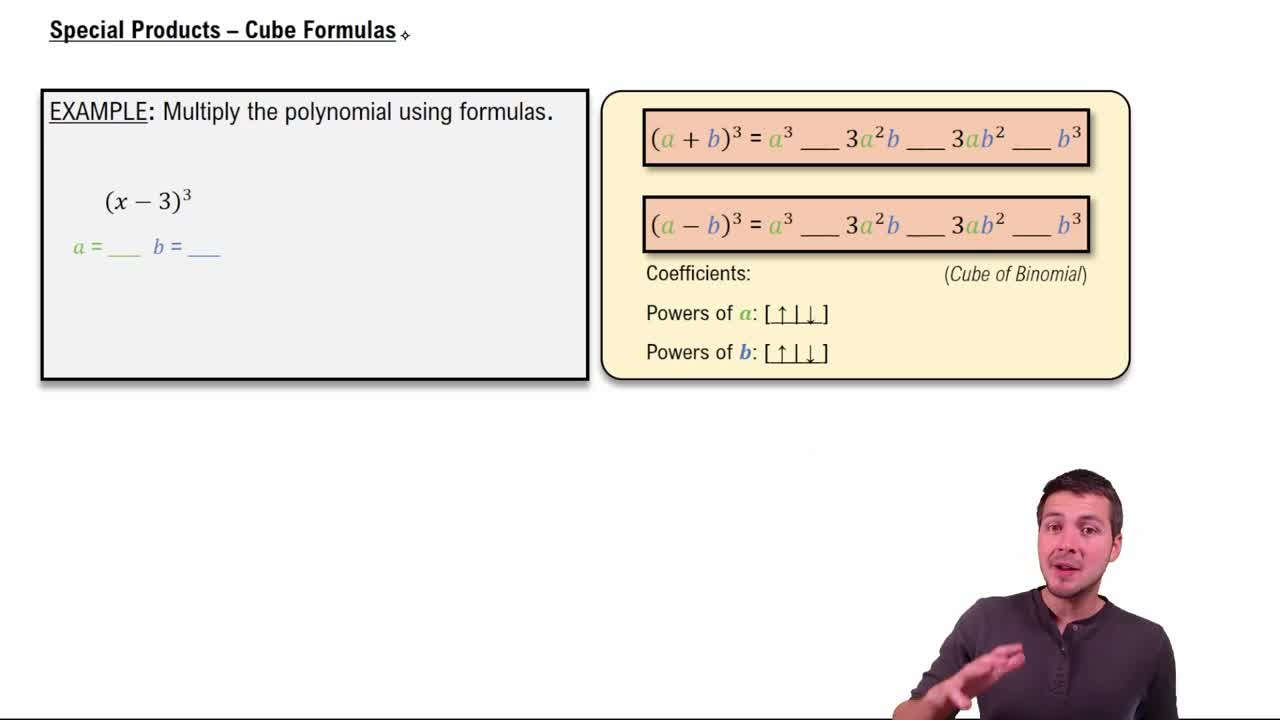
Identify that the problem involves the Binomial Theorem, which states that the expansion of \((a + b)^n\) is given by \(\sum_{k=0}^{n} \binom{n}{k} a^{n-k} b^k\), where \(\binom{n}{k}\) is the binomial coefficient.
Recognize that the fifth term in the expansion corresponds to \(k = 4\) (since the terms are indexed starting from \(k = 0\)).
Substitute \(n = 6\), \(a = 2x\), \(b = -3\), and \(k = 4\) into the general term formula \(T_{k+1} = \binom{n}{k} a^{n-k} b^k\). This gives \(T_5 = \binom{6}{4} (2x)^{6-4} (-3)^4\).
Simplify the binomial coefficient \(\binom{6}{4}\) using the formula \(\binom{n}{k} = \frac{n!}{k!(n-k)!}\). For \(\binom{6}{4}\), calculate \(\frac{6!}{4!(6-4)!}\).
Simplify the powers: \((2x)^2\) becomes \(4x^2\), and \((-3)^4\) becomes \(81\). Multiply these results with the binomial coefficient to express the fifth term.
Verified video answer for a similar problem:
This video solution was recommended by our tutors as helpful for the problem above
Video duration:
4m
Play a video:
Was this helpful?
Key Concepts
Here are the essential concepts you must grasp in order to answer the question correctly.
Binomial Theorem
The Binomial Theorem provides a formula for expanding expressions of the form (a + b)^n, where n is a non-negative integer. It states that the expansion can be expressed as a sum of terms involving binomial coefficients, which can be calculated using combinations. This theorem is essential for determining specific terms in the expansion of binomials.
Binomial coefficients are the numerical factors that appear in the expansion of a binomial expression. They are denoted as C(n, k) or 'n choose k', representing the number of ways to choose k elements from a set of n elements. These coefficients can be calculated using the formula C(n, k) = n! / (k!(n-k)!), where '!' denotes factorial.
In the expansion of (a + b)^n, the k-th term can be found using the formula T(k) = C(n, k-1) * a^(n-(k-1)) * b^(k-1). The position of the term is crucial, as it determines the powers of a and b in that term. For the fifth term, k would be 5, allowing us to apply the formula to find the specific term in the expansion.