Solve each rational inequality in Exercises 43–60 and graph the solution set on a real number line. Express each solution set in interval notation. x/(x + 2) ≥ 2
Verified step by step guidance
1
Step 1: Start by rewriting the inequality \( \frac{x}{x + 2} \geq 2 \) in a form that can be solved. Subtract 2 from both sides to get \( \frac{x}{x + 2} - 2 \geq 0 \).
Step 2: Combine the terms on the left side over a common denominator. Rewrite 2 as \( \frac{2(x + 2)}{x + 2} \) to get \( \frac{x - 2(x + 2)}{x + 2} \geq 0 \).
Step 3: Simplify the numerator: \( x - 2(x + 2) = x - 2x - 4 = -x - 4 \). The inequality becomes \( \frac{-x - 4}{x + 2} \geq 0 \).
Step 4: Identify the critical points by setting the numerator and denominator equal to zero: \(-x - 4 = 0\) gives \(x = -4\), and \(x + 2 = 0\) gives \(x = -2\).
Step 5: Use these critical points to test intervals on the number line: \((-\infty, -4)\), \((-4, -2)\), and \((-2, \infty)\). Determine where the inequality holds true and express the solution set in interval notation.
Verified video answer for a similar problem:
This video solution was recommended by our tutors as helpful for the problem above
Video duration:
4m
Play a video:
Was this helpful?
Key Concepts
Here are the essential concepts you must grasp in order to answer the question correctly.
Rational Inequalities
Rational inequalities involve expressions where a rational function is compared to a value, typically using inequality symbols like ≥, ≤, >, or <. To solve these inequalities, one must find the values of the variable that make the inequality true, often requiring the identification of critical points where the rational expression is zero or undefined.
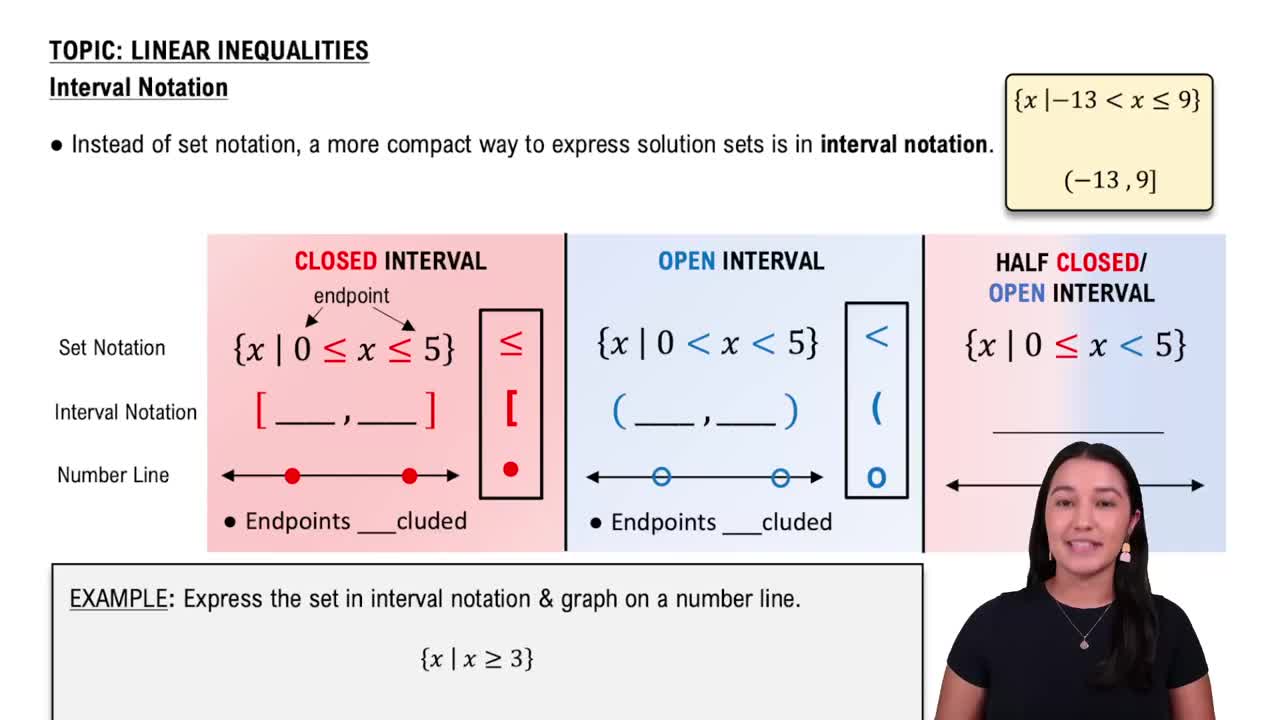
Interval notation is a mathematical notation used to represent a range of values on the real number line. It uses parentheses and brackets to indicate whether endpoints are included (closed intervals) or excluded (open intervals). For example, (a, b) represents all numbers between a and b, not including a and b, while [a, b] includes both endpoints.
Graphing solution sets involves visually representing the solutions of an inequality on a number line. This includes marking critical points and shading the appropriate regions to indicate where the inequality holds true. Understanding how to accurately depict these solutions helps in visualizing the behavior of the rational function and its inequalities.