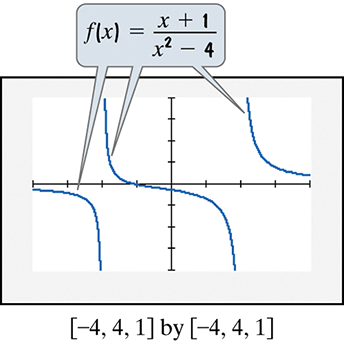
In Exercises 73–74, use the graph of the rational function to solve each inequality. 1/4(x + 2) > - 3/4(x - 2)
Verified step by step guidance
1
Step 1: Identify the rational function from the graph. The function given is \( \frac{x + 1}{x^2 - 4} \).
Step 2: Determine the vertical asymptotes by setting the denominator equal to zero and solving for x. This gives us \( x^2 - 4 = 0 \), which factors to \( (x - 2)(x + 2) = 0 \). Therefore, the vertical asymptotes are at \( x = 2 \) and \( x = -2 \).
Step 3: Determine the horizontal asymptote by comparing the degrees of the numerator and the denominator. Since the degree of the denominator (2) is greater than the degree of the numerator (1), the horizontal asymptote is at \( y = 0 \).
Step 4: Identify the x-intercept by setting the numerator equal to zero and solving for x. This gives us \( x + 1 = 0 \), so the x-intercept is at \( x = -1 \).
Step 5: Identify the y-intercept by evaluating the function at \( x = 0 \). This gives us \( f(0) = \frac{0 + 1}{0^2 - 4} = \frac{1}{-4} = -\frac{1}{4} \). So, the y-intercept is at \( y = -\frac{1}{4} \).
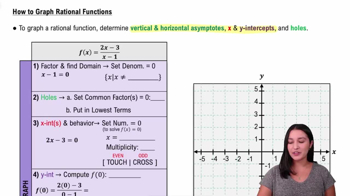
Verified video answer for a similar problem:
This video solution was recommended by our tutors as helpful for the problem above
Video duration:
7m
Play a video:
Was this helpful?
Key Concepts
Here are the essential concepts you must grasp in order to answer the question correctly.
Rational Functions
A rational function is a function that can be expressed as the ratio of two polynomials. The general form is f(x) = P(x)/Q(x), where P and Q are polynomials. Understanding rational functions is crucial for analyzing their behavior, including asymptotes, intercepts, and intervals of increase or decrease.
Inequalities express a relationship where one side is not necessarily equal to the other, using symbols like >, <, ≥, or ≤. Solving inequalities often involves finding the range of values that satisfy the condition, which can be visualized on a number line or through graphing. This is essential for determining where a rational function is greater or less than a certain value.
Asymptotes are lines that a graph approaches but never touches. For rational functions, vertical asymptotes occur where the denominator is zero, while horizontal asymptotes describe the behavior of the function as x approaches infinity. Identifying asymptotes helps in understanding the overall shape and limits of the function, which is vital for solving inequalities.