Use properties of logarithms to condense each logarithmic expression. Write the expression as a single logarithm whose coefficient is 1. Where possible, evaluate logarithmic expressions without using a calculator.
Table of contents
- 0. Review of Algebra4h 18m
- 1. Equations & Inequalities3h 18m
- 2. Graphs of Equations1h 43m
- 3. Functions2h 17m
- 4. Polynomial Functions1h 44m
- 5. Rational Functions1h 23m
- 6. Exponential & Logarithmic Functions2h 28m
- 7. Systems of Equations & Matrices4h 5m
- 8. Conic Sections2h 23m
- 9. Sequences, Series, & Induction1h 22m
- 10. Combinatorics & Probability1h 45m
6. Exponential & Logarithmic Functions
Properties of Logarithms
Problem 71
Textbook Question
In Exercises 71–78, use common logarithms or natural logarithms and a calculator to evaluate to four decimal places. log5 13
Verified step by step guidance1
Recognize that the logarithm given is \( \log_5 13 \), which means the logarithm of 13 with base 5.
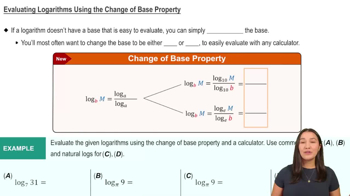
Recall the change of base formula for logarithms: \( \log_a b = \frac{\log_c b}{\log_c a} \), where \( c \) can be any positive number (commonly 10 or \( e \)).
Apply the change of base formula using common logarithms (base 10): \( \log_5 13 = \frac{\log_{10} 13}{\log_{10} 5} \).
Use a calculator to find the values of \( \log_{10} 13 \) and \( \log_{10} 5 \) separately, making sure to keep enough decimal places for accuracy.
Divide the value of \( \log_{10} 13 \) by \( \log_{10} 5 \) to get \( \log_5 13 \), then round your answer to four decimal places.
Verified video answer for a similar problem:This video solution was recommended by our tutors as helpful for the problem above
Video duration:
3mPlay a video:
Was this helpful?
Key Concepts
Here are the essential concepts you must grasp in order to answer the question correctly.
Logarithms and Their Bases
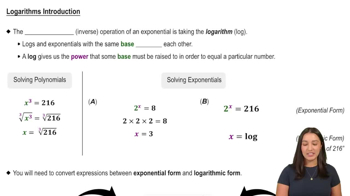
A logarithm answers the question: to what power must the base be raised to produce a given number? In this problem, log base 5 of 13 means finding the exponent x such that 5^x = 13. Understanding the relationship between exponents and logarithms is fundamental.
Recommended video:
Logarithms Introduction
Change of Base Formula
The change of base formula allows you to evaluate logarithms with any base using common (base 10) or natural (base e) logarithms: log_b(a) = log(a) / log(b). This is essential when calculators only provide log or ln functions, enabling calculation of log base 5 of 13.
Recommended video:
Change of Base Property
Using a Calculator for Logarithms
Calculators typically have buttons for common logarithms (log base 10) and natural logarithms (ln). To find log base 5 of 13, use the change of base formula with either log or ln, then compute the values and divide, rounding the result to four decimal places as required.
Recommended video:
Logarithms Introduction
Watch next
Master Product, Quotient, and Power Rules of Logs with a bite sized video explanation from Patrick
Start learningRelated Videos
Related Practice
Textbook Question
777
views
