
Textbook Question
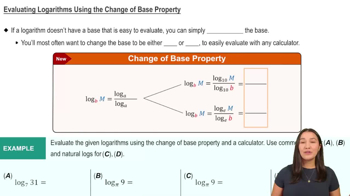
In Exercises 71–78, use common logarithms or natural logarithms and a calculator to evaluate to four decimal places. log0.1 17
804
views

 Verified step by step guidance
 7:30
7:30
 5:36 7:30
In Exercises 71–78, use common logarithms or natural logarithms and a calculator to evaluate to four decimal places. log0.1 17
Solve each logarithmic equation in Exercises 49–92. Be sure to reject any value of x that is not in the domain of the original logarithmic expressions. Give the exact answer. Then, where necessary, use a calculator to obtain a decimal approximation, correct to two decimal places, for the solution. log2(x+2)−log2(x−5)=3
In Exercises 71–78, use common logarithms or natural logarithms and a calculator to evaluate to four decimal places. log5 13
Solve each logarithmic equation in Exercises 49–92. Be sure to reject any value of x that is not in the domain of the original logarithmic expressions. Give the exact answer. Then, where necessary, use a calculator to obtain a decimal approximation, correct to two decimal places, for the solution. 2 log3(x+4)=log3 9 + 2
Find the domain of each logarithmic function. f(x) = log5(x+4)
Solve each logarithmic equation in Exercises 49–92. Be sure to reject any value of x that is not in the domain of the original logarithmic expressions. Give the exact answer. Then, where necessary, use a calculator to obtain a decimal approximation, correct to two decimal places, for the solution. log2(x−6)+log2(x−4)−log2 x=2