Exercises 108–110 will help you prepare for the material covered in the next section.Multiply: (2x³y²)(5x⁴y⁷).
Verified step by step guidance
1
Identify the expression to be multiplied: \((2x^3y^2)(5x^4y^7)\).
Apply the commutative property of multiplication to rearrange the terms: \((2 \cdot 5)(x^3 \cdot x^4)(y^2 \cdot y^7)\).
Multiply the coefficients: \(2 \cdot 5\).
Use the property of exponents \(a^m \cdot a^n = a^{m+n}\) to combine the \(x\) terms: \(x^3 \cdot x^4 = x^{3+4}\).
Use the property of exponents \(a^m \cdot a^n = a^{m+n}\) to combine the \(y\) terms: \(y^2 \cdot y^7 = y^{2+7}\).
Verified video answer for a similar problem:
This video solution was recommended by our tutors as helpful for the problem above
Video duration:
3m
Play a video:
Was this helpful?
Key Concepts
Here are the essential concepts you must grasp in order to answer the question correctly.
Polynomial Multiplication
Polynomial multiplication involves multiplying two or more polynomials together. This process requires distributing each term in the first polynomial to every term in the second polynomial. For example, when multiplying (2x³y²) by (5x⁴y⁷), you multiply the coefficients (2 and 5) and add the exponents of like bases (x and y) to find the resulting polynomial.
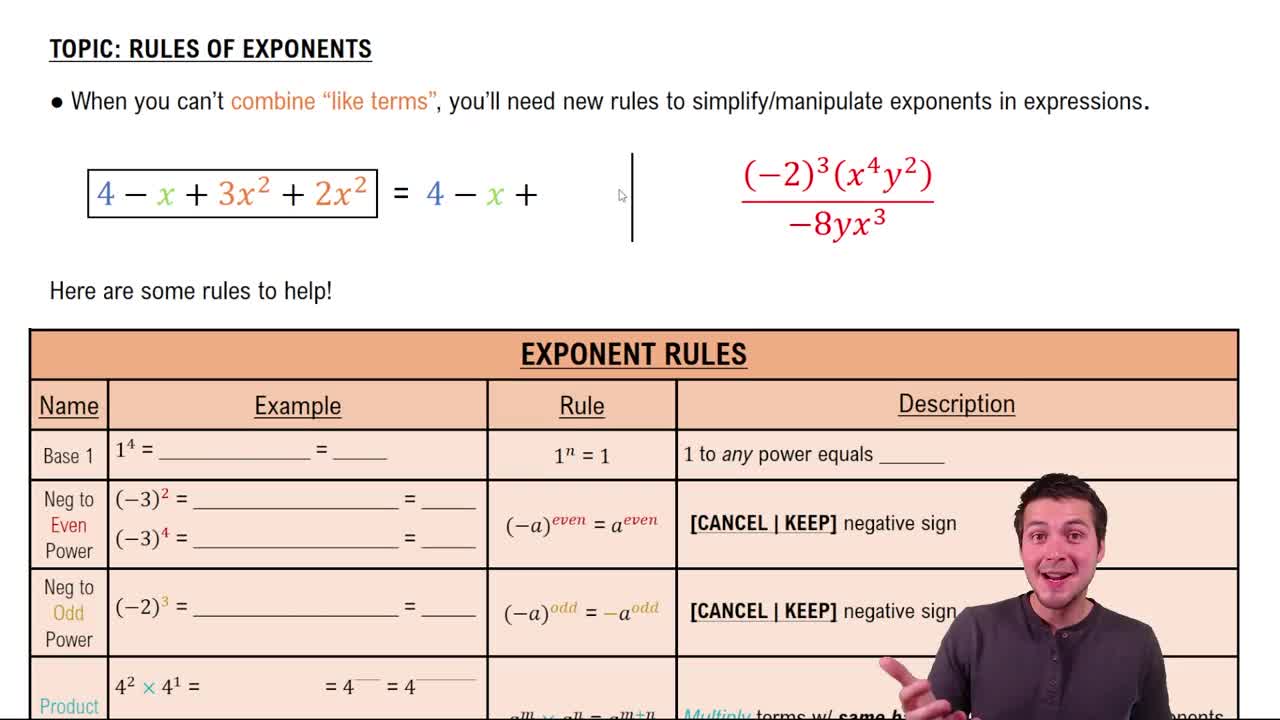
Exponent rules are essential for simplifying expressions involving powers. When multiplying terms with the same base, you add the exponents. For instance, in the expression (2x³y²)(5x⁴y⁷), the x terms combine as x^(3+4) = x⁷, and the y terms combine as y^(2+7) = y⁹. Understanding these rules is crucial for correctly simplifying the result.
Combining like terms is the process of simplifying an expression by adding or subtracting terms that have the same variable raised to the same power. In the context of polynomial multiplication, after multiplying, you may end up with multiple terms that can be combined. This step is important for expressing the final answer in its simplest form.