In Exercises 83–90, perform the indicated operations. Simplify the result, if possible. 2y−1−(y+2)−1
Verified step by step guidance
1
Rewrite the expression clearly: \(\frac{y^{-1} - (y+2)^{-1}}{2}\).
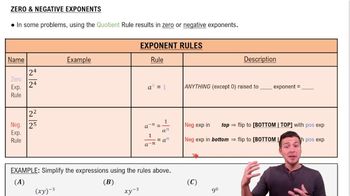
Express the negative exponents as fractions: \(y^{-1} = \frac{1}{y}\) and \((y+2)^{-1} = \frac{1}{y+2}\), so the expression becomes \(\frac{\frac{1}{y} - \frac{1}{y+2}}{2}\).
Find a common denominator for the numerator: the common denominator is \(y(y+2)\), so rewrite the numerator as \(\frac{(y+2) - y}{y(y+2)}\).
Simplify the numerator inside the fraction: \((y+2) - y = 2\), so the numerator becomes \(\frac{2}{y(y+2)}\).
Divide the numerator by 2, which is the same as multiplying by \(\frac{1}{2}\): \(\frac{2}{y(y+2)} \times \frac{1}{2} = \frac{1}{y(y+2)}\). This is the simplified form.
Verified video answer for a similar problem:
This video solution was recommended by our tutors as helpful for the problem above
Video duration:
5m
Play a video:
Was this helpful?
Key Concepts
Here are the essential concepts you must grasp in order to answer the question correctly.
Negative Exponents
A negative exponent indicates the reciprocal of the base raised to the positive exponent. For example, y^(-1) equals 1/y. Understanding this allows you to rewrite expressions with negative exponents as fractions, which is essential for simplifying the given expression.
Rational expressions are fractions involving variables. To add or subtract them, you need a common denominator. This concept is crucial for combining terms like 1/y and 1/(y+2) in the numerator before dividing by 2.
A complex fraction has fractions in its numerator, denominator, or both. Simplifying involves rewriting the numerator and denominator as single fractions and then dividing by multiplying by the reciprocal. This process helps simplify the entire expression efficiently.