Exercises 108–110 will help you prepare for the material covered in the next section.
Simplify and express the polynomial in standard form:
3x(x² + 4x + 5) + 7(x² + 4x + 5)
Verified step by step guidance
1
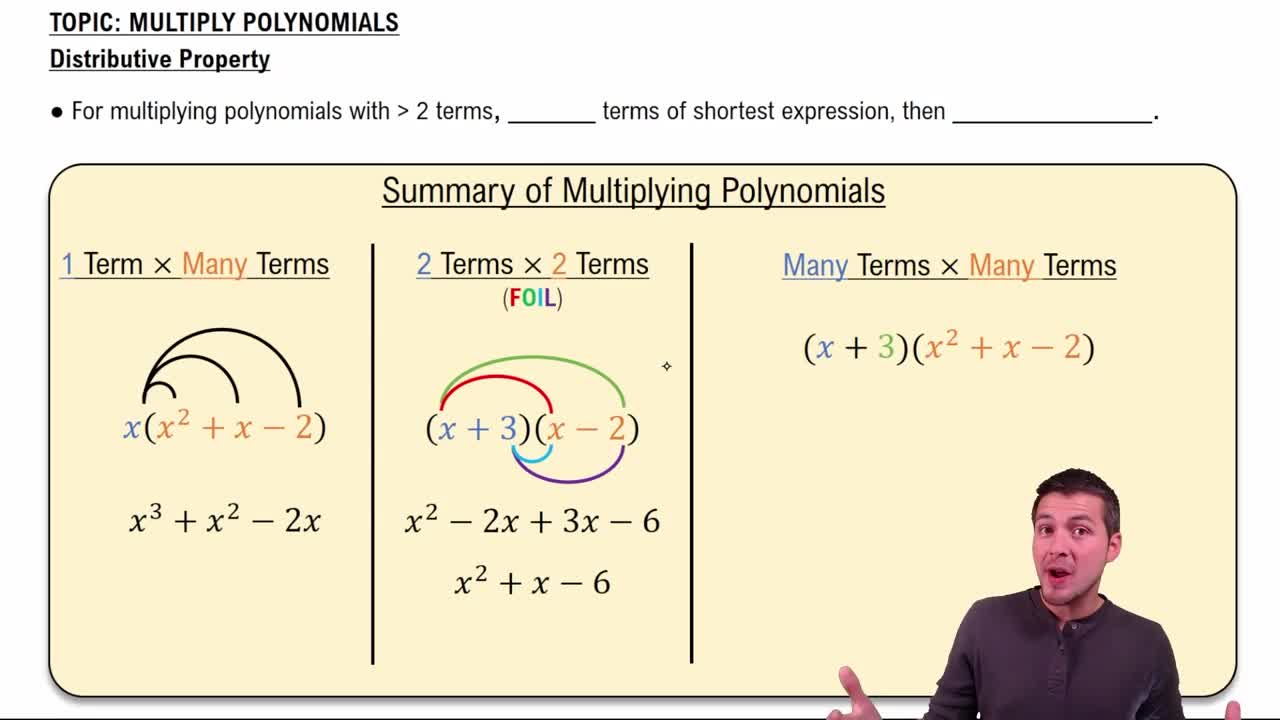
Distribute the 3x across the terms in the first polynomial: 3x(x^2 + 4x + 5).
This results in: 3x^3 + 12x^2 + 15x.
Next, distribute the 7 across the terms in the second polynomial: 7(x^2 + 4x + 5).
This results in: 7x^2 + 28x + 35.
Combine like terms from both expressions to form the polynomial in standard form.
Verified video answer for a similar problem:
This video solution was recommended by our tutors as helpful for the problem above.
Video duration:
8m
Play a video:
0 Comments
Key Concepts
Here are the essential concepts you must grasp in order to answer the question correctly.
Polynomials
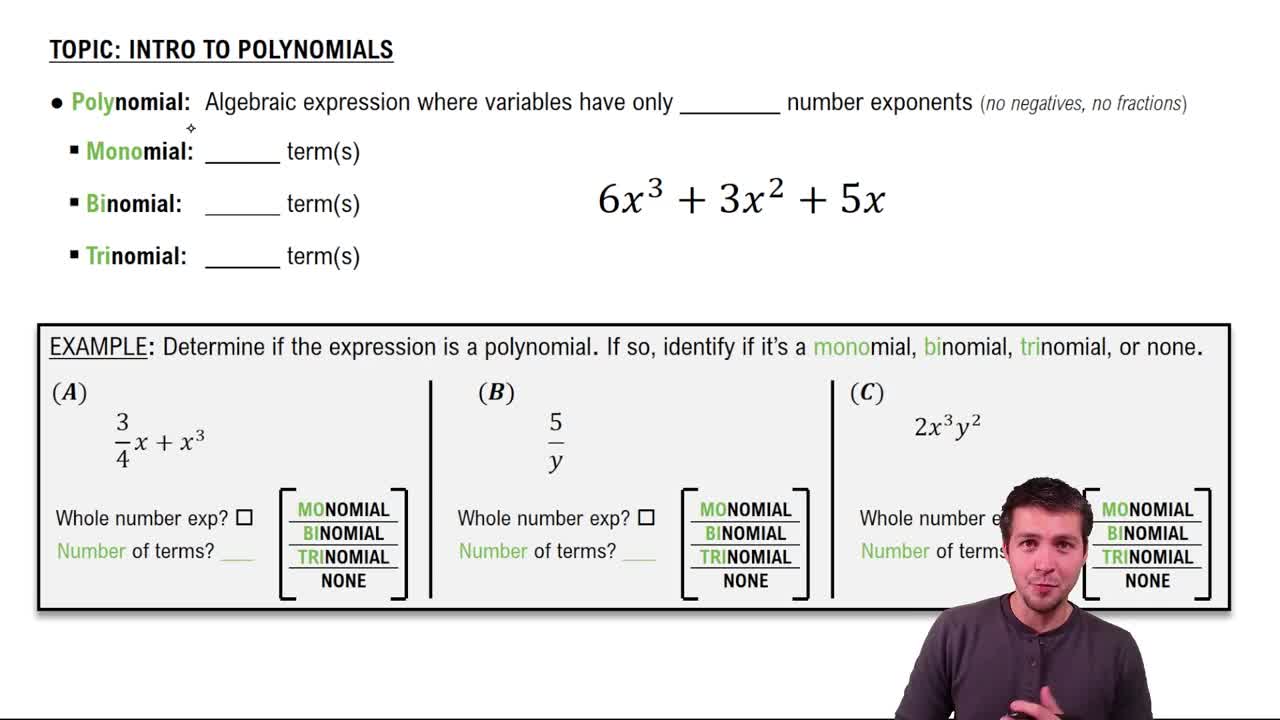
A polynomial is a mathematical expression consisting of variables raised to non-negative integer powers and coefficients. It can be expressed in the form of a sum of terms, where each term is a product of a coefficient and a variable raised to a power. Understanding polynomials is essential for simplifying expressions and performing operations like addition and multiplication.
The distributive property states that a(b + c) = ab + ac, allowing us to multiply a single term by each term within a parenthesis. This property is crucial for simplifying expressions involving polynomials, as it enables the expansion of terms and the combination of like terms, which is necessary for expressing the polynomial in standard form.
Multiply Polynomials Using the Distributive Property
Standard Form of a Polynomial
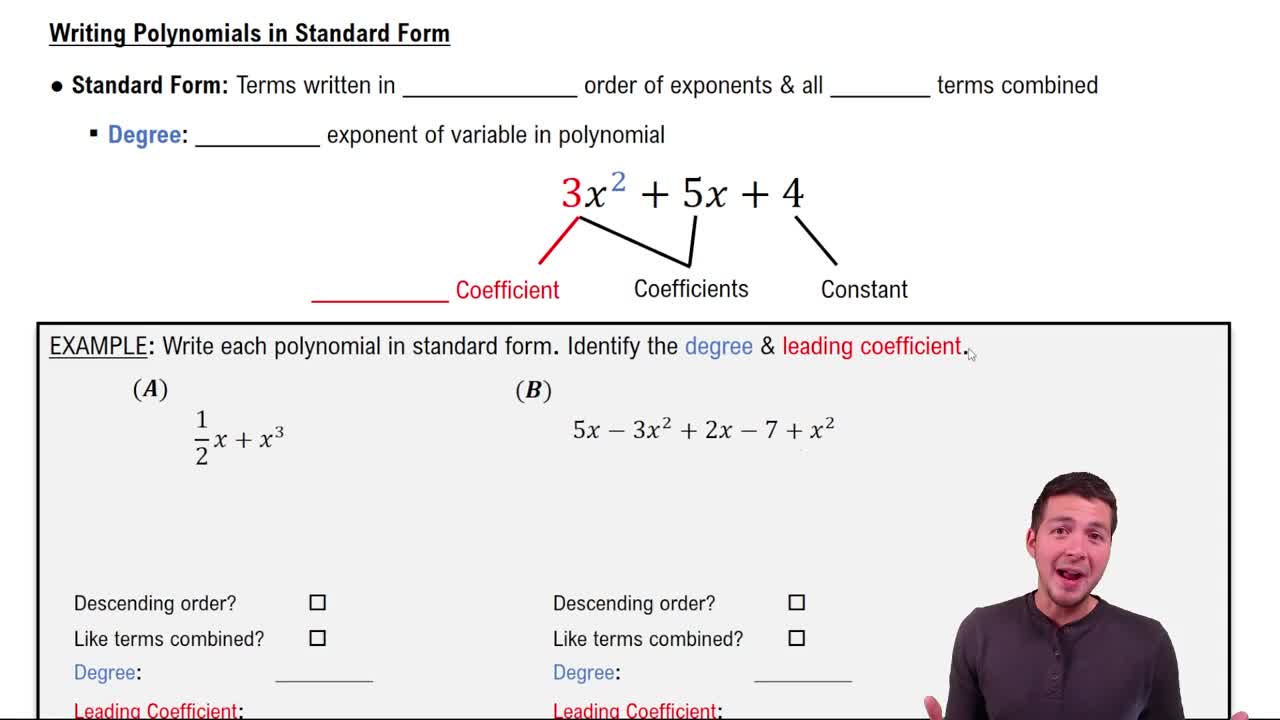
The standard form of a polynomial is when it is expressed as a sum of its terms in descending order of the degree of the variable. This means that the term with the highest power of the variable comes first, followed by terms of lower degrees. Writing a polynomial in standard form helps in easily identifying the leading coefficient and the degree of the polynomial, which are important for further analysis.

 8:04 minutes
 Verified step by step guidance
 05:13
05:13