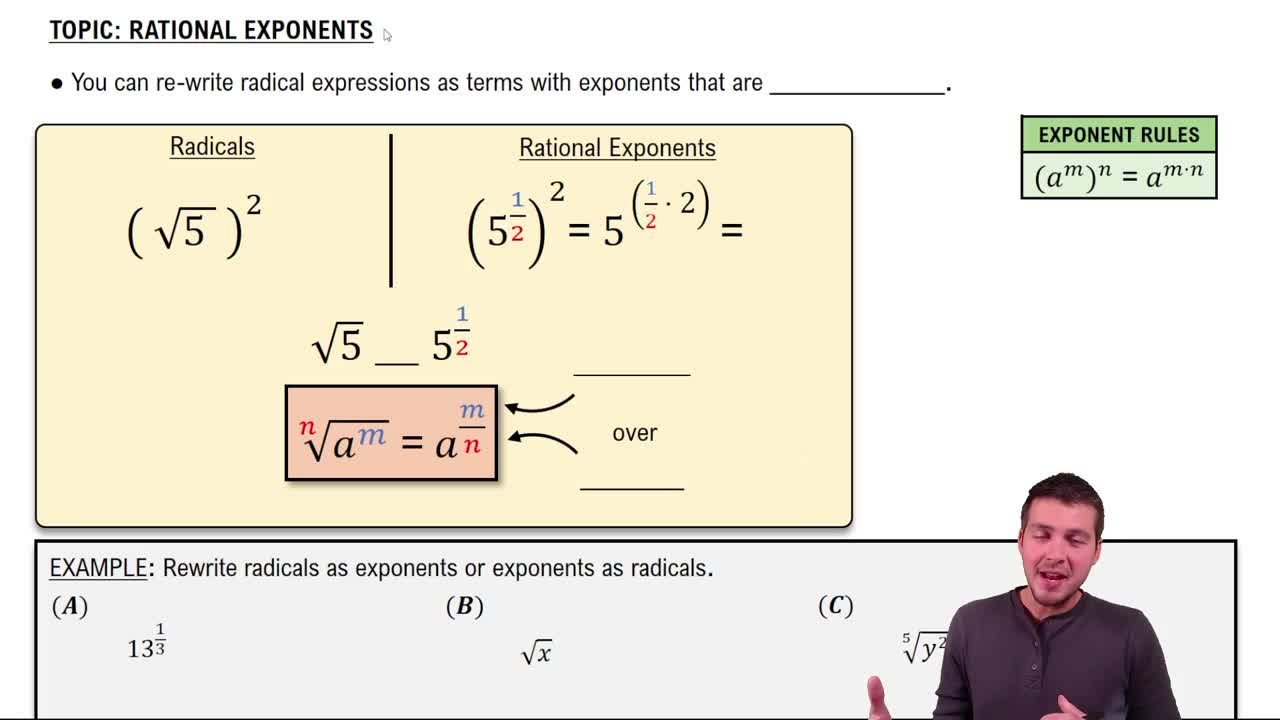
Recognize that the expression involves a fourth root, which can be written as an exponent of \( \frac{1}{4} \). So, rewrite the expression \( \sqrt[4]{81p^{12}q^{4}} \) as \( (81p^{12}q^{4})^{\frac{1}{4}} \).
Apply the exponent \( \frac{1}{4} \) to each factor inside the parentheses separately: \( 81^{\frac{1}{4}} \), \( (p^{12})^{\frac{1}{4}} \), and \( (q^{4})^{\frac{1}{4}} \).
Simplify each term using the power of a power rule \( (a^{m})^{n} = a^{mn} \): \( 81^{\frac{1}{4}} \), \( p^{12 \times \frac{1}{4}} = p^{3} \), and \( q^{4 \times \frac{1}{4}} = q^{1} = q \).
Evaluate \( 81^{\frac{1}{4}} \) by recognizing that 81 is a perfect power of 3: \( 81 = 3^{4} \), so \( 81^{\frac{1}{4}} = 3 \).
Combine all simplified parts to write the final expression for the root as \( 3p^{3}q \).
Verified video answer for a similar problem:
This video solution was recommended by our tutors as helpful for the problem above
Video duration:
1m
Play a video:
Was this helpful?
Key Concepts
Here are the essential concepts you must grasp in order to answer the question correctly.
Nth Root of a Number
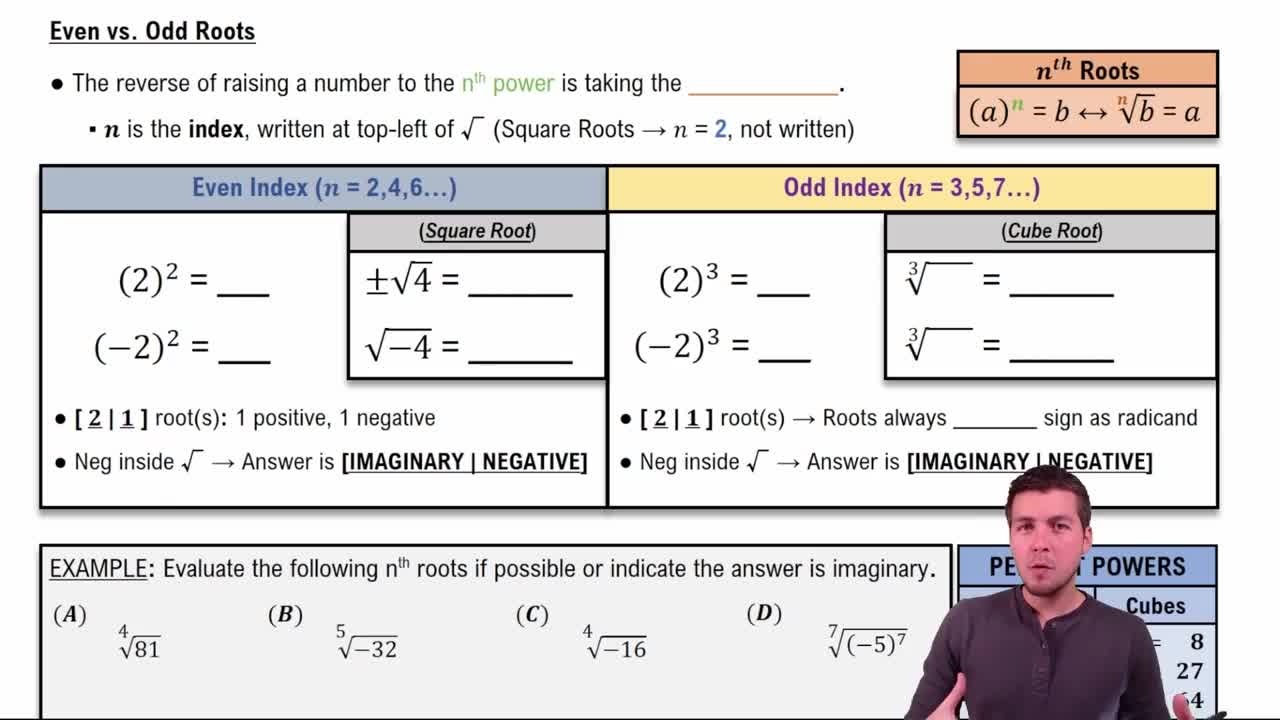
The nth root of a number is a value that, when raised to the power n, equals the original number. For example, the fourth root (∜) of 81 is the number that raised to the 4th power gives 81. Understanding how to find roots is essential for simplifying expressions involving radicals.
Exponents indicate repeated multiplication, and their properties help simplify expressions. When taking roots, exponents can be divided by the root's index (e.g., the fourth root of p¹² is p^(12/4) = p³). This rule applies to variables and constants alike.
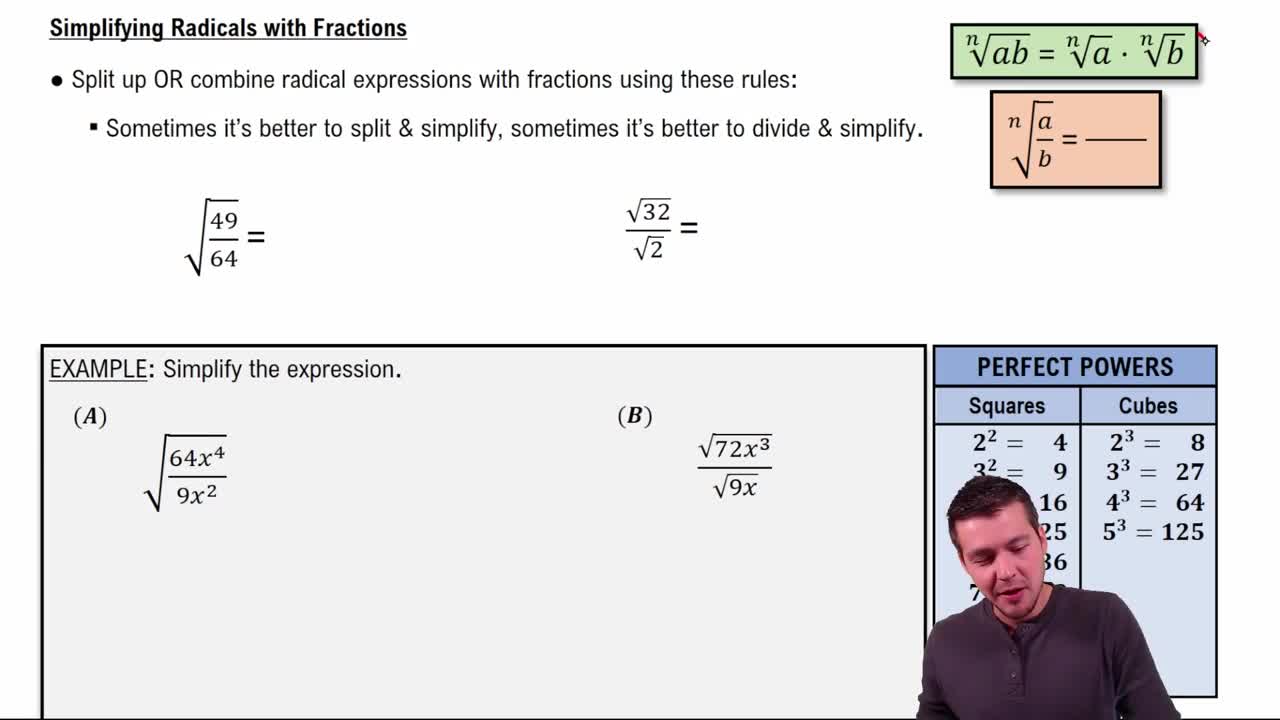
Simplifying radicals involves rewriting expressions to their simplest form by factoring and applying root and exponent rules. For example, breaking down 81 into 3⁴ helps find its fourth root easily. This process makes expressions easier to interpret and use.