Write each expression without negative exponents, and evaluate if possible. Assume all variables represent nonzero real numbers. See Example 4. (1/3)-2
Verified step by step guidance
1
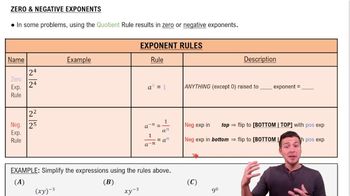
Recall the rule for negative exponents: \(a^{-n} = \frac{1}{a^n}\), where \(a \neq 0\). This means that a negative exponent indicates the reciprocal of the base raised to the positive exponent.
Apply this rule to the expression \(\left(\frac{1}{3}\right)^{-2}\). Rewrite it as the reciprocal raised to the positive exponent: \(\left(\frac{1}{3}\right)^{-2} = \left(\frac{3}{1}\right)^2\).
Simplify the reciprocal: \(\frac{3}{1}\) is just \$3\(, so the expression becomes \)3^2$.
Evaluate the positive exponent: \$3^2 = 3 \times 3$.
Calculate the product to find the value of the expression without negative exponents.
Verified video answer for a similar problem:
This video solution was recommended by our tutors as helpful for the problem above
Video duration:
1m
Play a video:
Was this helpful?
Key Concepts
Here are the essential concepts you must grasp in order to answer the question correctly.
Negative Exponents
A negative exponent indicates the reciprocal of the base raised to the corresponding positive exponent. For example, a^(-n) equals 1 divided by a^n. This rule allows rewriting expressions to eliminate negative exponents by converting them into positive ones.
Raising a fraction to a power means raising both the numerator and denominator to that power separately. For instance, (a/b)^n equals a^n divided by b^n. This property helps simplify expressions involving fractional bases.
Evaluating powers involves multiplying the base by itself as many times as indicated by the exponent. For example, 3^2 equals 3 × 3 = 9. Understanding this helps in calculating the numerical value of expressions after rewriting them without negative exponents.