Identify which graphs are not those of polynomial functions.
Table of contents
- 0. Review of Algebra4h 18m
- 1. Equations & Inequalities3h 18m
- 2. Graphs of Equations1h 43m
- 3. Functions2h 17m
- 4. Polynomial Functions1h 44m
- 5. Rational Functions1h 23m
- 6. Exponential & Logarithmic Functions2h 28m
- 7. Systems of Equations & Matrices4h 5m
- 8. Conic Sections2h 23m
- 9. Sequences, Series, & Induction1h 22m
- 10. Combinatorics & Probability1h 45m
4. Polynomial Functions
Understanding Polynomial Functions
Problem 19
Textbook Question
In Exercises 19–24, (a) Use the Leading Coefficient Test to determine the graph's end behavior. (b) Determine whether the graph has y-axis symmetry, origin symmetry, or neither. (c) Graph the function.
Verified step by step guidance1
Identify the degree and leading coefficient of the polynomial function \(f(x) = x^3 - x^2 - 9x + 9\). The degree is the highest power of \(x\), which is 3, and the leading coefficient is the coefficient of \(x^3\), which is 1.
Apply the Leading Coefficient Test to determine the end behavior: Since the degree is odd (3) and the leading coefficient is positive (1), as \(x \to \infty\), \(f(x) \to \infty\), and as \(x \to -\infty\), \(f(x) \to -\infty\).
Check for symmetry by evaluating \(f(-x)\) and comparing it to \(f(x)\) and \(-f(x)\). Calculate \(f(-x) = (-x)^3 - (-x)^2 - 9(-x) + 9 = -x^3 - x^2 + 9x + 9\). Since \(f(-x) \neq f(x)\) and \(f(-x) \neq -f(x)\), the function has neither y-axis symmetry nor origin symmetry.
To graph the function, first find the x-intercepts by solving \(f(x) = 0\), which means solving \(x^3 - x^2 - 9x + 9 = 0\). Use factoring techniques or the Rational Root Theorem to find possible roots.
Next, find the y-intercept by evaluating \(f(0) = 9\). Plot the intercepts and use the end behavior and symmetry information to sketch the graph, noting the general shape of a cubic function with the given leading coefficient.
Verified video answer for a similar problem:This video solution was recommended by our tutors as helpful for the problem above
Video duration:
5mPlay a video:
Was this helpful?
Key Concepts
Here are the essential concepts you must grasp in order to answer the question correctly.
Leading Coefficient Test
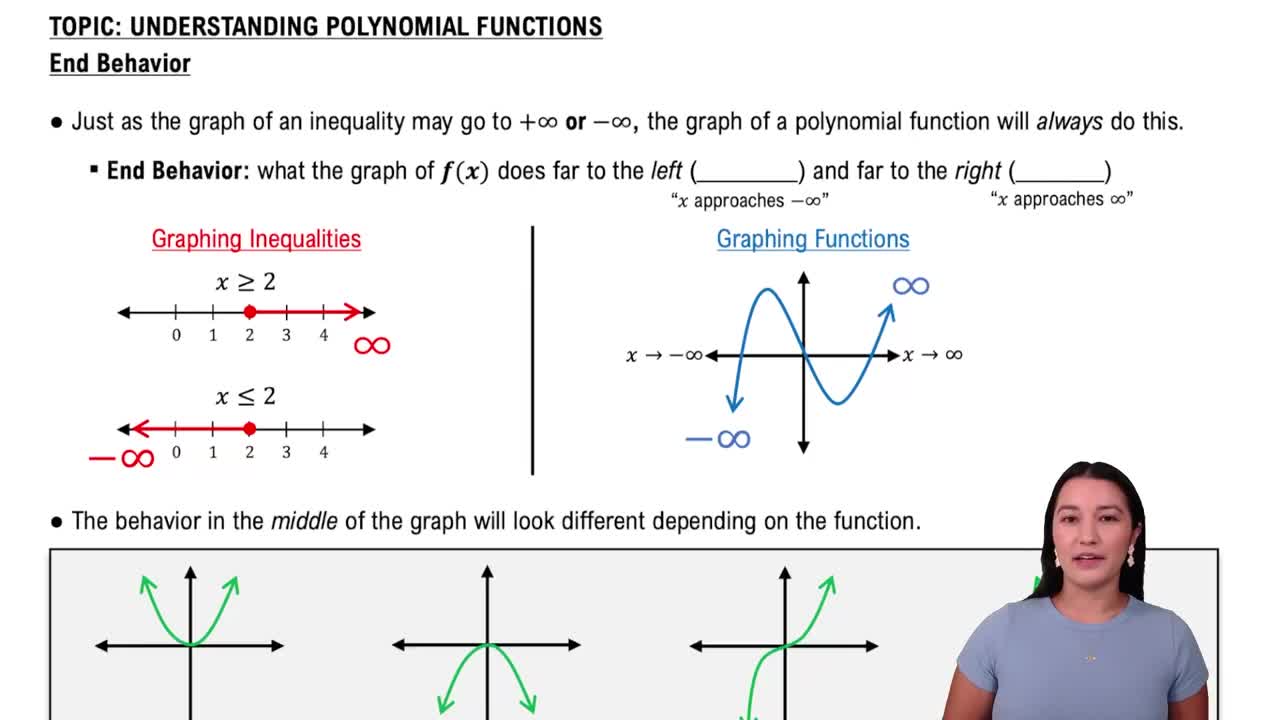
The Leading Coefficient Test helps determine the end behavior of a polynomial function by examining the degree and the leading coefficient. For a cubic function, if the leading coefficient is positive, the graph falls to the left and rises to the right; if negative, it rises to the left and falls to the right.
Recommended video:
End Behavior of Polynomial Functions
Symmetry of Functions
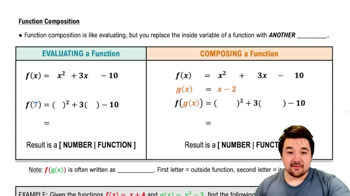
Symmetry in graphs can be about the y-axis, origin, or neither. A function is symmetric about the y-axis if f(-x) = f(x) (even function), symmetric about the origin if f(-x) = -f(x) (odd function), and neither if neither condition holds. Checking symmetry helps understand the graph's shape.
Recommended video:
Function Composition
Graphing Polynomial Functions
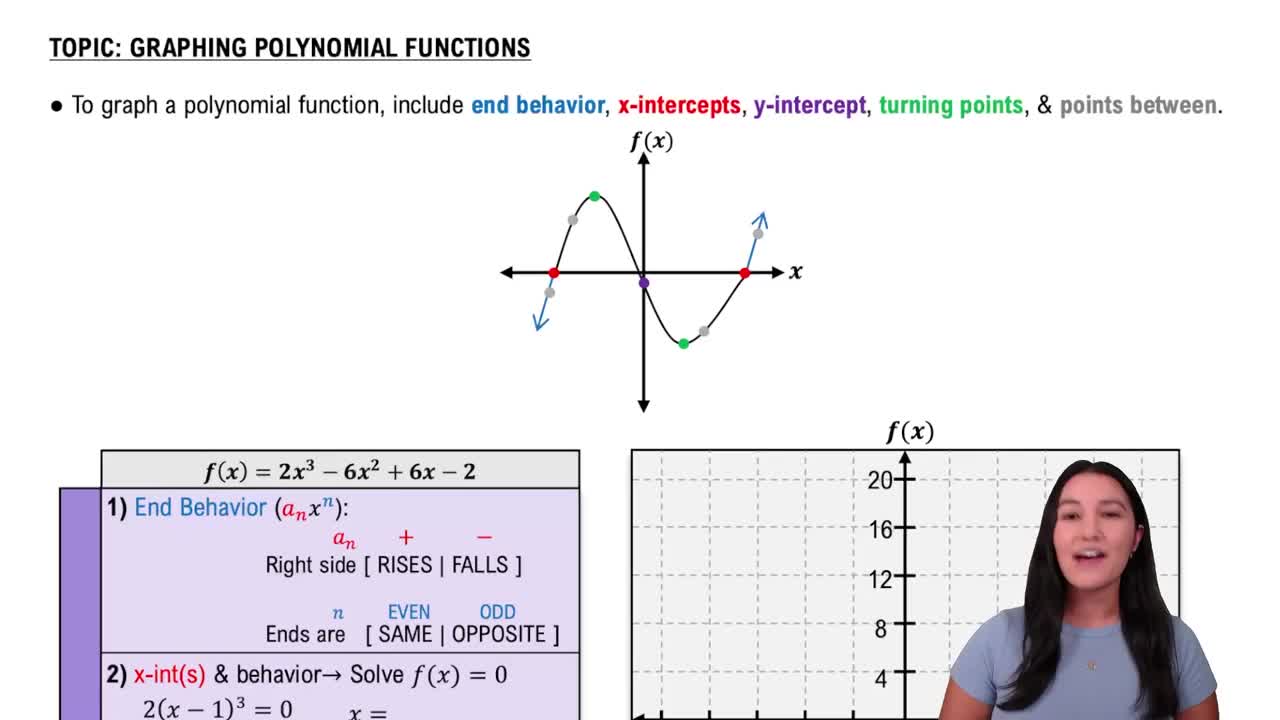
Graphing involves plotting key points such as intercepts, turning points, and using end behavior and symmetry to sketch the curve. For cubic polynomials, identifying roots and behavior between them is essential to accurately represent the function's shape.
Recommended video:
Graphing Polynomial Functions
Watch next
Master Introduction to Polynomial Functions with a bite sized video explanation from Patrick
Start learningRelated Videos
Related Practice
Textbook Question
772
views