Join thousands of students who trust us to help them ace their exams!
Multiple Choice
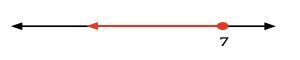
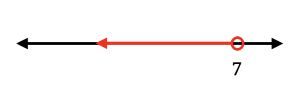
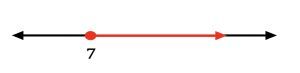
Express the given set in interval notation and graph.
A
(−∞,7]
B
[−∞,7]
C
(−∞,7)
D
[7, ∞)
0 Comments
Verified step by step guidance
1
Identify the inequality given in the set notation: \( x \leq 7 \). This means all numbers less than or equal to 7 are included in the set.
In interval notation, a square bracket \([\) is used to denote that the endpoint is included, while a parenthesis \(()\) is used to denote that the endpoint is not included.
Since the inequality is \( x \leq 7 \), the number 7 is included in the set. Therefore, we use a square bracket at 7.
The set includes all numbers less than 7, extending indefinitely to the left. This is represented by \(-\infty\) in interval notation, which always uses a parenthesis because infinity is not a specific number that can be reached.
Combine these observations to express the set in interval notation: \((-\infty, 7]\).




 Verified step by step guidance

