For each line, (a) find the slope and (b) sketch the graph. See Examples 6 and 7. 2y = -3x
Verified step by step guidance
1
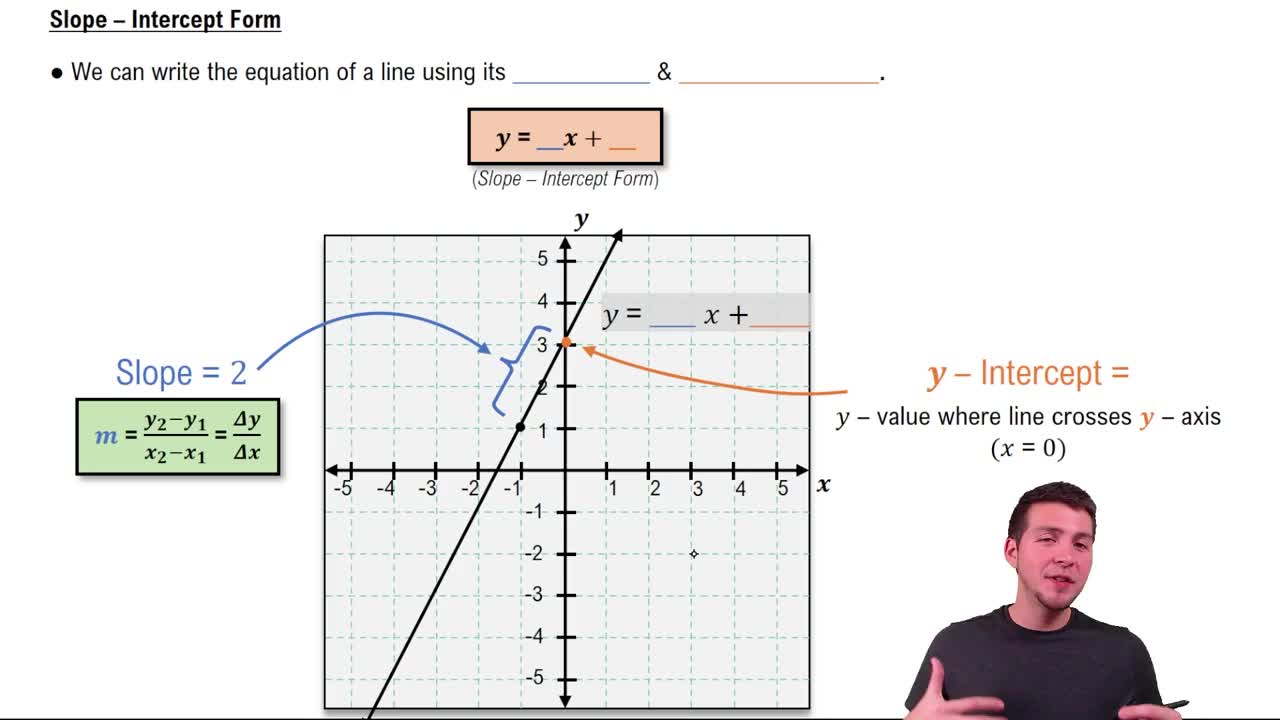
Rewrite the equation in slope-intercept form, which is y = mx + b, where m is the slope and b is the y-intercept.
Start by dividing both sides of the equation 2y = -3x by 2 to solve for y.
This gives y = (-3/2)x, which is now in slope-intercept form.
Identify the slope (m) from the equation y = (-3/2)x. The slope is -3/2.
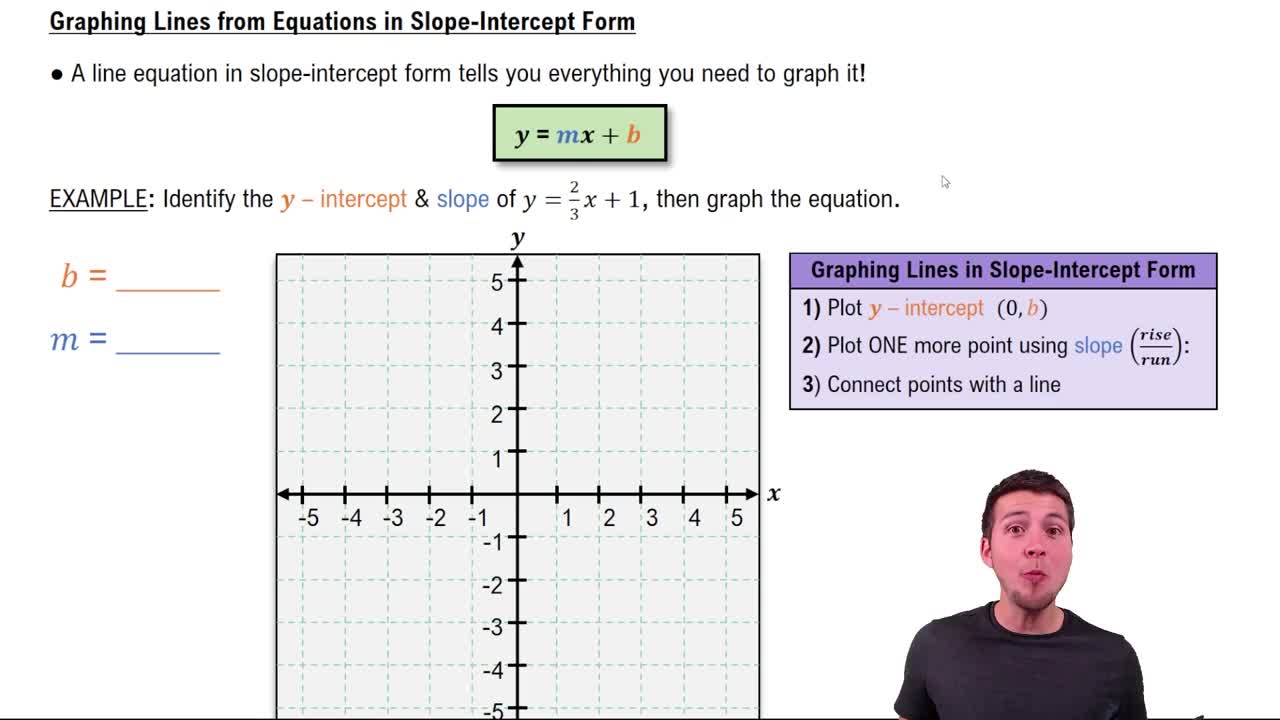
To sketch the graph, note that the line passes through the origin (0,0) since there is no y-intercept term (b = 0), and use the slope to determine the direction and steepness of the line.
Verified video answer for a similar problem:
This video solution was recommended by our tutors as helpful for the problem above
Video duration:
4m
Play a video:
Was this helpful?
Key Concepts
Here are the essential concepts you must grasp in order to answer the question correctly.
Slope
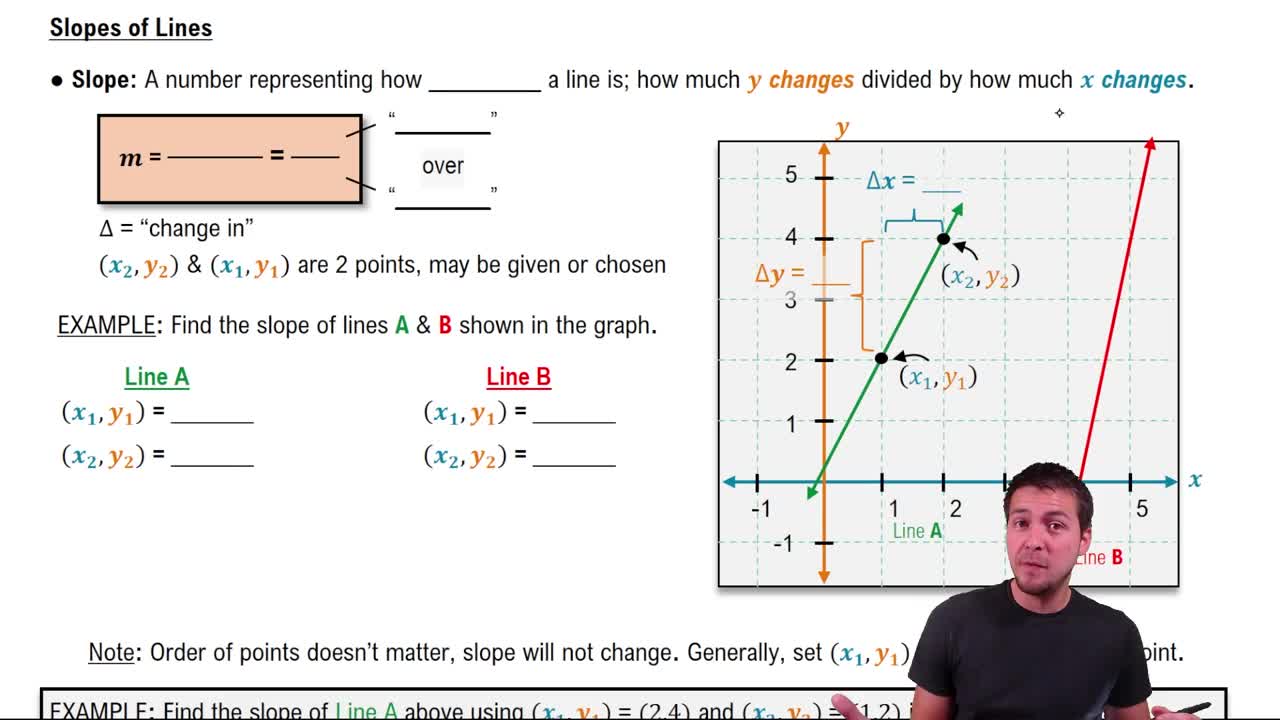
The slope of a line is a measure of its steepness and direction, typically represented as 'm' in the slope-intercept form of a linear equation, y = mx + b. It is calculated as the ratio of the change in the y-coordinates to the change in the x-coordinates between two points on the line. A positive slope indicates the line rises from left to right, while a negative slope indicates it falls.
Graphing a linear equation involves plotting points that satisfy the equation on a coordinate plane and connecting them to form a straight line. To graph the equation, it is often helpful to convert it into slope-intercept form (y = mx + b) to easily identify the slope and y-intercept. This visual representation helps in understanding the relationship between the variables.
The standard form of a linear equation is typically expressed as Ax + By = C, where A, B, and C are constants. This form is useful for identifying the x- and y-intercepts of the line, which can be plotted to aid in graphing. To find the slope from this form, one can rearrange the equation into slope-intercept form or use the coefficients directly.