For the linear function f(x) = mx + b, f(−2) = 11 and ƒ(3) = -9. Find m and b.
Verified step by step guidance
1
Start with the general form of the linear function: , where is the slope and is the y-intercept.
Use the given values to create two equations by substituting the points into the function. For , substitute and to get: .
Similarly, for , substitute and to get: .
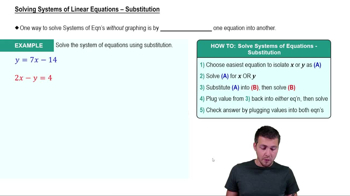
Now you have a system of two linear equations: and . Use either the substitution or elimination method to solve for and .
After solving the system, you will find the values of and that satisfy both equations, which define the linear function.
Verified video answer for a similar problem:
This video solution was recommended by our tutors as helpful for the problem above
Video duration:
4m
Play a video:
Was this helpful?
Key Concepts
Here are the essential concepts you must grasp in order to answer the question correctly.
Linear Functions
A linear function is an equation of the form f(x) = mx + b, where m represents the slope and b the y-intercept. It produces a straight line when graphed, and each input x corresponds to exactly one output f(x). Understanding this form is essential for identifying and working with linear relationships.
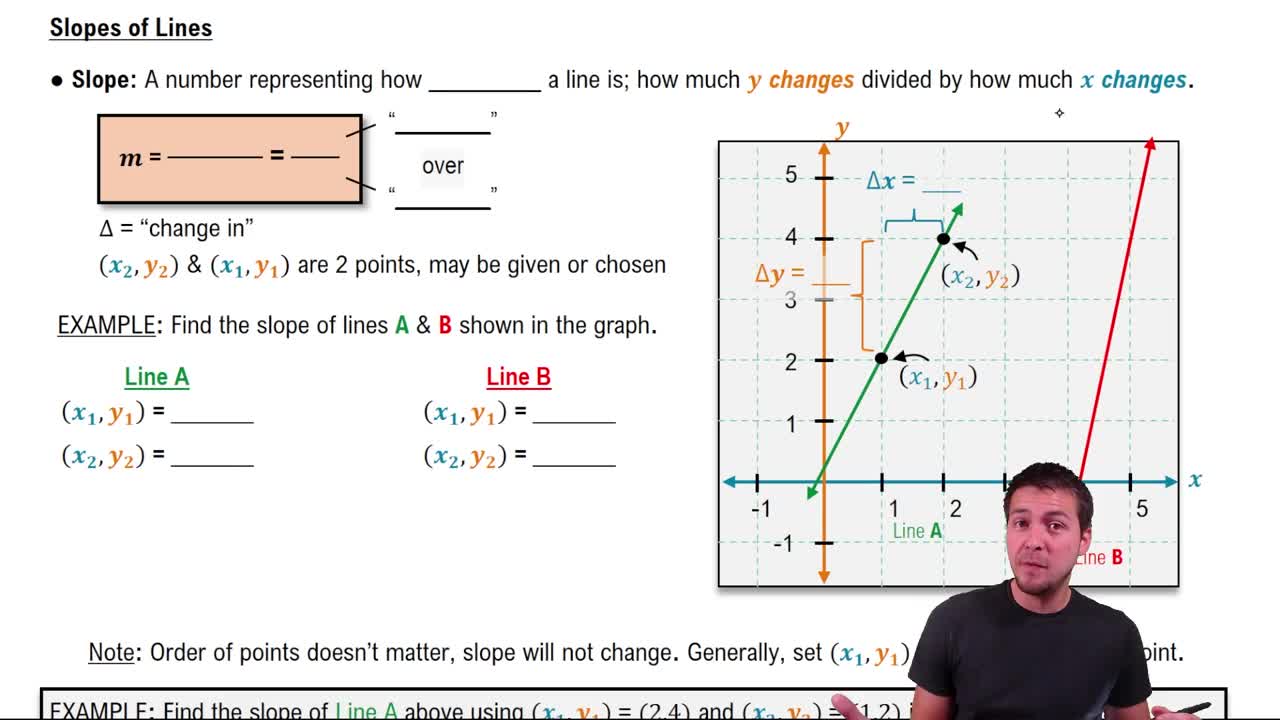
The slope (m) measures the rate of change of the function, indicating how much f(x) changes for a unit change in x. It can be found using two points (x₁, y₁) and (x₂, y₂) with the formula m = (y₂ - y₁) / (x₂ - x₁). Calculating the slope is crucial for determining the linear function's behavior.
Given two points on a line, you can create two equations by substituting the points into f(x) = mx + b. Solving this system simultaneously allows you to find the values of m and b. Techniques include substitution or elimination, which are fundamental for solving multiple-variable problems.