Write an equation in point-slope form and slope-intercept form for the line passing through (-2, -6) and perpendicular to the line whose equation is x − 3y+ 9 = 0.
Verified step by step guidance
1
First, rewrite the given line equation in slope-intercept form by isolating . Start by moving and to the other side: .
Next, divide both sides of the equation by to solve for : . So, the slope of the given line is .
Since the line we want is perpendicular to the given line, find the negative reciprocal of the slope . The negative reciprocal is . This will be the slope of the new line.
Use the point-slope form of a line equation, which is , where is the slope and is the point the line passes through. Substitute and the point to get .
Simplify the point-slope form equation to get the slope-intercept form. Distribute the slope and simplify: , then . Finally, subtract 6 from both sides to isolate : .
Verified video answer for a similar problem:
This video solution was recommended by our tutors as helpful for the problem above
Video duration:
3m
Play a video:
Was this helpful?
Key Concepts
Here are the essential concepts you must grasp in order to answer the question correctly.
Slope of a Line
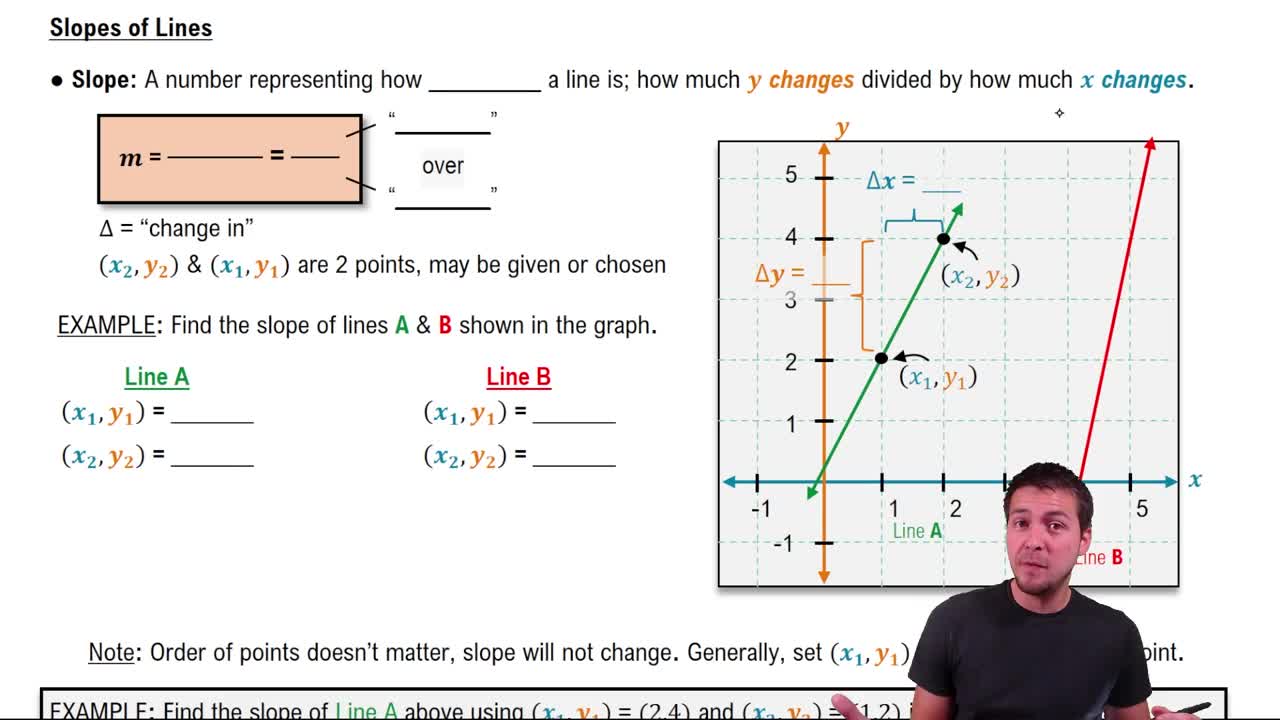
The slope measures the steepness of a line and is calculated as the ratio of the change in y to the change in x between two points. For a line in standard form Ax + By + C = 0, the slope is -A/B. Understanding slope is essential for finding parallel or perpendicular lines.
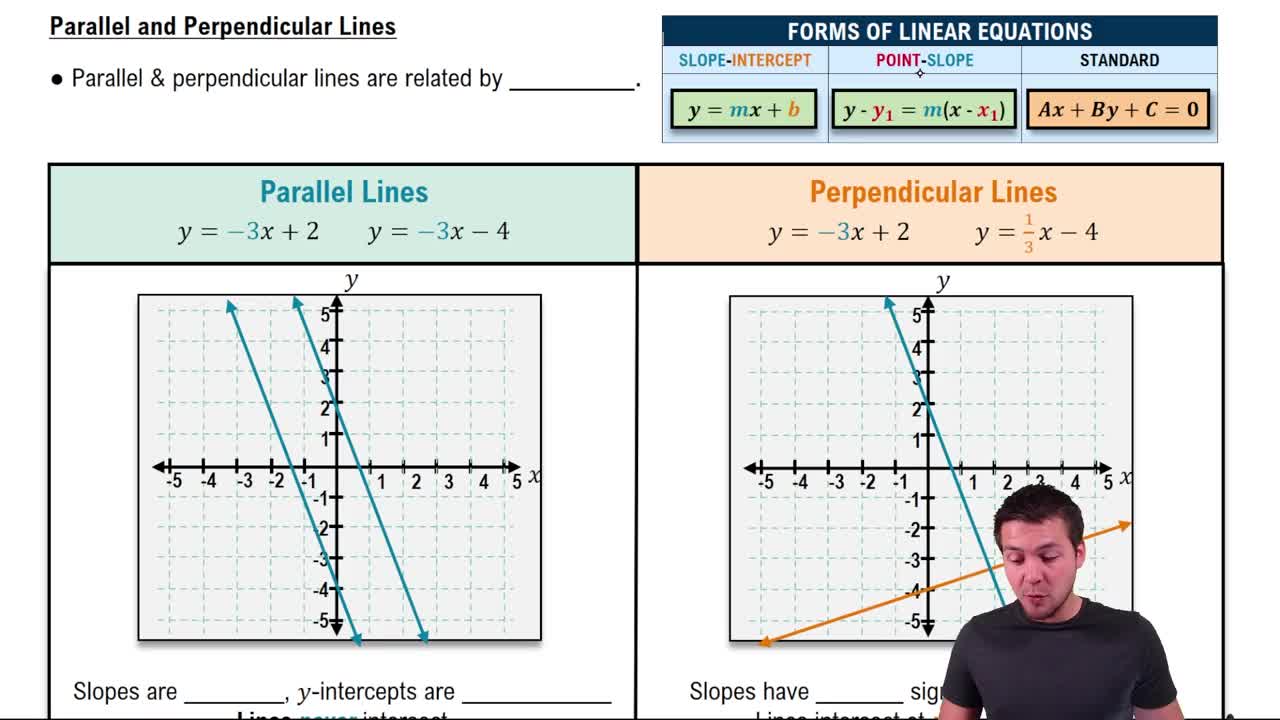
Two lines are perpendicular if the product of their slopes is -1. This means the slope of a line perpendicular to another with slope m is the negative reciprocal, -1/m. This relationship helps determine the slope of the required line.
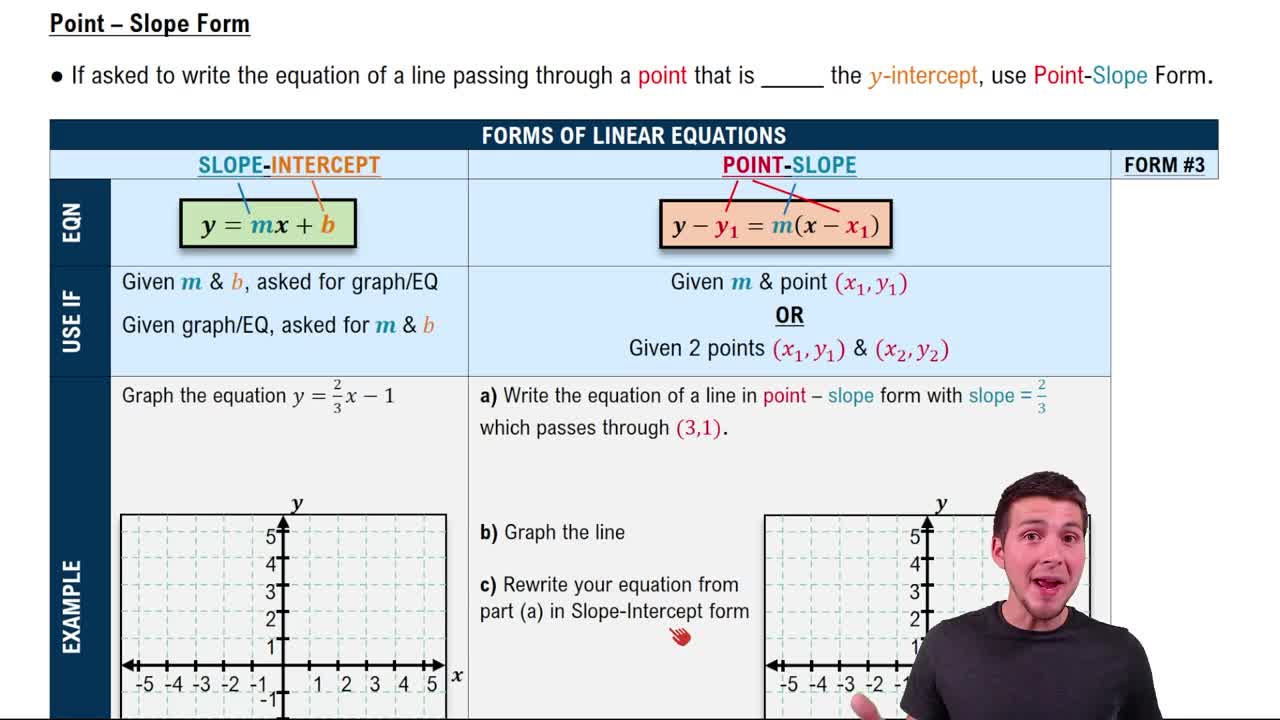
Point-slope form is written as y - y₁ = m(x - x₁), using a point (x₁, y₁) and slope m. Slope-intercept form is y = mx + b, where m is the slope and b is the y-intercept. Both forms are useful for expressing the equation of a line once the slope and a point are known.