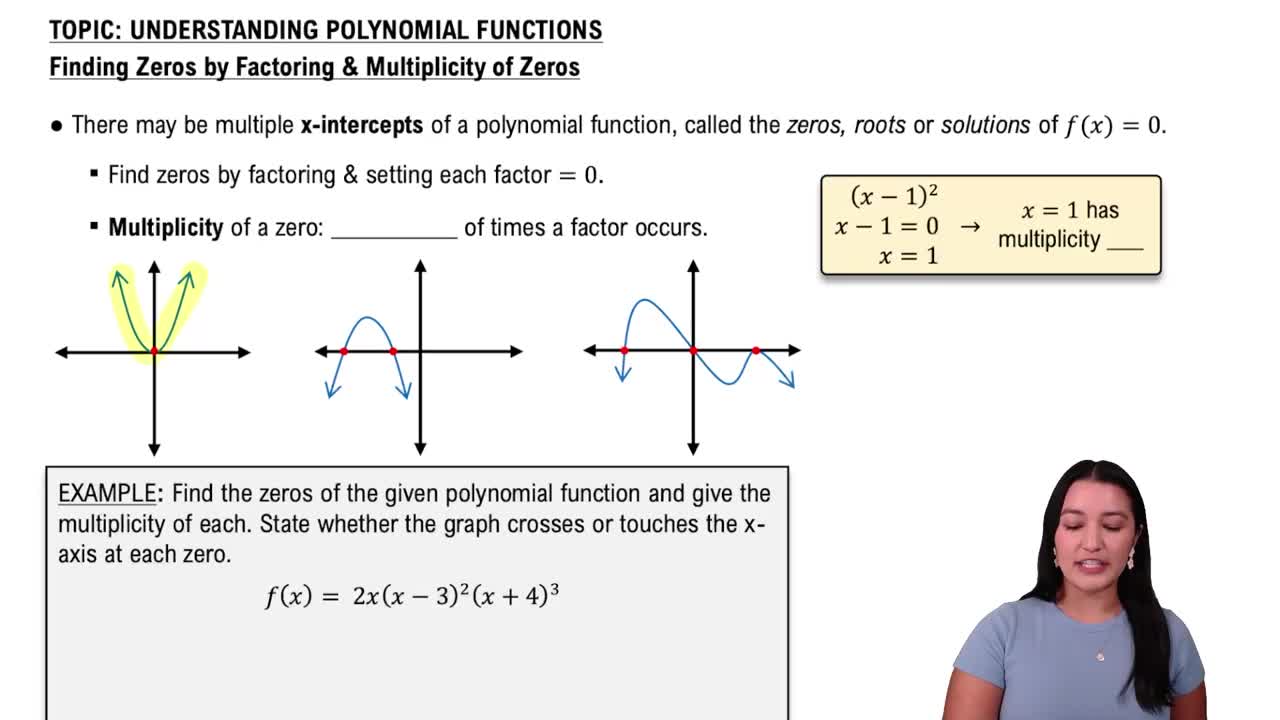
For each polynomial function, find all zeros and their multiplicities. ƒ(x)=5x2(x2-16)(x+5)
Verified step by step guidance
1
Start by writing the given polynomial function clearly: \(f(x) = 5x^2 (x^2 - 16)(x + 5)\).
Recognize that the polynomial is factored into three parts: \$5x^2\(, \)(x^2 - 16)\(, and \)(x + 5)$. Each factor can give zeros when set equal to zero.
Find the zeros from each factor: For \$5x^2\(, set \)x^2 = 0\( which gives \)x = 0\(. For \)(x^2 - 16)\(, recognize it as a difference of squares and factor it further into \)(x - 4)(x + 4)\(, giving zeros \)x = 4\( and \)x = -4\(. For \)(x + 5)\(, set \)x + 5 = 0\( which gives \)x = -5$.
Determine the multiplicity of each zero by looking at the exponents of the factors: \(x = 0\) comes from \(x^2\) so its multiplicity is 2; \(x = 4\) and \(x = -4\) come from linear factors each with multiplicity 1; \(x = -5\) also comes from a linear factor with multiplicity 1.
Summarize the zeros and their multiplicities: \(x = 0\) (multiplicity 2), \(x = 4\) (multiplicity 1), \(x = -4\) (multiplicity 1), and \(x = -5\) (multiplicity 1).
Verified video answer for a similar problem:
This video solution was recommended by our tutors as helpful for the problem above
Video duration:
4m
Play a video:
Was this helpful?
Key Concepts
Here are the essential concepts you must grasp in order to answer the question correctly.
Polynomial Zeros
Zeros of a polynomial are the values of x that make the function equal to zero. Finding zeros involves setting the polynomial equal to zero and solving for x. These values correspond to the x-intercepts of the graph.
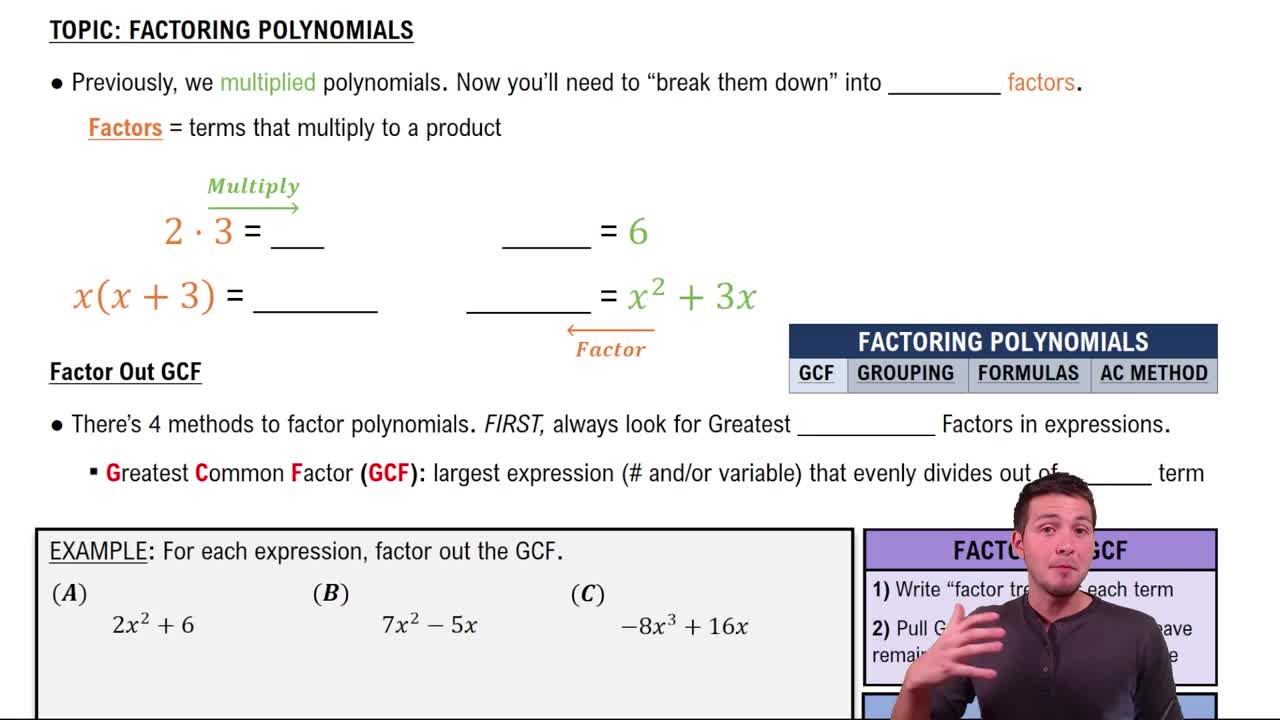
Factoring breaks down a polynomial into simpler expressions multiplied together. This process helps identify zeros by setting each factor equal to zero. Recognizing special products like difference of squares is useful in factoring.
Multiplicity refers to how many times a particular zero appears as a root of the polynomial. It is determined by the exponent of the factor associated with that zero. Multiplicity affects the graph's behavior at the zero, such as touching or crossing the x-axis.