
Textbook Question
Exercises 53–60 show incomplete graphs of given polynomial functions. a) Find all the zeros of each function. b) Without using a graphing utility, draw a complete graph of the function. f(x)=−x3+x2+16x−16
530
views

 Verified step by step guidance
 02:58
02:58
 6:54
6:54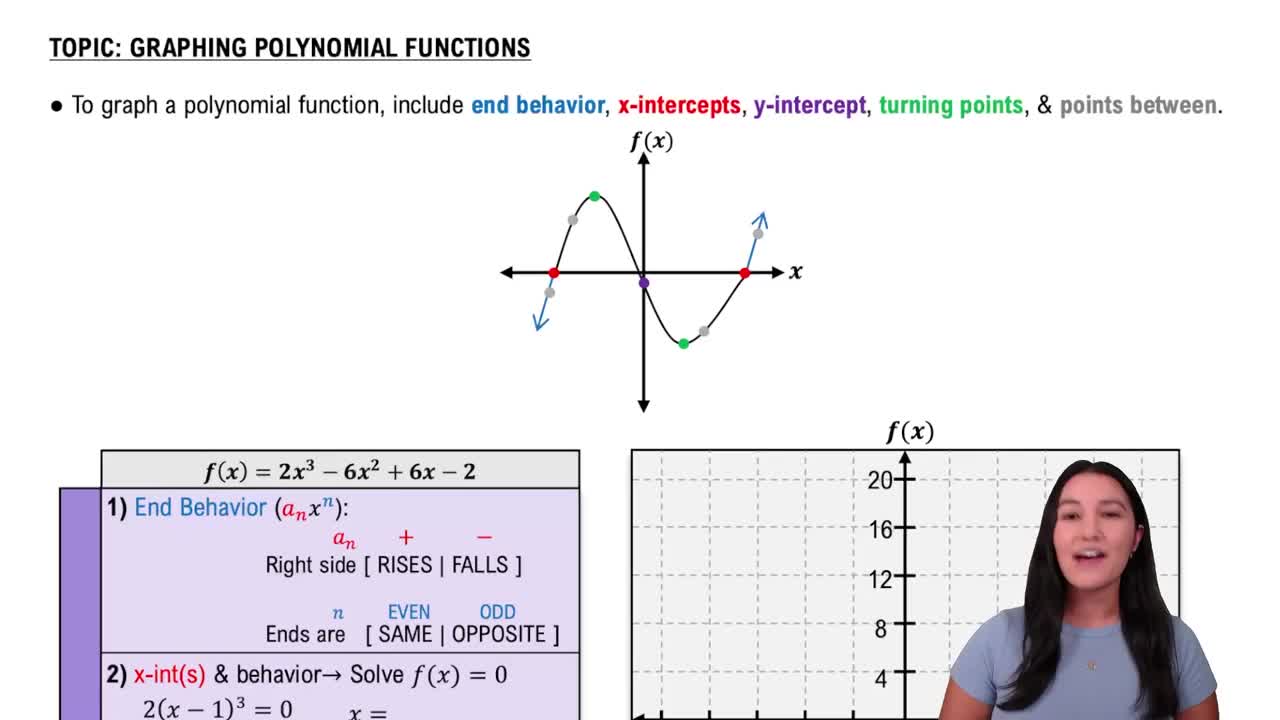 05:25
05:25Exercises 53–60 show incomplete graphs of given polynomial functions. a) Find all the zeros of each function. b) Without using a graphing utility, draw a complete graph of the function. f(x)=−x3+x2+16x−16
In Exercises 51–54, graphs of fifth-degree polynomial functions are shown. In each case, specify the number of real zeros and the number of imaginary zeros. Indicate whether there are any real zeros with multiplicity other than 1.
Solve each rational inequality in Exercises 43–60 and graph the solution set on a real number line. Express each solution set in interval notation. (x+4)/x>0
Use transformations of f(x)=1/x or f(x)=1/x2 to graph each rational function. h(x)=1/x2 − 4
Write an equation in vertex form of the parabola that has the same shape as the graph of f(x) = 2x2 but with the given point as the vertex. (−10, −5)
Solve each rational inequality in Exercises 43–60 and graph the solution set on a real number line. Express each solution set in interval notation. x/(x−3)>0