In Exercises 49–50, find all the zeros of each polynomial function and write the polynomial as a product of linear factors. g(x) = x^4 - 6x^3 + x^2 + 24x + 16
Verified step by step guidance
1
Step 1: Use the Rational Root Theorem to list all possible rational roots of the polynomial. The possible rational roots are the factors of the constant term (16) divided by the factors of the leading coefficient (1).
Step 2: Test each possible rational root by substituting them into the polynomial \( g(x) = x^4 - 6x^3 + x^2 + 24x + 16 \) to see which ones are actual roots.
Step 3: Once a root is found, use synthetic division to divide the polynomial by \( x - \text{root} \) to reduce the polynomial's degree.
Step 4: Repeat the process of finding roots and using synthetic division on the resulting polynomial until it is reduced to a quadratic or linear factor.
Step 5: Factor the remaining quadratic polynomial, if necessary, to find all zeros and express the original polynomial as a product of linear factors.
Verified video answer for a similar problem:
This video solution was recommended by our tutors as helpful for the problem above
Video duration:
12m
Play a video:
Was this helpful?
Key Concepts
Here are the essential concepts you must grasp in order to answer the question correctly.
Polynomial Functions
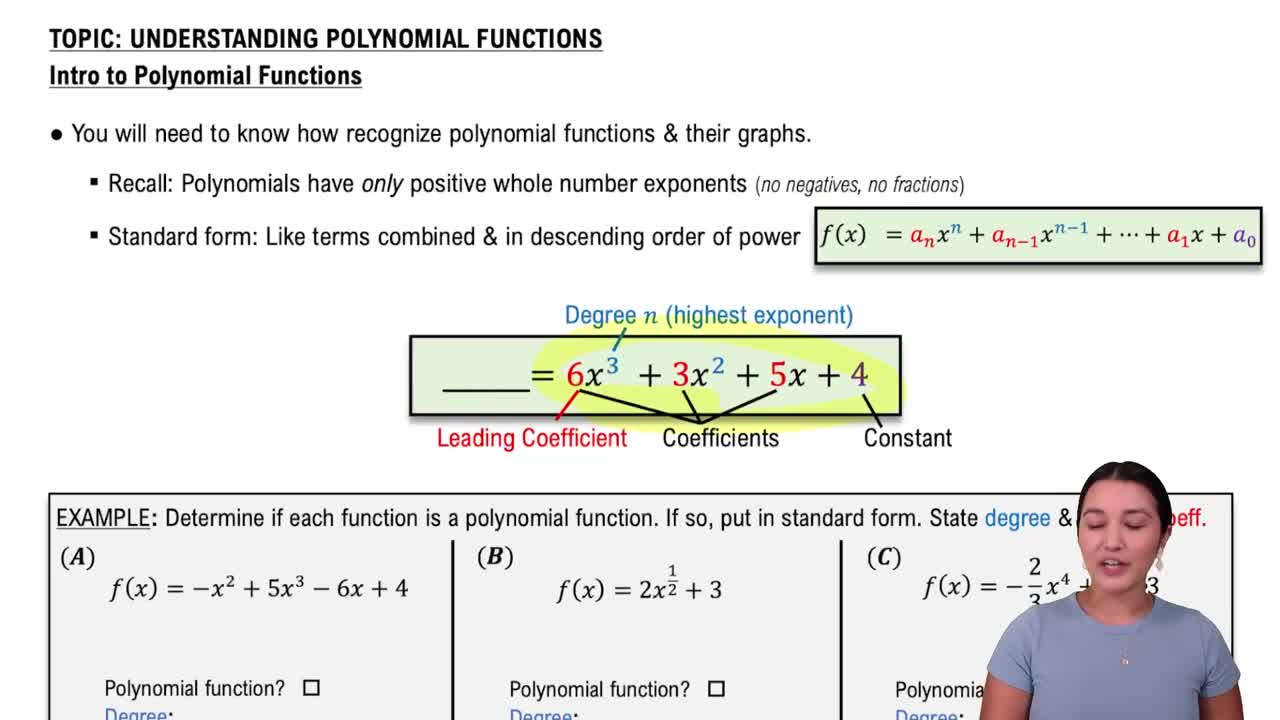
A polynomial function is a mathematical expression involving a sum of powers in one or more variables multiplied by coefficients. The general form is f(x) = a_n*x^n + a_(n-1)*x^(n-1) + ... + a_1*x + a_0, where a_n is not zero. Understanding polynomial functions is crucial for analyzing their behavior, including finding zeros, which are the values of x that make the function equal to zero.
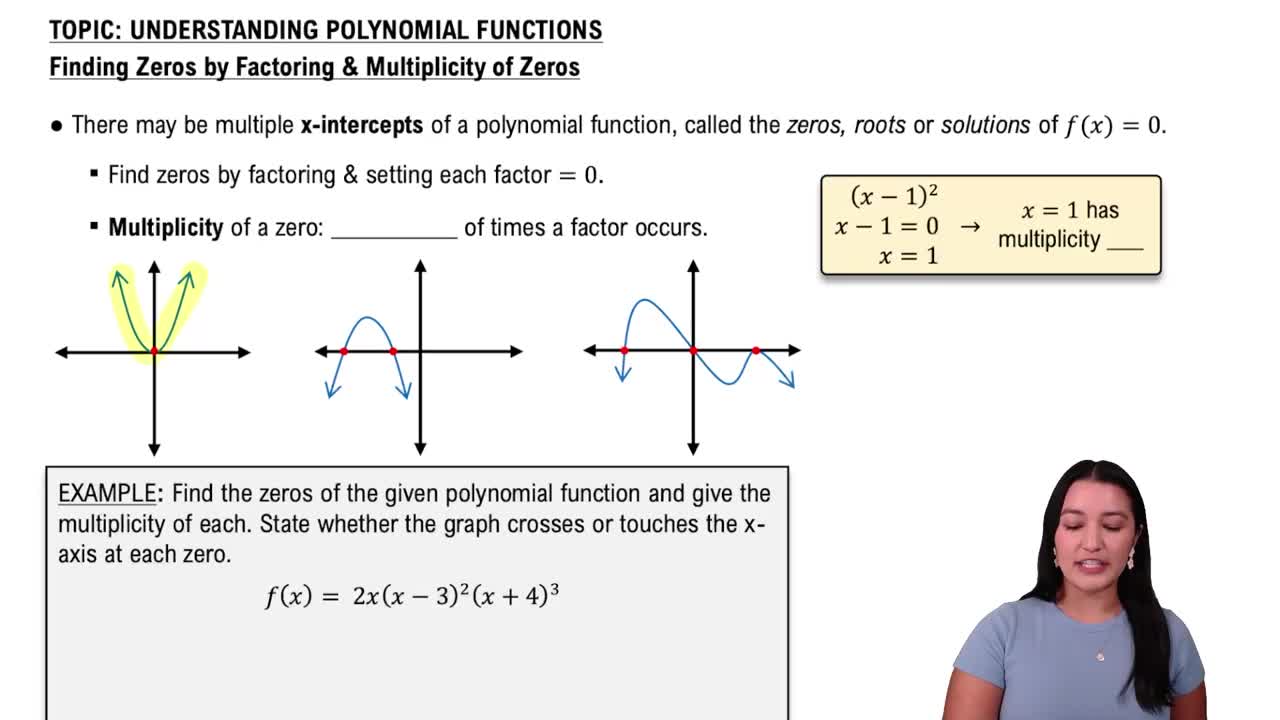
Finding the zeros of a polynomial involves determining the values of x for which the polynomial equals zero. This can be achieved through various methods, including factoring, using the Rational Root Theorem, or applying synthetic division. Zeros are essential as they indicate the x-intercepts of the graph of the polynomial and are key to expressing the polynomial as a product of linear factors.
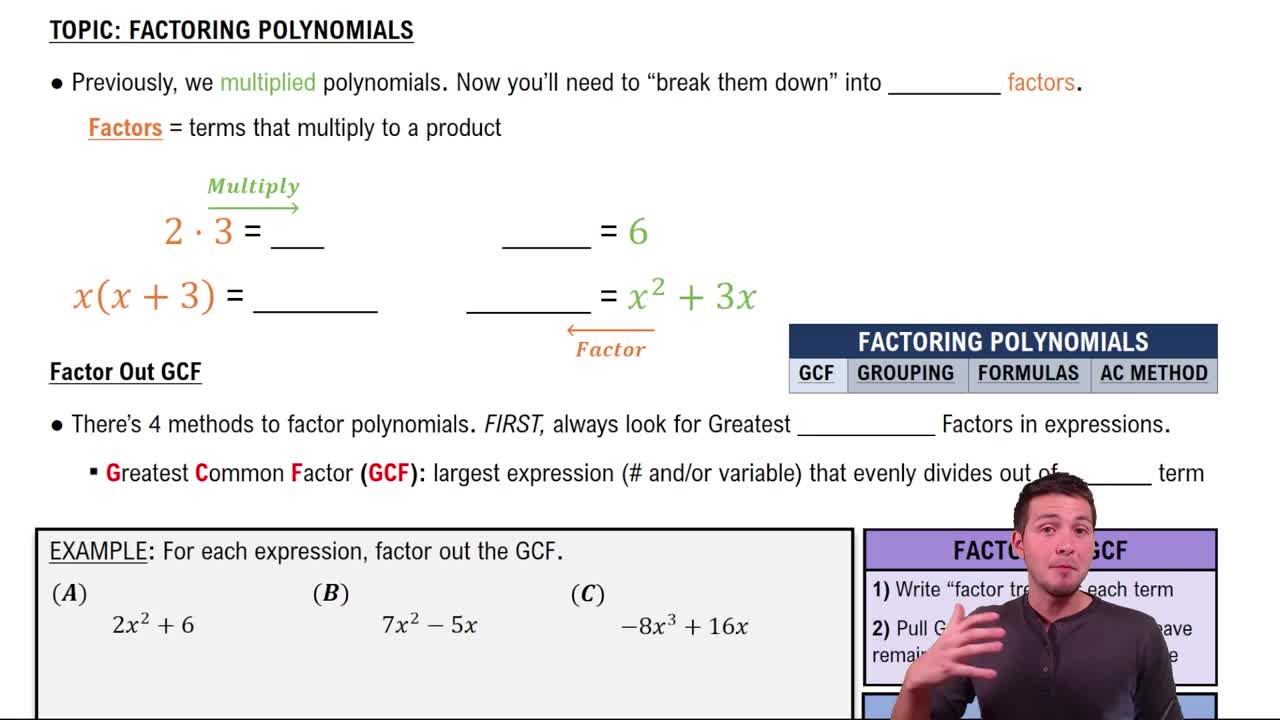
Factoring polynomials is the process of breaking down a polynomial into simpler components, specifically linear factors. For a polynomial of degree n, it can be expressed as a product of n linear factors if it has n zeros. This is important for simplifying expressions and solving equations, as well as for understanding the polynomial's roots and their multiplicities.