In Exercises 77–92, use the graph to determine a. the function's domain; b. the function's range; c. the x-intercepts, if any; d. the y-intercept, if any; and e. the missing function values, indicated by question marks, below each graph.
Table of contents
- 0. Review of Algebra4h 18m
- 1. Equations & Inequalities3h 18m
- 2. Graphs of Equations1h 43m
- 3. Functions2h 17m
- 4. Polynomial Functions1h 44m
- 5. Rational Functions1h 23m
- 6. Exponential & Logarithmic Functions2h 28m
- 7. Systems of Equations & Matrices4h 5m
- 8. Conic Sections2h 23m
- 9. Sequences, Series, & Induction1h 22m
- 10. Combinatorics & Probability1h 45m
2. Graphs of Equations
Graphs and Coordinates
Problem 7
Textbook Question
Fill in the blank(s) to correctly complete each sentence. The function has domain ________.
Verified step by step guidance1
Recall that the function \( g(x) = \sqrt{x} \) involves a square root, and the expression inside the square root (called the radicand) must be greater than or equal to zero for the function to be defined in the real numbers.
Set the radicand \( x \) to be greater than or equal to zero: \( x \geq 0 \). This ensures that the square root is defined for all \( x \) values that are zero or positive.
Express the domain of \( g(x) \) as all real numbers \( x \) such that \( x \geq 0 \). In interval notation, this is written as \( [0, \infty) \).
Therefore, the domain of \( g(x) = \sqrt{x} \) is all real numbers \( x \) where \( x \geq 0 \), or equivalently, \( [0, \infty) \).
This means you can input any number zero or greater into the function \( g(x) \) and get a real number output.
Verified video answer for a similar problem:This video solution was recommended by our tutors as helpful for the problem above
Video duration:
1mPlay a video:
Was this helpful?
Key Concepts
Here are the essential concepts you must grasp in order to answer the question correctly.
Domain of a Function
The domain of a function is the set of all possible input values (x-values) for which the function is defined. Determining the domain involves identifying values that do not cause undefined expressions, such as division by zero or taking the square root of negative numbers.
Recommended video:
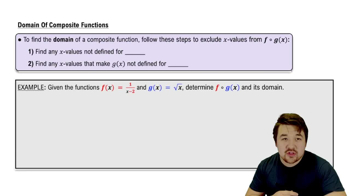
Domain Restrictions of Composed Functions
Square Root Function Properties
The square root function, √x, is only defined for non-negative real numbers because the square root of a negative number is not a real number. Therefore, the input x must be greater than or equal to zero to keep the function real-valued.
Recommended video:
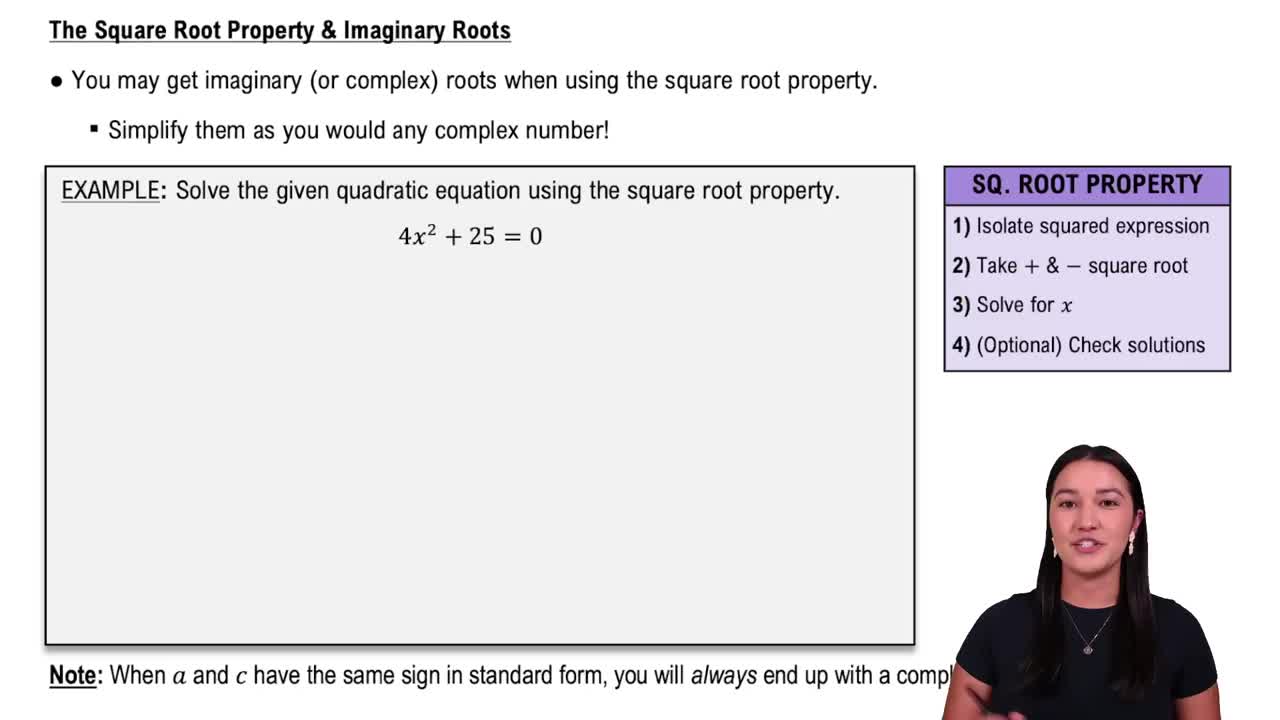
Imaginary Roots with the Square Root Property
Inequalities and Set Notation
To express the domain, inequalities are used to specify the range of valid x-values, such as x ≥ 0. Set notation or interval notation (e.g., [0, ∞)) is commonly used to represent the domain clearly and concisely.
Recommended video:
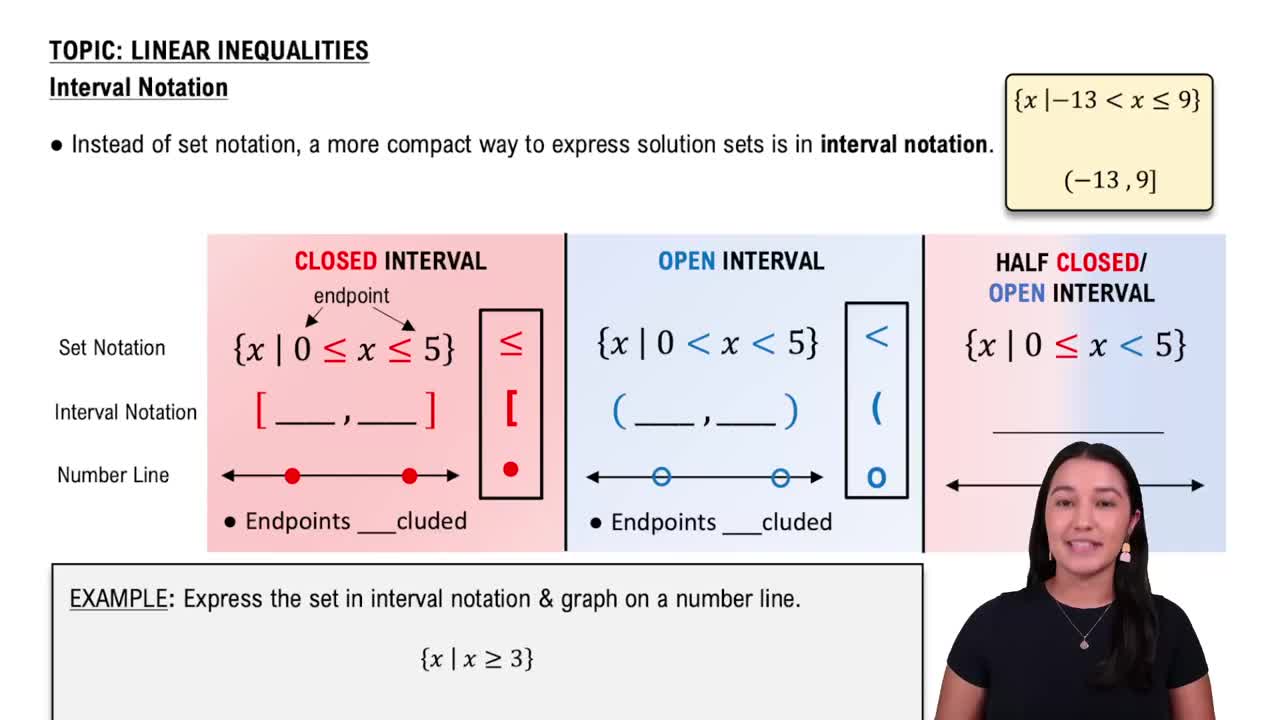
Interval Notation
Watch next
Master Graphs & the Rectangular Coordinate System with a bite sized video explanation from Patrick
Start learningRelated Videos
Related Practice
Textbook Question
34
views