In Exercises 77–92, use the graph to determine a. the function's domain; b. the function's range; c. the x-intercepts, if any; d. the y-intercept, if any; and e. the missing function values, indicated by question marks, below each graph.
Table of contents
- 0. Review of Algebra4h 18m
- 1. Equations & Inequalities3h 18m
- 2. Graphs of Equations1h 43m
- 3. Functions2h 17m
- 4. Polynomial Functions1h 44m
- 5. Rational Functions1h 23m
- 6. Exponential & Logarithmic Functions2h 28m
- 7. Systems of Equations & Matrices4h 5m
- 8. Conic Sections2h 23m
- 9. Sequences, Series, & Induction1h 22m
- 10. Combinatorics & Probability1h 45m
2. Graphs of Equations
Graphs and Coordinates
Problem 85
Textbook Question
In Exercises 77–92, use the graph to determine a. the function's domain; b. the function's range; c. the x-intercepts, if any; d. the y-intercept, if any; and e. the missing function values, indicated by question marks, below each graph.

Verified step by step guidance1
Step 1: To determine the function's domain, analyze the graph and identify all the x-values for which the function is defined. The domain is the set of all x-values that correspond to points on the graph. Express the domain in interval notation.
Step 2: To determine the function's range, examine the graph and identify all the y-values that the function takes. The range is the set of all y-values that correspond to points on the graph. Express the range in interval notation.
Step 3: To find the x-intercepts, locate the points where the graph crosses or touches the x-axis. These are the points where the y-value is zero. Write the x-intercepts as ordered pairs (x, 0).
Step 4: To find the y-intercept, locate the point where the graph crosses or touches the y-axis. This is the point where the x-value is zero. Write the y-intercept as an ordered pair (0, y).
Step 5: To determine the missing function values indicated by question marks, locate the corresponding x-values on the graph and read the associated y-values. Substitute the x-values into the function if necessary to confirm the y-values.
Verified video answer for a similar problem:This video solution was recommended by our tutors as helpful for the problem above
Video duration:
3mPlay a video:
Was this helpful?
Key Concepts
Here are the essential concepts you must grasp in order to answer the question correctly.
Domain of a Function
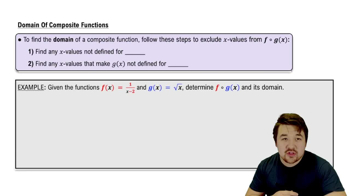
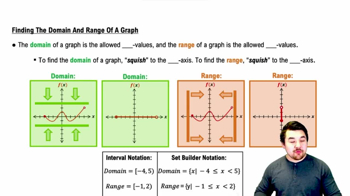
The domain of a function refers to the complete set of possible input values (x-values) for which the function is defined. In graphical terms, it is represented by the horizontal extent of the graph. Identifying the domain involves determining the x-values that do not lead to undefined situations, such as division by zero or taking the square root of a negative number.
Recommended video:
Domain Restrictions of Composed Functions
Range of a Function
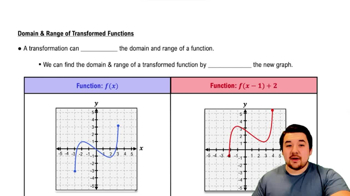
The range of a function is the set of all possible output values (y-values) that the function can produce. This can be visualized as the vertical extent of the graph. To find the range, one must analyze the graph to see which y-values are covered, including any gaps or limits in the output values.
Recommended video:
Domain & Range of Transformed Functions
Intercepts of a Function
Intercepts are points where the graph of a function crosses the axes. The x-intercepts occur where the function's output is zero (y=0), while the y-intercept occurs where the input is zero (x=0). Identifying these points is crucial for understanding the function's behavior and can provide insights into its roots and overall shape.
Recommended video:
Guided course
Graphing Intercepts
Watch next
Master Graphs & the Rectangular Coordinate System with a bite sized video explanation from Patrick
Start learningRelated Videos
Related Practice
Textbook Question
80
views