Identify the base of the logarithm and the transformations applied to the function. Here, the function is \(f(x) = \log_{3}(x - 1) + 2\), which is a logarithmic function with base 3, shifted horizontally and vertically.
Determine the domain of the function by setting the argument of the logarithm greater than zero: \(x - 1 > 0\). Solve this inequality to find the domain.
Find the vertical asymptote by setting the argument of the logarithm equal to zero: \(x - 1 = 0\). This vertical line is where the function approaches infinity or negative infinity.
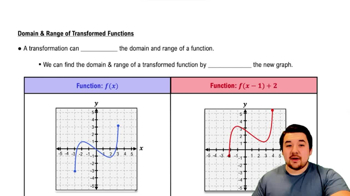
Identify the horizontal shift and vertical shift. The \(x - 1\) inside the logarithm shifts the graph 1 unit to the right, and the \(+2\) outside shifts the graph 2 units upward.
Plot key points by choosing values of \(x\) greater than 1, calculate corresponding \(f(x)\) values using the function, and sketch the graph showing the vertical asymptote at \(x=1\), the general shape of the logarithmic curve, and the shifts.
Verified video answer for a similar problem:
This video solution was recommended by our tutors as helpful for the problem above
Video duration:
3m
Play a video:
Was this helpful?
Key Concepts
Here are the essential concepts you must grasp in order to answer the question correctly.
Logarithmic Functions
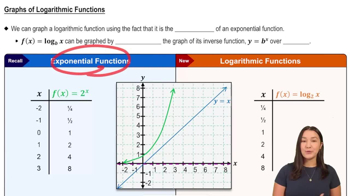
A logarithmic function is the inverse of an exponential function and is written as f(x) = log_b(x), where b is the base. It answers the question: to what power must the base b be raised to produce x? Understanding the properties of logarithms is essential for graphing and interpreting these functions.
The domain of a logarithmic function f(x) = log_b(x - h) is all x-values for which the argument (x - h) is positive. For example, in f(x) = log_3(x - 1) + 2, the domain is x > 1 because the logarithm is undefined for zero or negative inputs. Identifying the domain helps in correctly plotting the graph.
Transformations shift or change the shape of a graph. For f(x) = log_3(x - 1) + 2, the (x - 1) inside the log shifts the graph 1 unit to the right, and the +2 outside shifts it 2 units up. Recognizing horizontal and vertical shifts is crucial for accurately graphing the function.