Graph each function. Give the domain and range. ƒ(x) = | log1/2 (x-2) |
Verified step by step guidance
1
Identify the function given: \(f(x) = \left| \log_{\frac{1}{2}} (x - 2) \right|\). This is the absolute value of a logarithmic function with base \(\frac{1}{2}\) and argument \((x - 2)\).
Determine the domain by finding the values of \(x\) for which the argument of the logarithm is positive: solve \(x - 2 > 0\), which gives \(x > 2\). So, the domain is \((2, \infty)\).
Understand the behavior of the logarithm with base \(\frac{1}{2}\). Since \(\frac{1}{2} < 1\), the logarithmic function \(\log_{\frac{1}{2}}(x - 2)\) is a decreasing function. It approaches \(+\infty\) as \(x\) approaches 2 from the right, and it approaches \(-\infty\) as \(x\) goes to infinity.
Apply the absolute value to the logarithmic function. This means all negative values of \(\log_{\frac{1}{2}}(x - 2)\) become positive, so the graph will reflect any part of the logarithm below the \(x\)-axis upwards.
Determine the range by considering the absolute value transformation. Since the logarithm can take all real values from \(-\infty\) to \(+\infty\), after applying the absolute value, the range becomes \([0, \infty)\). The function never outputs negative values.
Verified video answer for a similar problem:
This video solution was recommended by our tutors as helpful for the problem above
Video duration:
3m
Play a video:
Was this helpful?
Key Concepts
Here are the essential concepts you must grasp in order to answer the question correctly.
Logarithmic Functions
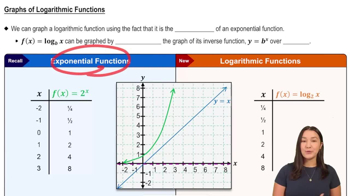
A logarithmic function is the inverse of an exponential function and is defined as log base b of x, where b > 0 and b ≠ 1. It answers the question: to what power must the base be raised to get x? Understanding the properties of logarithms, including their domain restrictions (x > 0), is essential for graphing and analyzing these functions.
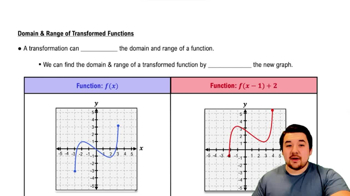
The domain of a function is the set of all possible input values (x-values) for which the function is defined, while the range is the set of all possible output values (f(x)). For logarithmic functions, the domain is restricted by the argument inside the log, and the range depends on transformations applied to the function, such as absolute value.
Applying the absolute value to a function, |f(x)|, reflects all negative output values of f(x) above the x-axis, making the entire graph non-negative. This transformation affects the range by ensuring all outputs are zero or positive, which is important when analyzing the graph and determining the range of the given function.