Identify the base of the logarithm. The function is \( f(x) = \log_{\frac{1}{2}}(x+3) - 2 \), which means the base is \( \frac{1}{2} \).
Determine the vertical shift. The \(-2\) at the end of the function indicates a vertical shift downward by 2 units.
Identify the horizontal shift. The \(x+3\) inside the logarithm indicates a horizontal shift to the left by 3 units.
Consider the domain of the function. Since the argument of the logarithm \(x+3\) must be greater than 0, solve \(x+3 > 0\) to find the domain \(x > -3\).
Sketch the graph by plotting key points and considering the transformations: start with the basic shape of \(\log_{\frac{1}{2}}(x)\), apply the horizontal shift left by 3, and then the vertical shift down by 2.
Verified video answer for a similar problem:
This video solution was recommended by our tutors as helpful for the problem above
Video duration:
3m
Play a video:
Was this helpful?
Key Concepts
Here are the essential concepts you must grasp in order to answer the question correctly.
Logarithmic Functions
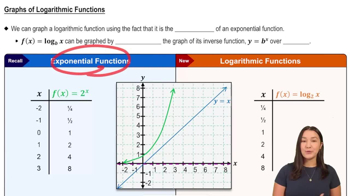
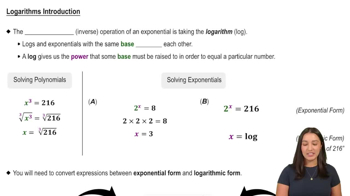
Logarithmic functions are the inverses of exponential functions and are defined for positive real numbers. The function ƒ(x) = log_b(x) gives the exponent to which the base b must be raised to produce x. Understanding the properties of logarithms, such as the change of base formula and the relationship between logarithms and exponents, is essential for graphing and analyzing these functions.
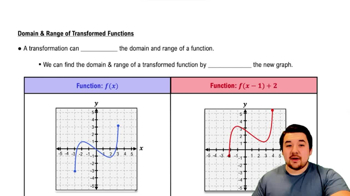
Transformations of functions involve shifting, stretching, compressing, or reflecting the graph of a function. In the given function ƒ(x) = log_1/2(x + 3) - 2, the term (x + 3) indicates a horizontal shift to the left by 3 units, while the -2 indicates a vertical shift downward by 2 units. Understanding these transformations helps in accurately sketching the graph of the function.
The domain of a logarithmic function is determined by the argument of the logarithm being positive. For ƒ(x) = log_1/2(x + 3), the domain is x > -3. The range of logarithmic functions is all real numbers, as they can take any value depending on the input. Recognizing the domain and range is crucial for understanding the behavior of the graph and ensuring it is correctly represented.