Given that log↓10 2 ≈ 0.3010 and log↓10 3 ≈ 0.4771, find each logarithm without using a calculator. log↓10 3/2
Verified step by step guidance
1
Recognize that the expression \( \log_{10} \frac{3}{2} \) can be rewritten using the quotient rule for logarithms: \( \log_{10} 3 - \log_{10} 2 \).
Substitute the given values into the expression: \( \log_{10} 3 \approx 0.4771 \) and \( \log_{10} 2 \approx 0.3010 \).
Calculate the difference: \( 0.4771 - 0.3010 \).
Simplify the expression to find the value of \( \log_{10} \frac{3}{2} \).
Conclude with the simplified result of the subtraction, which represents \( \log_{10} \frac{3}{2} \).
Verified video answer for a similar problem:
This video solution was recommended by our tutors as helpful for the problem above
Video duration:
1m
Play a video:
Was this helpful?
Key Concepts
Here are the essential concepts you must grasp in order to answer the question correctly.
Properties of Logarithms
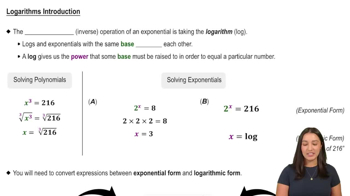
Logarithms have specific properties that simplify calculations. One key property is the quotient rule, which states that log_b(a/c) = log_b(a) - log_b(c). This allows us to break down complex logarithmic expressions into simpler parts, making it easier to compute values using known logarithms.
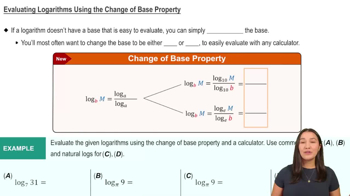
The change of base formula allows us to express logarithms in terms of logarithms of a different base. Specifically, log_b(a) can be rewritten as log_k(a) / log_k(b) for any positive k. This is particularly useful when we have logarithm values for certain bases, enabling us to calculate logarithms for other bases using known values.
In this problem, we are given approximate values for log_10(2) and log_10(3). Understanding how to use these approximations effectively is crucial for solving logarithmic expressions. By substituting these values into the logarithmic properties, we can find the logarithm of more complex expressions without needing a calculator.