
Textbook Question
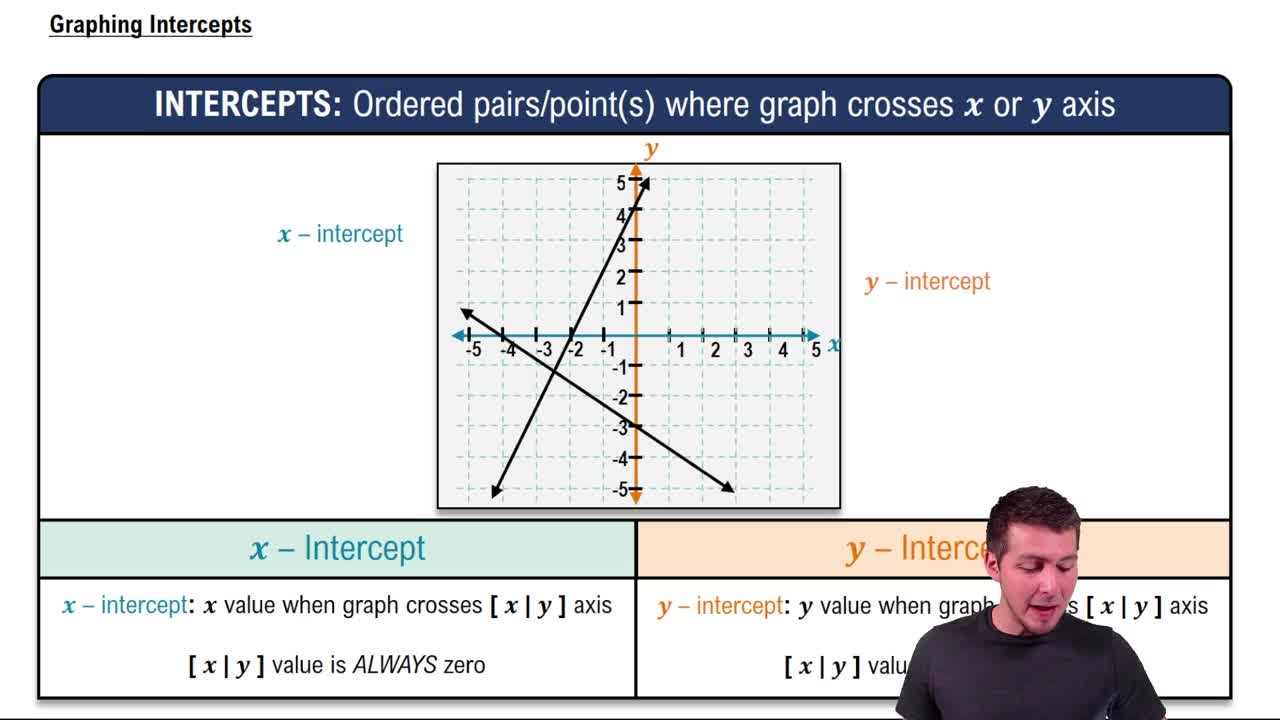
Graph both equations in the same rectangular coordinate system and find all points of intersection. Then show that these ordered pairs satisfy the equations. x² + y² = 16, x-y = 4
980
views

 Verified step by step guidance
 04:08
04:08 04:08
04:08 06:00
06:00Graph both equations in the same rectangular coordinate system and find all points of intersection. Then show that these ordered pairs satisfy the equations. x² + y² = 16, x-y = 4
Find a. (fog) (x) b. the domain of f o g. f(x) = x/(x+1), g(x) = 4/x
Begin by graphing the square root function, f(x) = √x. Then use transformations of this graph to graph the given function. g(x) = √x + 1
In Exercises 65–70, use the graph of f to find each indicated function value. f(4)
In Exercises 67–69, begin by graphing the absolute value function, f(x) = |x|. Then use transformations of this graph to graph the given function. r(x) = (1/2) |x + 2|
In Exercises 67-74, find a. (fog) (x) b. the domain of f o g. f(x) = 2/(x+3), g(x) = 1/x