Graph each line. Give the domain and range. x = -4
Verified step by step guidance
1
Step 1: Understand the equation x = -4. This is a vertical line where every point on the line has an x-coordinate of -4.
Step 2: Visualize the graph. Since x = -4 is a vertical line, it will run parallel to the y-axis and intersect the x-axis at -4.
Step 3: Determine the domain. The domain of a vertical line x = -4 is simply the set containing the single value {-4}, since x is always -4.
Step 4: Determine the range. The range of a vertical line is all real numbers, because the line extends infinitely in both the positive and negative directions along the y-axis.
Step 5: Graph the line. On a coordinate plane, draw a straight vertical line through the point (-4, 0) and extend it infinitely in both directions along the y-axis.
Verified video answer for a similar problem:
This video solution was recommended by our tutors as helpful for the problem above
Video duration:
2m
Play a video:
Was this helpful?
Key Concepts
Here are the essential concepts you must grasp in order to answer the question correctly.
Graphing Linear Equations
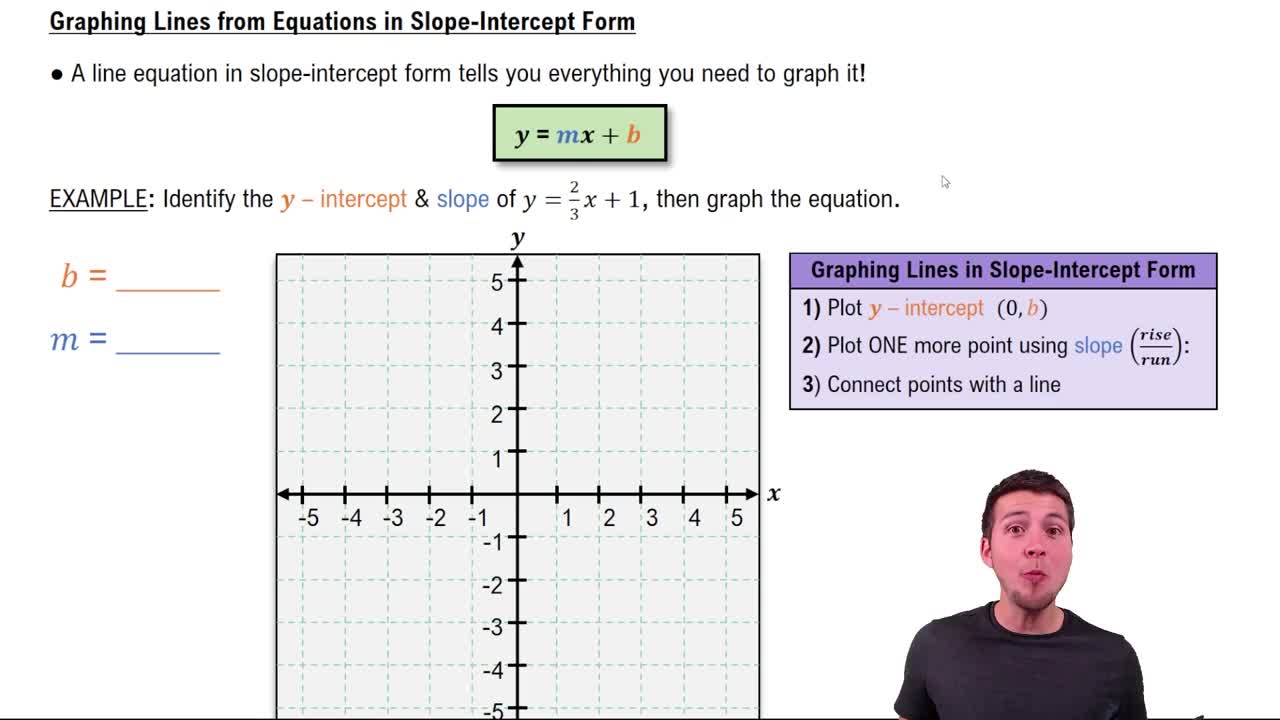
Graphing linear equations involves plotting points on a coordinate plane that satisfy the equation. For the equation x = -4, this represents a vertical line where all points have an x-coordinate of -4, regardless of the y-coordinate. Understanding how to graph such equations is essential for visualizing their behavior.
The domain of a function or relation refers to the set of all possible input values (x-values) that can be used without causing any mathematical inconsistencies. In the case of the line x = -4, the domain is simply the single value {-4}, as this line does not extend horizontally.
The range of a function or relation is the set of all possible output values (y-values) that can result from the inputs in the domain. For the line x = -4, the range is all real numbers, represented as (-∞, ∞), since the line extends infinitely in the vertical direction.