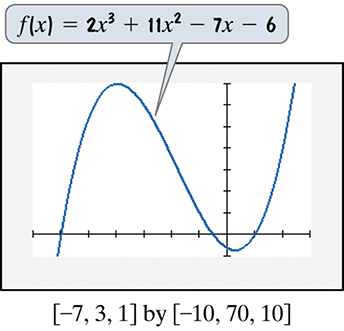
In Exercises 71–72, use the graph of the polynomial function to solve each inequality.
2x^3 + 11x^2 ≥ 7x + 6
Verified step by step guidance
1
Rewrite the inequality 2x^3 + 11x^2 ≥ 7x + 6 by moving all terms to one side to set the inequality to zero: 2x^3 + 11x^2 - 7x - 6 ≥ 0.
Recognize that the inequality now involves the polynomial function f(x) = 2x^3 + 11x^2 - 7x - 6, so the problem reduces to finding where f(x) ≥ 0.
Identify the roots of the polynomial from the graph, which are the x-values where the graph crosses the x-axis: x = -1, x = 2/3, and x = 2.
Use the roots to divide the number line into intervals: (-∞, -1), (-1, 2/3), (2/3, 2), and (2, ∞).
Determine the sign of f(x) on each interval by observing the graph: check whether the graph is above (f(x) > 0) or below (f(x) < 0) the x-axis in each interval, then select the intervals where f(x) ≥ 0 to solve the inequality.
Verified video answer for a similar problem:
This video solution was recommended by our tutors as helpful for the problem above
Video duration:
4m
Play a video:
Was this helpful?
Key Concepts
Here are the essential concepts you must grasp in order to answer the question correctly.
Polynomial Functions and Their Graphs
A polynomial function is an expression involving variables raised to whole-number exponents and their coefficients. Its graph is a smooth, continuous curve that can cross the x-axis at points called roots or zeros. Understanding the shape and roots of the polynomial helps in analyzing its behavior and solving inequalities.
Roots or zeros of a polynomial are the x-values where the function equals zero, i.e., where the graph intersects the x-axis. These points divide the number line into intervals where the polynomial can be positive or negative. Identifying roots is essential for solving inequalities involving polynomials.
To solve inequalities like f(x) ≥ 0, analyze the graph to determine where the polynomial is above or on the x-axis. The solution includes intervals where the graph lies on or above zero, including the roots if the inequality is non-strict (≥ or ≤). This graphical approach provides a visual method to solve polynomial inequalities.