In Exercises 59–94, solve each absolute value inequality.
Table of contents
- 0. Review of Algebra4h 18m
- 1. Equations & Inequalities3h 18m
- 2. Graphs of Equations1h 43m
- 3. Functions2h 17m
- 4. Polynomial Functions1h 44m
- 5. Rational Functions1h 23m
- 6. Exponential & Logarithmic Functions2h 28m
- 7. Systems of Equations & Matrices4h 5m
- 8. Conic Sections2h 23m
- 9. Sequences, Series, & Induction1h 22m
- 10. Combinatorics & Probability1h 45m
1. Equations & Inequalities
Linear Inequalities
Problem 98
Textbook Question
Use interval notation to represent all values of x satisfying the given conditions. y = 2x - 11 + 3(x + 2) and y is at most 0
Verified step by step guidance1
Step 1: Start by simplifying the given equation y = 2x - 11 + 3(x + 2). Combine like terms to simplify the expression for y. Distribute the 3 across (x + 2) to get y = 2x - 11 + 3x + 6.
Step 2: Combine the terms involving x and the constants. This results in y = (2x + 3x) + (-11 + 6), which simplifies to y = 5x - 5.
Step 3: The problem states that y is at most 0, which means y ≤ 0. Substitute the simplified expression for y into the inequality: 5x - 5 ≤ 0.
Step 4: Solve the inequality 5x - 5 ≤ 0. First, isolate the term involving x by adding 5 to both sides: 5x ≤ 5.
Step 5: Divide both sides of the inequality by 5 to solve for x: x ≤ 1. Represent this solution in interval notation as (-∞, 1].
Verified video answer for a similar problem:This video solution was recommended by our tutors as helpful for the problem above
Video duration:
3mPlay a video:
Was this helpful?
Key Concepts
Here are the essential concepts you must grasp in order to answer the question correctly.
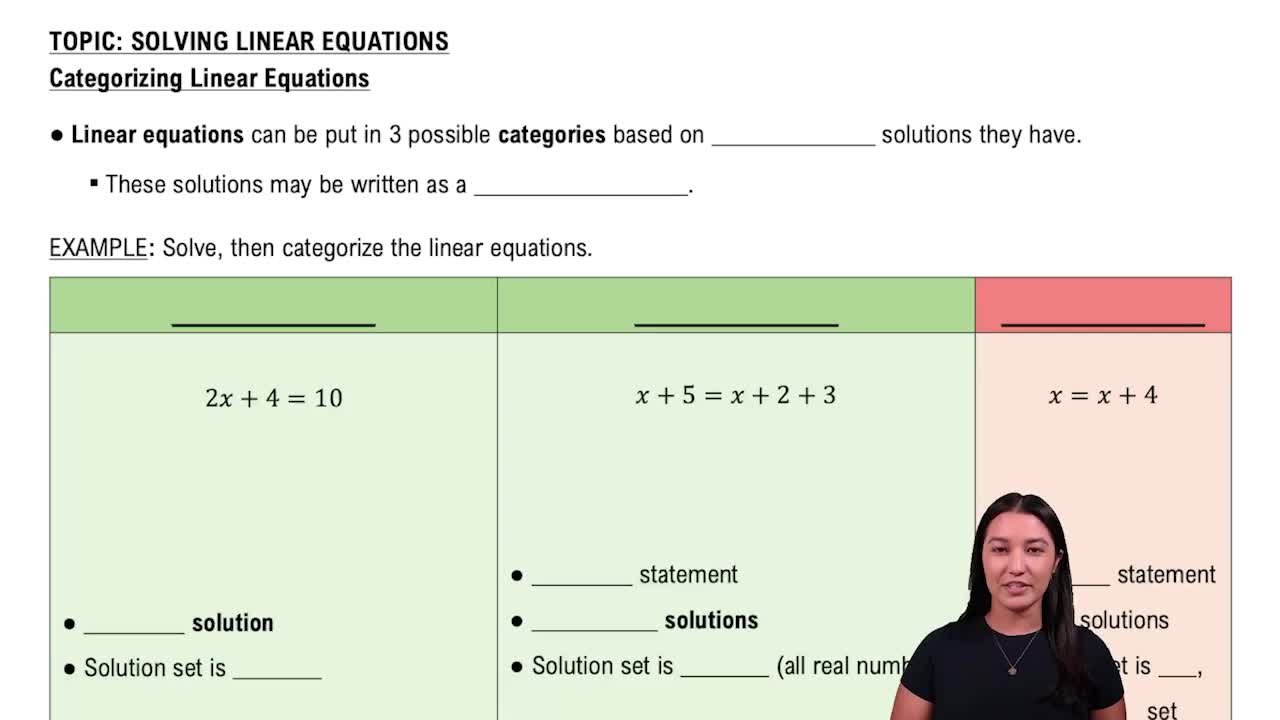
Linear Equations
A linear equation is an algebraic expression that represents a straight line when graphed. It typically takes the form y = mx + b, where m is the slope and b is the y-intercept. In this question, the equation y = 2x - 11 + 3(x + 2) must be simplified to identify the values of x that satisfy the condition y ≤ 0.
Recommended video:
Categorizing Linear Equations
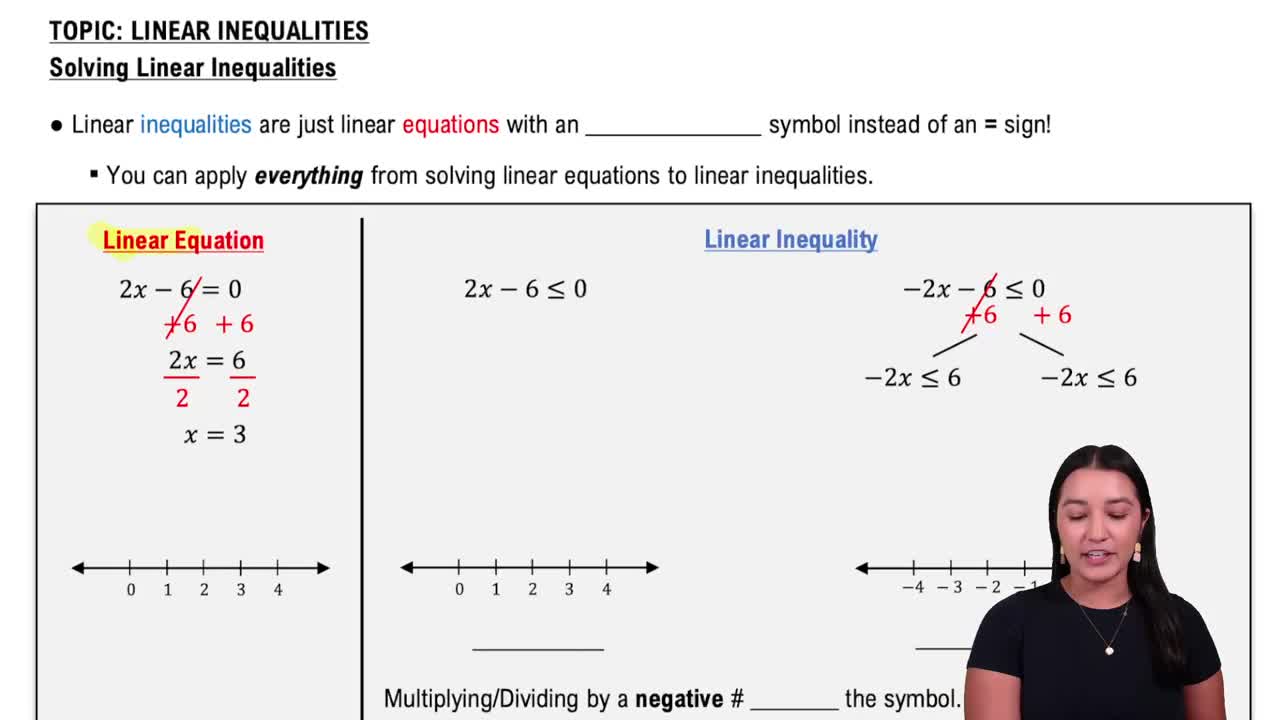
Inequalities
An inequality is a mathematical statement that compares two expressions, indicating that one is less than, greater than, or equal to the other. In this case, we are interested in the inequality y ≤ 0, which means we need to find the range of x values for which the linear expression results in a value of y that is less than or equal to zero.
Recommended video:
Linear Inequalities
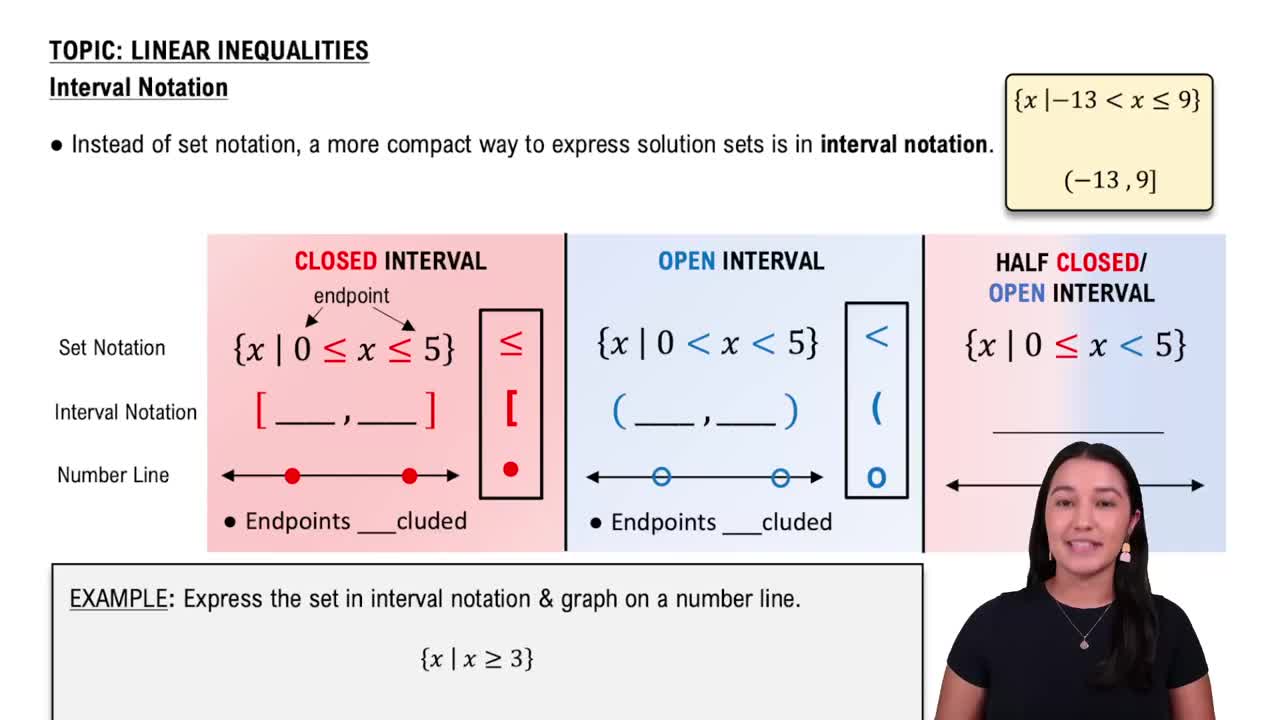
Interval Notation
Interval notation is a way of representing a range of values on the number line. It uses brackets and parentheses to indicate whether endpoints are included or excluded. For example, [a, b] includes both a and b, while (a, b) excludes them. In this problem, once the values of x that satisfy the inequality are determined, they will be expressed in interval notation to clearly communicate the solution set.
Recommended video:
Interval Notation
Related Videos
Related Practice
Textbook Question
568
views