In Exercises 95–102, use interval notation to represent all values of x satisfying the given conditions. y1=2x+3,y2=3x+25,andy1≤y2
Verified step by step guidance
1
Start with the inequality given: \(y_1 \leq y_2\), which means \(\frac{x}{2} + 3 \leq \frac{x}{3} + \frac{5}{2}\).
To solve for \(x\), first eliminate the fractions by finding a common denominator or multiply both sides by the least common multiple of the denominators (which is 6) to clear the fractions.
After clearing fractions, simplify the inequality to isolate terms involving \(x\) on one side and constants on the other side.
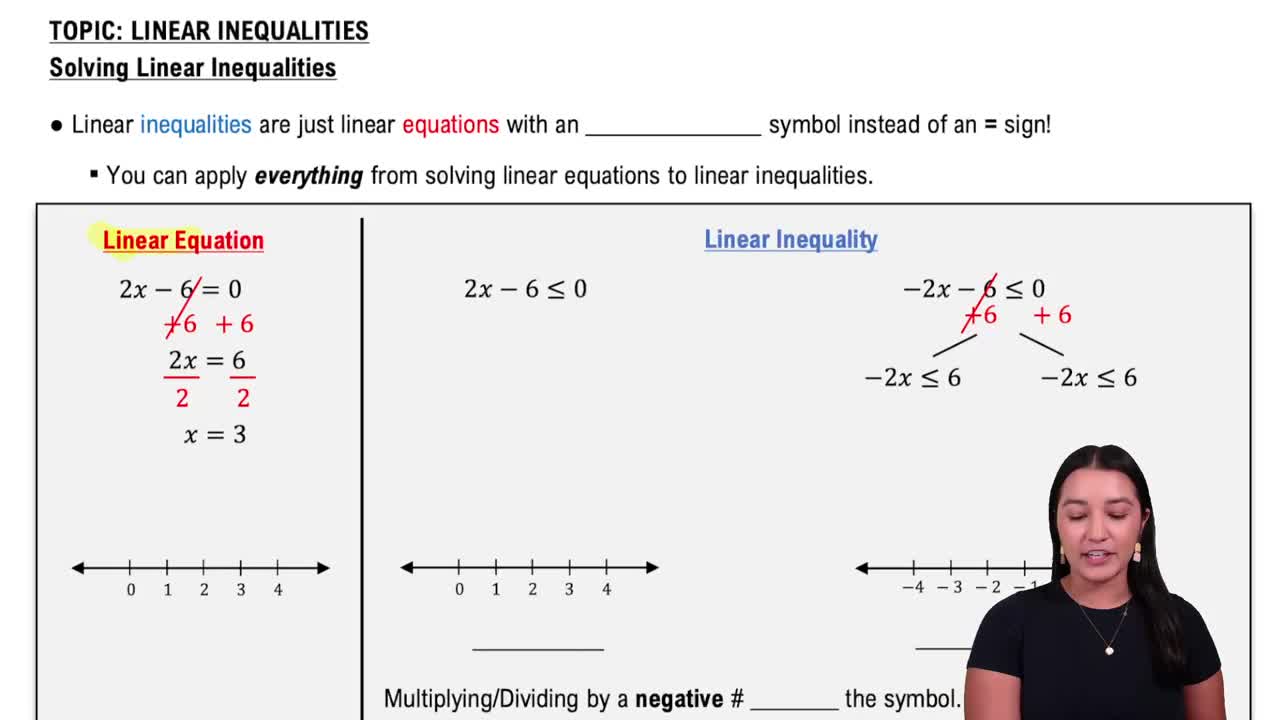
Solve the resulting linear inequality for \(x\) by performing algebraic operations such as addition, subtraction, multiplication, or division, keeping in mind to reverse the inequality sign if multiplying or dividing by a negative number.
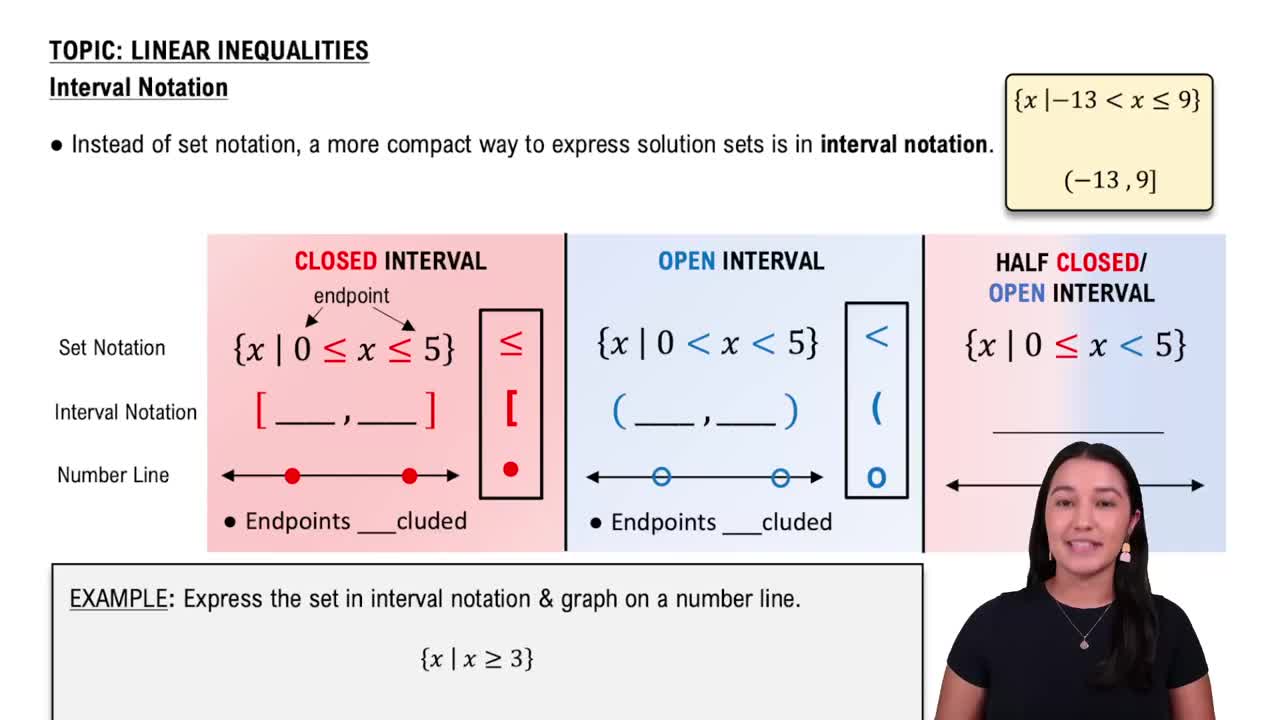
Express the solution set for \(x\) using interval notation, which describes all values of \(x\) that satisfy the inequality.
Verified video answer for a similar problem:
This video solution was recommended by our tutors as helpful for the problem above
Video duration:
4m
Play a video:
Was this helpful?
Key Concepts
Here are the essential concepts you must grasp in order to answer the question correctly.
Inequalities
Inequalities express a relationship where one quantity is less than or equal to another. Solving inequalities involves finding all values of the variable that satisfy this condition, often resulting in a range or interval of solutions rather than a single value.
Interval notation is a concise way to represent sets of numbers between two endpoints. It uses brackets [ ] for inclusive boundaries and parentheses ( ) for exclusive boundaries, making it ideal for expressing solution sets of inequalities.
Linear functions have the form y = mx + b, where m is the slope and b is the y-intercept. Understanding how to compare two linear functions helps determine where one is less than or equal to the other, which is essential for solving inequalities involving linear expressions.