In Exercises 9–16, use the formula for nCr to evaluate each expression. 11C4
Table of contents
- 0. Review of Algebra4h 18m
- 1. Equations & Inequalities3h 18m
- 2. Graphs of Equations1h 43m
- 3. Functions2h 17m
- 4. Polynomial Functions1h 44m
- 5. Rational Functions1h 23m
- 6. Exponential & Logarithmic Functions2h 28m
- 7. Systems of Equations & Matrices4h 5m
- 8. Conic Sections2h 23m
- 9. Sequences, Series, & Induction1h 22m
- 10. Combinatorics & Probability1h 45m
10. Combinatorics & Probability
Combinatorics
Problem 1
Textbook Question
In Exercises 1–8, use the formula for nPr to evaluate each expression. 9P4
Verified step by step guidance1
Recall the formula for permutations: , where n is the total number of items and r is the number of items to arrange.
Identify the values of n and r from the problem: here, n = 9 and r = 4.
Substitute these values into the formula: .
Write out the factorial expressions explicitly to simplify: , so the terms will cancel out.
Simplify the expression by canceling and multiplying the remaining terms: . This product gives the number of permutations.
Verified video answer for a similar problem:This video solution was recommended by our tutors as helpful for the problem above
Video duration:
2mPlay a video:
Was this helpful?
Key Concepts
Here are the essential concepts you must grasp in order to answer the question correctly.
Permutation (nPr)
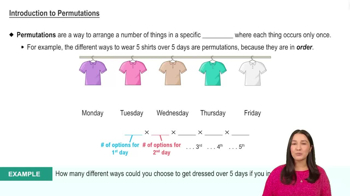
A permutation represents the number of ways to arrange a subset of items from a larger set, where order matters. The notation nPr denotes the number of permutations of n items taken r at a time.
Recommended video:
Introduction to Permutations
Permutation Formula
The formula for permutations is nPr = n! / (n - r)!, where n! is the factorial of n. This formula calculates the total ordered arrangements of r items selected from n distinct items.
Recommended video:
Introduction to Permutations
Factorial Function
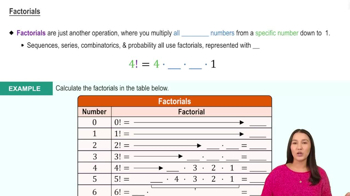
Factorial, denoted by n!, is the product of all positive integers from 1 to n. It is essential in permutations to compute the number of ways to arrange items, for example, 5! = 5 × 4 × 3 × 2 × 1 = 120.
Recommended video:
Factorials
Watch next
Master Fundamental Counting Principle with a bite sized video explanation from Patrick
Start learningRelated Videos
Related Practice
Textbook Question
449
views