Solve each problem. Find a polynomial function ƒ of degree 3 with -2, 1, and 4 as zeros, and ƒ(2)=16.
Table of contents
- 0. Review of Algebra4h 18m
- 1. Equations & Inequalities3h 18m
- 2. Graphs of Equations1h 43m
- 3. Functions2h 17m
- 4. Polynomial Functions1h 44m
- 5. Rational Functions1h 23m
- 6. Exponential & Logarithmic Functions2h 28m
- 7. Systems of Equations & Matrices4h 5m
- 8. Conic Sections2h 23m
- 9. Sequences, Series, & Induction1h 22m
- 10. Combinatorics & Probability1h 45m
4. Polynomial Functions
Zeros of Polynomial Functions
Problem 67
Textbook Question
Find a polynomial function ƒ(x) of least degree having only real coefficients and zeros as given. Assume multiplicity 1 unless otherwise stated. 2-i, 3, and -1
Verified step by step guidance1
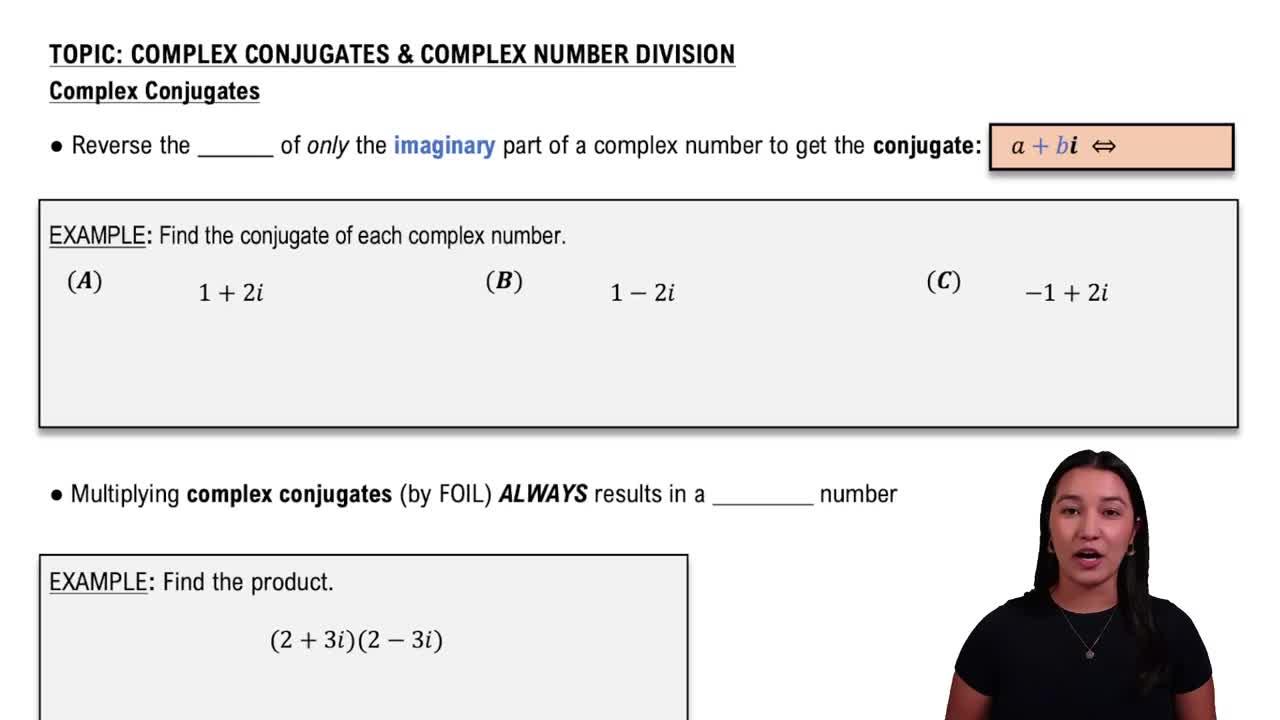
Identify the given zeros of the polynomial: \$2 - i\(, \)3\(, and \)-1\(. Since the polynomial must have only real coefficients, the complex zeros must come in conjugate pairs. Therefore, include the conjugate of \)2 - i\(, which is \)2 + i$, as a zero as well.
Write the factors corresponding to each zero. For zeros \$3\( and \)-1\(, the factors are \)(x - 3)\( and \)(x + 1)\( respectively. For the complex zeros \)2 - i\( and \)2 + i\(, the factors are \)(x - (2 - i))\( and \)(x - (2 + i))$.
Multiply the complex conjugate factors to get a quadratic with real coefficients:
\[ (x - (2 - i))(x - (2 + i)) = ((x - 2) + i)((x - 2) - i) = (x - 2)^2 - (i)^2 \]
Simplify the expression from the previous step using \(i^2 = -1\):
\[ (x - 2)^2 - (-1) = (x - 2)^2 + 1 \]
Write the polynomial function \(f(x)\) as the product of the quadratic from step 4 and the linear factors from step 2:
\[ f(x) = ((x - 2)^2 + 1)(x - 3)(x + 1) \]
Verified video answer for a similar problem:This video solution was recommended by our tutors as helpful for the problem above
Video duration:
10mPlay a video:
Key Concepts
Here are the essential concepts you must grasp in order to answer the question correctly.
Complex Conjugate Root Theorem
For polynomials with real coefficients, any non-real complex roots must occur in conjugate pairs. Since 2 - i is a root, its conjugate 2 + i must also be a root to ensure the polynomial has real coefficients.
Recommended video:
Complex Conjugates
Constructing Polynomials from Roots
A polynomial can be formed by creating factors from each root, such as (x - root). Multiplying these factors together yields a polynomial with the given roots. The degree of the polynomial equals the number of roots, counting multiplicities.
Recommended video:
Imaginary Roots with the Square Root Property
Multiplicity of Roots
Multiplicity refers to how many times a root appears. Here, all roots have multiplicity 1 unless stated otherwise, meaning each root contributes one factor to the polynomial. This affects the degree and shape of the polynomial.
Recommended video:
Imaginary Roots with the Square Root Property
Related Videos
Related Practice
Textbook Question
708
views