Write each number as the product of a real number and i. √-288
Verified step by step guidance
1
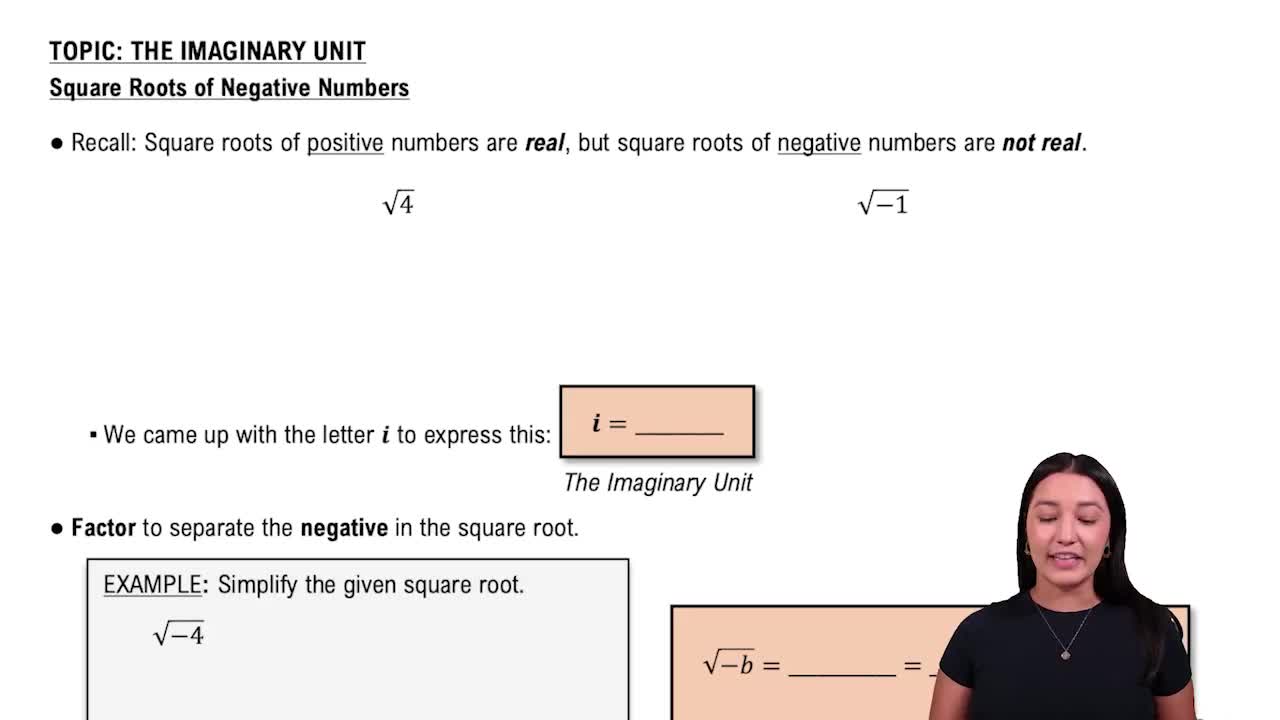
Recognize that the expression involves the square root of a negative number, which means we will use the imaginary unit \(i\), where \(i = \sqrt{-1}\).
Rewrite the square root of the negative number as \(\sqrt{-288} = \sqrt{288} \times \sqrt{-1} = \sqrt{288} \times i\).
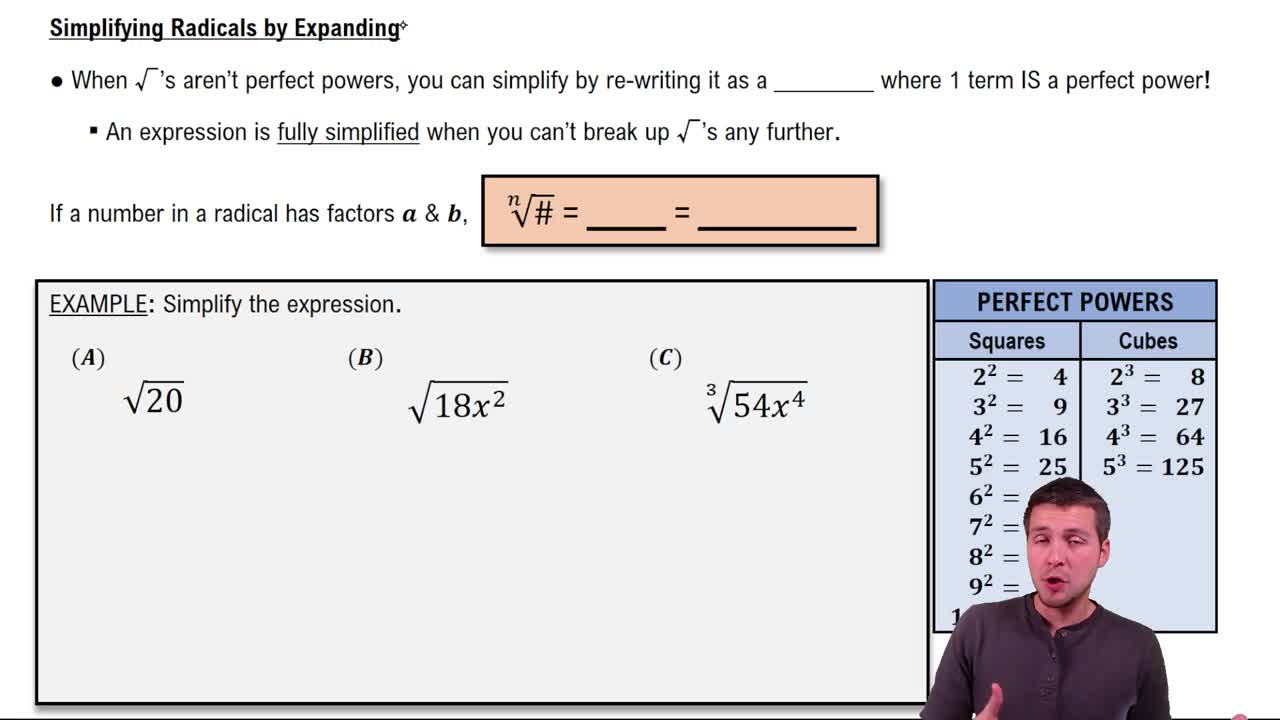
Simplify \(\sqrt{288}\) by factoring 288 into its prime factors or perfect squares. For example, \$288 = 144 \times 2\(, so \)\sqrt{288} = \sqrt{144 \times 2} = \sqrt{144} \times \sqrt{2}$.
Calculate \(\sqrt{144}\), which is a perfect square, so \(\sqrt{144} = 12\). Therefore, \(\sqrt{288} = 12 \sqrt{2}\).
Combine the results to express the original number as the product of a real number and \(i\): \(\sqrt{-288} = 12 \sqrt{2} \times i\).
Verified video answer for a similar problem:
This video solution was recommended by our tutors as helpful for the problem above
Video duration:
1m
Play a video:
Was this helpful?
Key Concepts
Here are the essential concepts you must grasp in order to answer the question correctly.
Imaginary Unit (i)
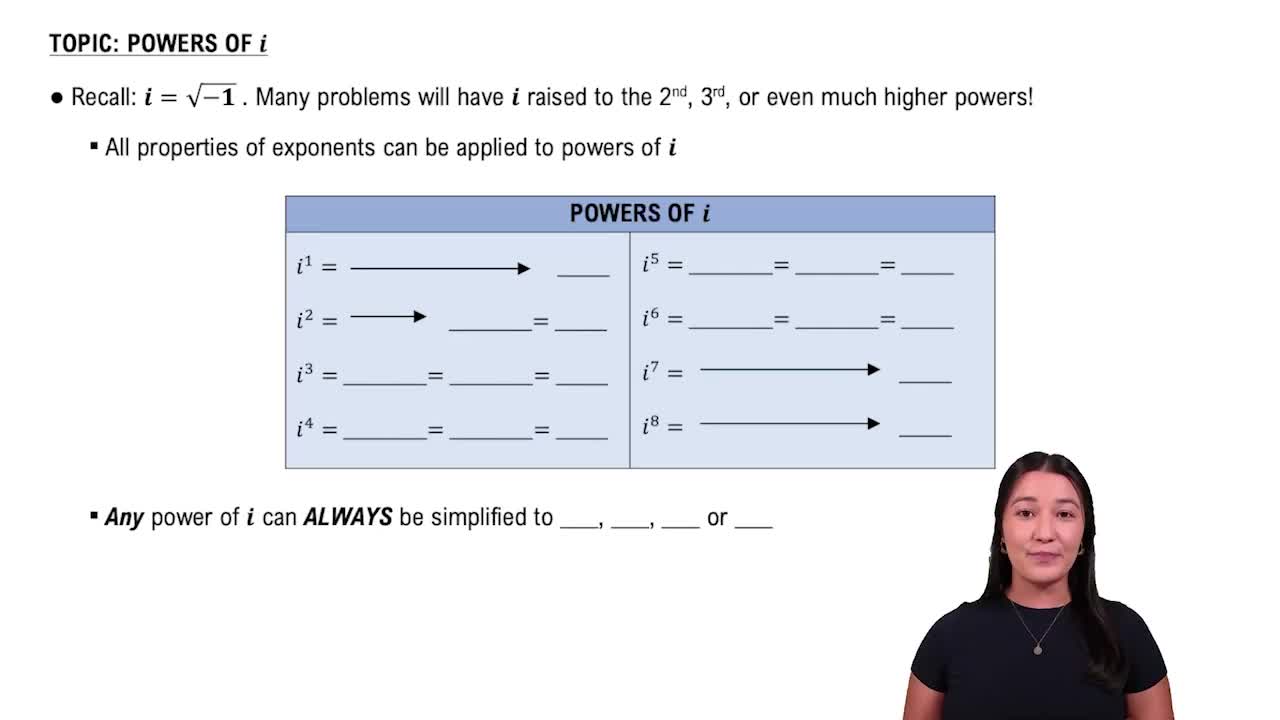
The imaginary unit i is defined as the square root of -1, i.e., i² = -1. It allows us to express the square roots of negative numbers in terms of real numbers multiplied by i, enabling the extension of the real number system to complex numbers.
To simplify the square root of a negative number, separate it into the square root of the negative part and the positive part. For example, √-288 = √(-1) × √288 = i × √288, which can then be simplified further by factoring 288 into perfect squares.
Prime Factorization and Simplification of Radicals
Prime factorization helps break down numbers into their prime factors to identify perfect squares. This process simplifies radicals by extracting square factors outside the root, making expressions like √288 easier to write in simplest radical form.