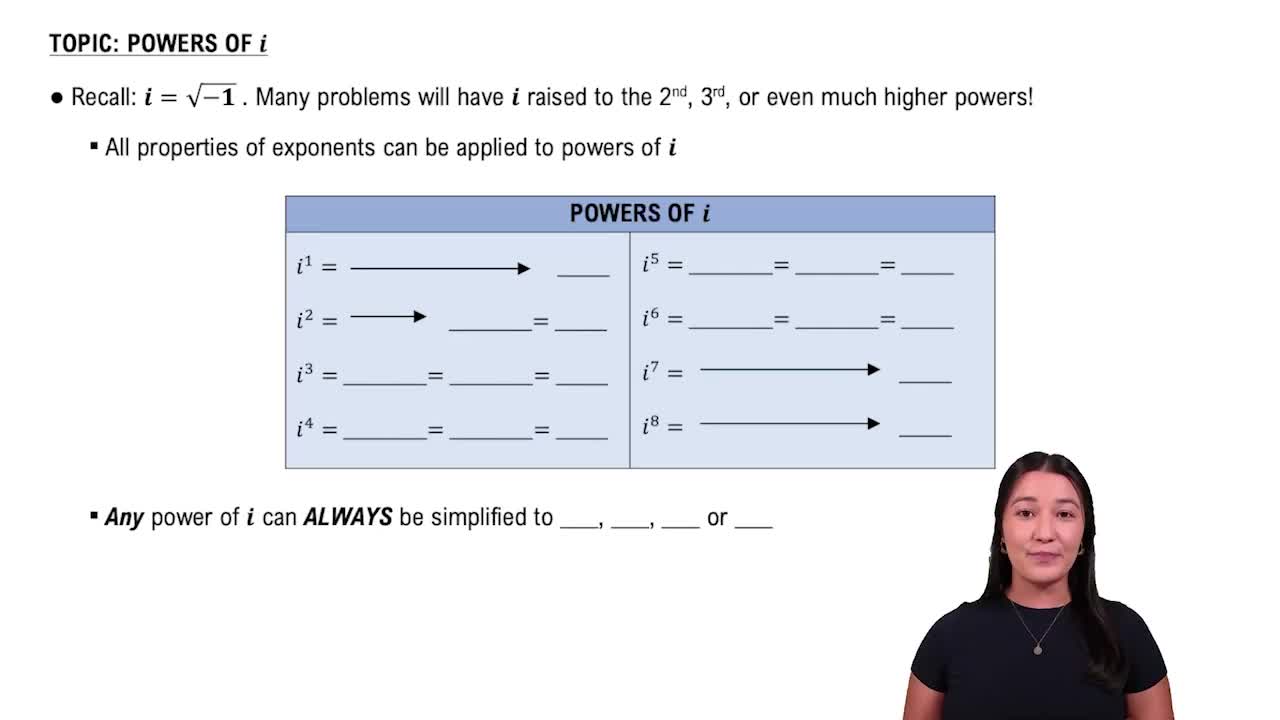
Recall that the imaginary unit \(i\) has the property \(i^2 = -1\), and powers of \(i\) cycle every 4 steps: \(i^0 = 1\), \(i^1 = i\), \(i^2 = -1\), \(i^3 = -i\), and \(i^4 = 1\) again.
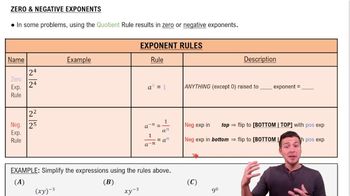
Rewrite the expression \(\frac{1}{i^{-12}}\) by using the property of negative exponents: \(\frac{1}{i^{-12}} = i^{12}\).
Simplify \(i^{12}\) by reducing the exponent modulo 4, since powers of \(i\) repeat every 4: calculate \$12 \mod 4$.
Since \$12 \mod 4 = 0\(, \)i^{12} = i^0 = 1$.
Therefore, the simplified form of \(\frac{1}{i^{-12}}\) is \$1$.
Verified video answer for a similar problem:
This video solution was recommended by our tutors as helpful for the problem above
Video duration:
3m
Play a video:
Was this helpful?
Key Concepts
Here are the essential concepts you must grasp in order to answer the question correctly.
Imaginary Unit and Powers of i
The imaginary unit i is defined as the square root of -1, with the property i² = -1. Powers of i cycle every four steps: i¹ = i, i² = -1, i³ = -i, and i⁴ = 1, then the pattern repeats. Understanding this cyclic nature helps simplify expressions involving powers of i.
A negative exponent indicates the reciprocal of the base raised to the positive exponent, such that a^(-n) = 1/(a^n). Applying this rule allows rewriting expressions with negative powers into fractions, which is essential for simplifying terms like i^-12.
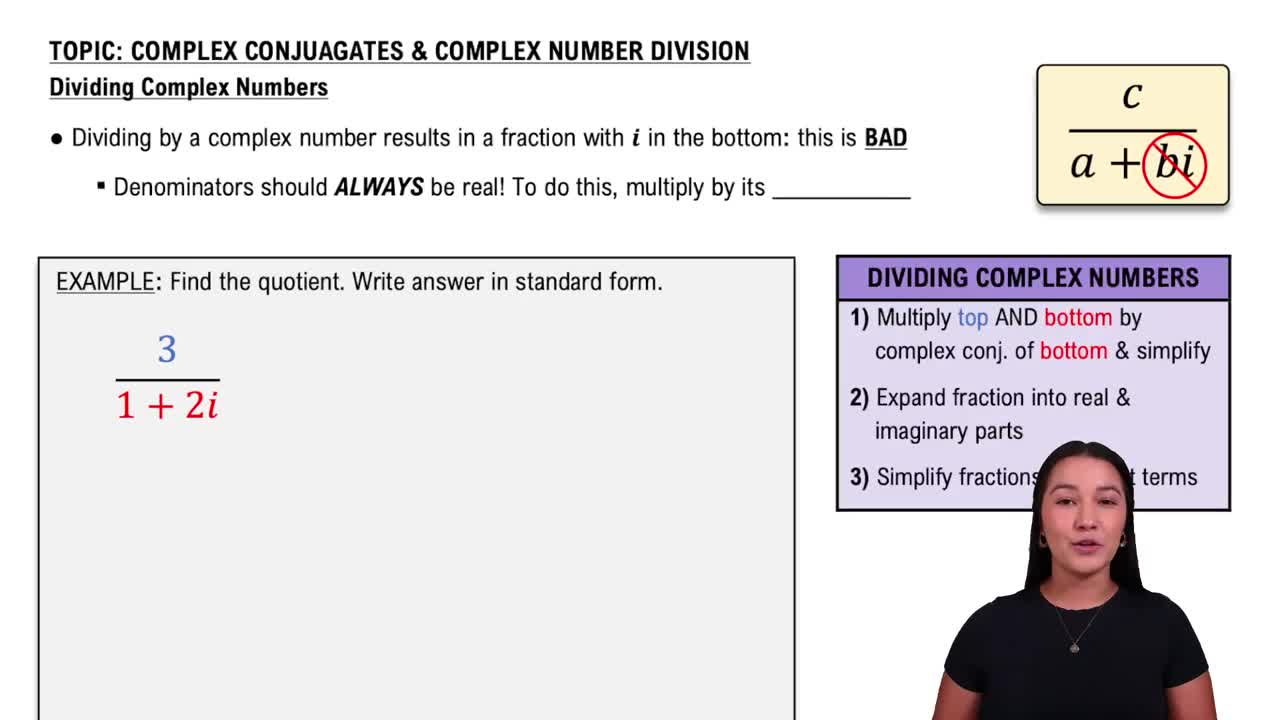
Simplifying complex fractions involves rewriting the expression to eliminate fractions within fractions, often by multiplying numerator and denominator by a common term. This process helps in reducing expressions like 1/i^-12 to a simpler form by handling the denominator's power correctly.