Find the slope of the line satisfying the given conditions. See Example 5. through (5, 9) and (-2, 9)
Verified step by step guidance
1
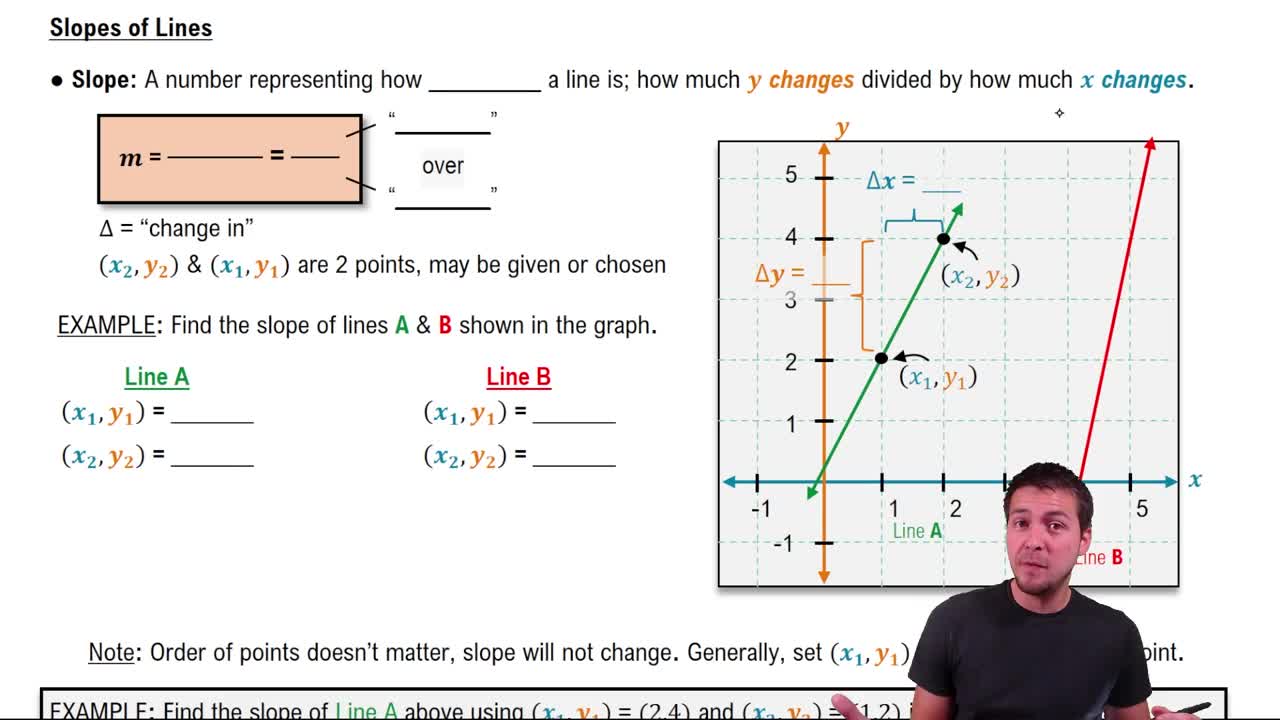
To find the slope of a line passing through two points, use the slope formula: m = \frac{y_2 - y_1}{x_2 - x_1}.
Identify the coordinates of the two points: (x_1, y_1) = (5, 9) and (x_2, y_2) = (-2, 9).
Substitute the coordinates into the slope formula: m = \frac{9 - 9}{-2 - 5}.
Simplify the expression in the numerator and the denominator.
Conclude that the slope is 0, indicating a horizontal line.
Verified video answer for a similar problem:
This video solution was recommended by our tutors as helpful for the problem above
Video duration:
2m
Play a video:
Was this helpful?
Key Concepts
Here are the essential concepts you must grasp in order to answer the question correctly.
Slope of a Line
The slope of a line measures its steepness and direction, calculated as the ratio of the vertical change (rise) to the horizontal change (run) between two points on the line. It is often represented as 'm' in the slope-intercept form of a linear equation, y = mx + b. A positive slope indicates the line rises from left to right, while a negative slope indicates it falls.
Coordinate points are pairs of numbers that define a position in a two-dimensional space, typically written as (x, y). In this context, the points (5, 9) and (-2, 9) represent specific locations on the Cartesian plane. Understanding how to interpret these points is crucial for calculating the slope between them.
The formula for calculating the slope (m) between two points (x1, y1) and (x2, y2) is given by m = (y2 - y1) / (x2 - x1). This formula allows you to find the slope by substituting the y-coordinates and x-coordinates of the two points. In this case, substituting the coordinates (5, 9) and (-2, 9) will yield the slope of the line connecting these points.