For each line described, write an equation in(a)slope-intercept form, if possible, and(b)standard form. through (-7, 4), perpendicular to y=8
Verified step by step guidance
1
Identify the slope of the given line. The equation y = 8 is a horizontal line, which means its slope is 0.
Determine the slope of the line perpendicular to the given line. The slope of a line perpendicular to a horizontal line is undefined, which means it is a vertical line.
Since the line is vertical, it cannot be expressed in slope-intercept form (y = mx + b).
Write the equation of the vertical line in standard form. A vertical line through the point (-7, 4) has the equation x = -7.
Thus, the equation of the line perpendicular to y = 8 and passing through (-7, 4) is x = -7 in standard form.
Verified video answer for a similar problem:
This video solution was recommended by our tutors as helpful for the problem above
Video duration:
2m
Play a video:
Was this helpful?
Key Concepts
Here are the essential concepts you must grasp in order to answer the question correctly.
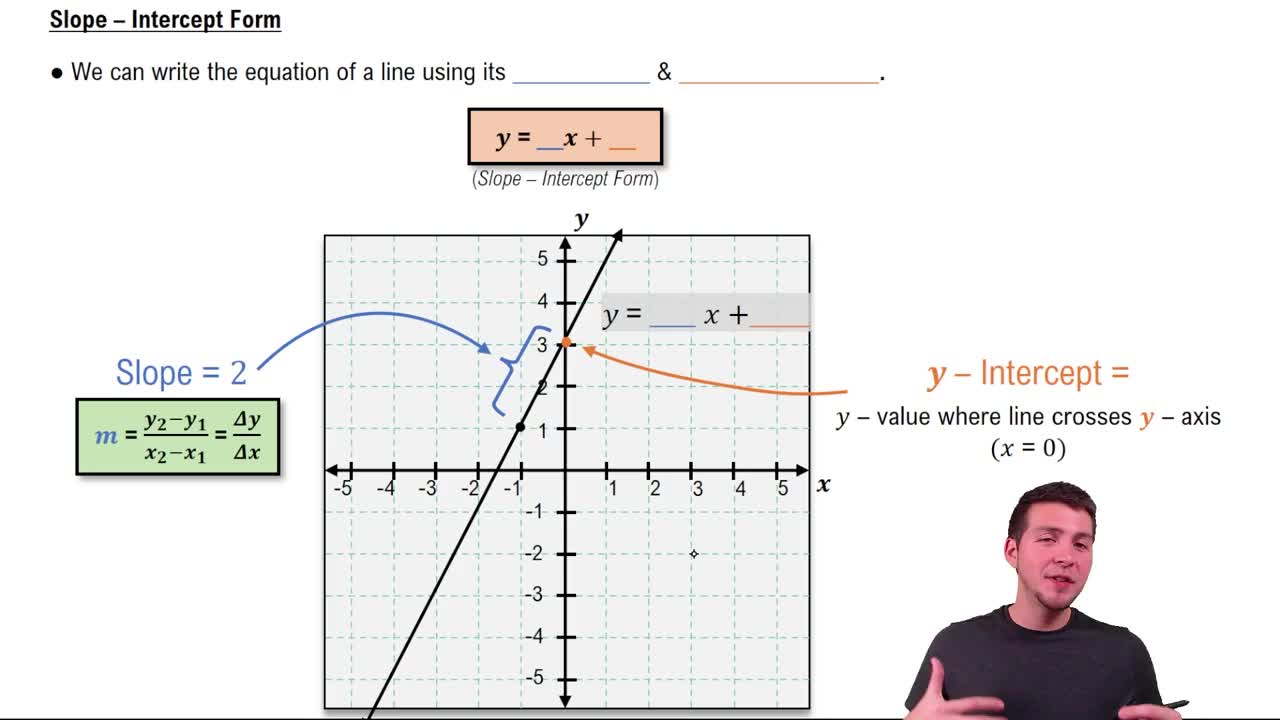
Slope-Intercept Form
The slope-intercept form of a linear equation is expressed as y = mx + b, where m represents the slope of the line and b is the y-intercept. This form is useful for quickly identifying the slope and y-intercept, making it easier to graph the line. To convert an equation into this form, one typically isolates y on one side of the equation.
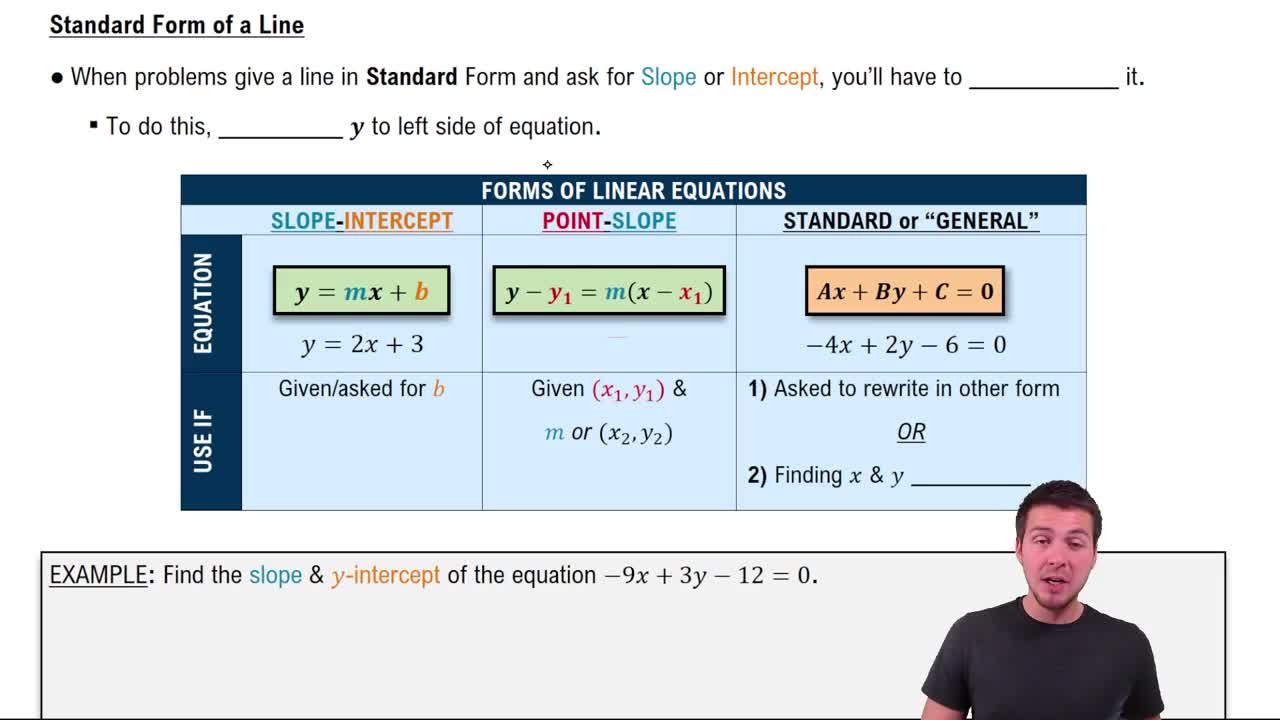
The standard form of a linear equation is given by Ax + By = C, where A, B, and C are integers, and A should be non-negative. This form is particularly useful for analyzing the relationship between x and y and for solving systems of equations. To convert from slope-intercept form to standard form, one rearranges the equation to fit this structure.
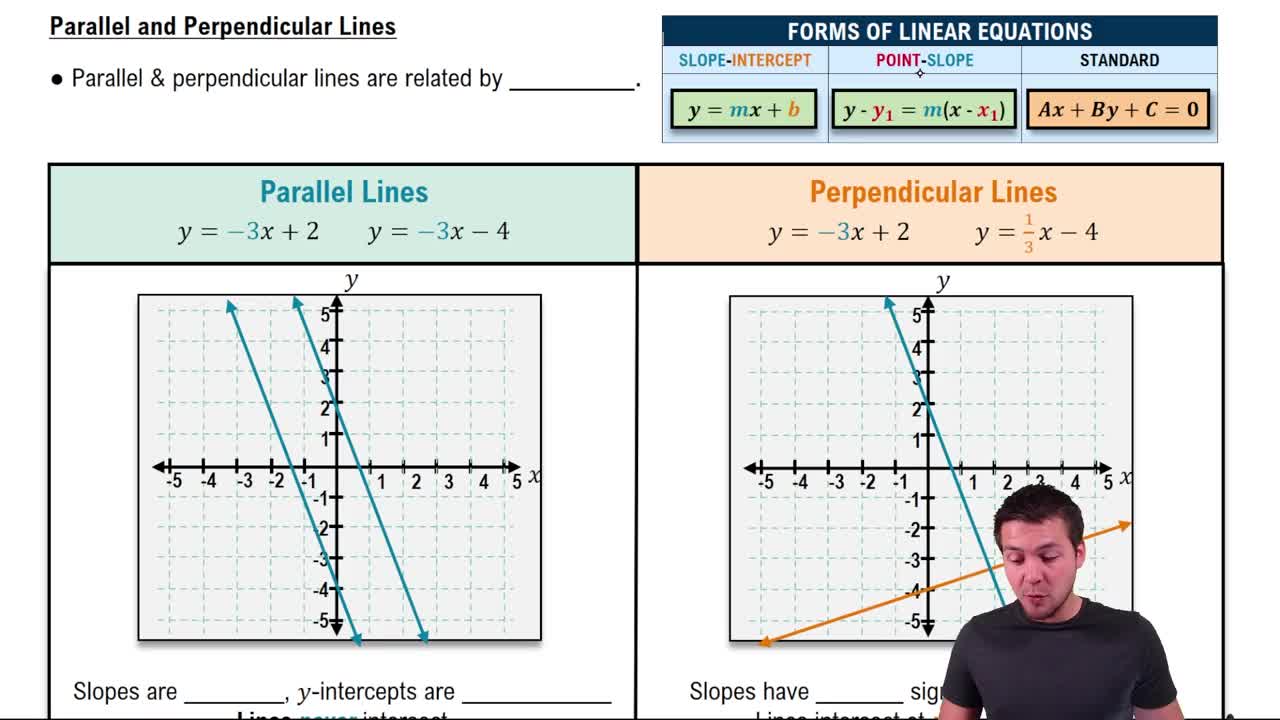
Two lines are perpendicular if the product of their slopes is -1. This means that if one line has a slope of m, the slope of the line perpendicular to it will be -1/m. In the context of the given question, since the line y = 8 is horizontal (slope = 0), the perpendicular line will be vertical, which cannot be expressed in slope-intercept form but can be represented in standard form.