Find the slope of the line satisfying the given conditions. See Example 5. through (2, -1) and (-3, -3)
Verified step by step guidance
1
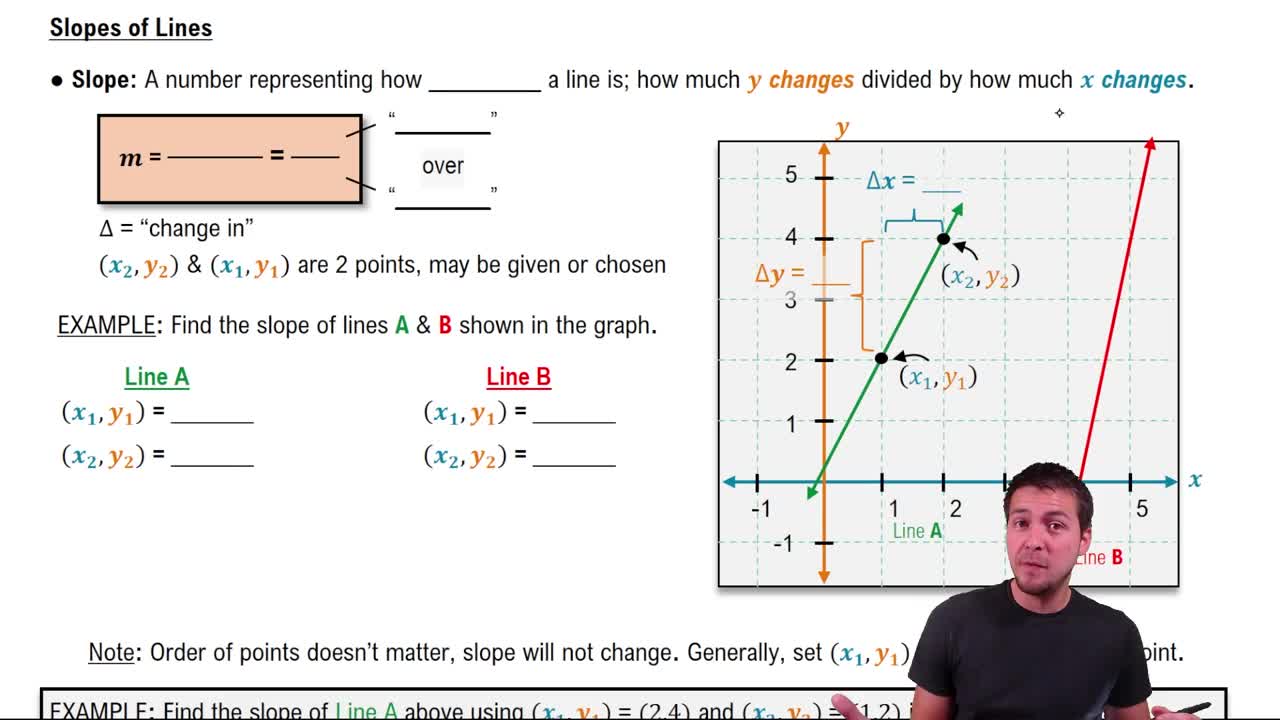
Identify the formula for the slope of a line given two points: \( m = \frac{y_2 - y_1}{x_2 - x_1} \).
Assign the coordinates of the first point \((x_1, y_1) = (2, -1)\) and the second point \((x_2, y_2) = (-3, -3)\).
Substitute the coordinates into the slope formula: \( m = \frac{-3 - (-1)}{-3 - 2} \).
Simplify the numerator: \(-3 - (-1) = -3 + 1\).
Simplify the denominator: \(-3 - 2 = -5\).
Verified video answer for a similar problem:
This video solution was recommended by our tutors as helpful for the problem above
Video duration:
2m
Play a video:
Was this helpful?
Key Concepts
Here are the essential concepts you must grasp in order to answer the question correctly.
Slope of a Line
The slope of a line measures its steepness and direction, calculated as the ratio of the vertical change (rise) to the horizontal change (run) between two points on the line. It is often represented by the letter 'm' and can be found using the formula m = (y2 - y1) / (x2 - x1), where (x1, y1) and (x2, y2) are the coordinates of the two points.
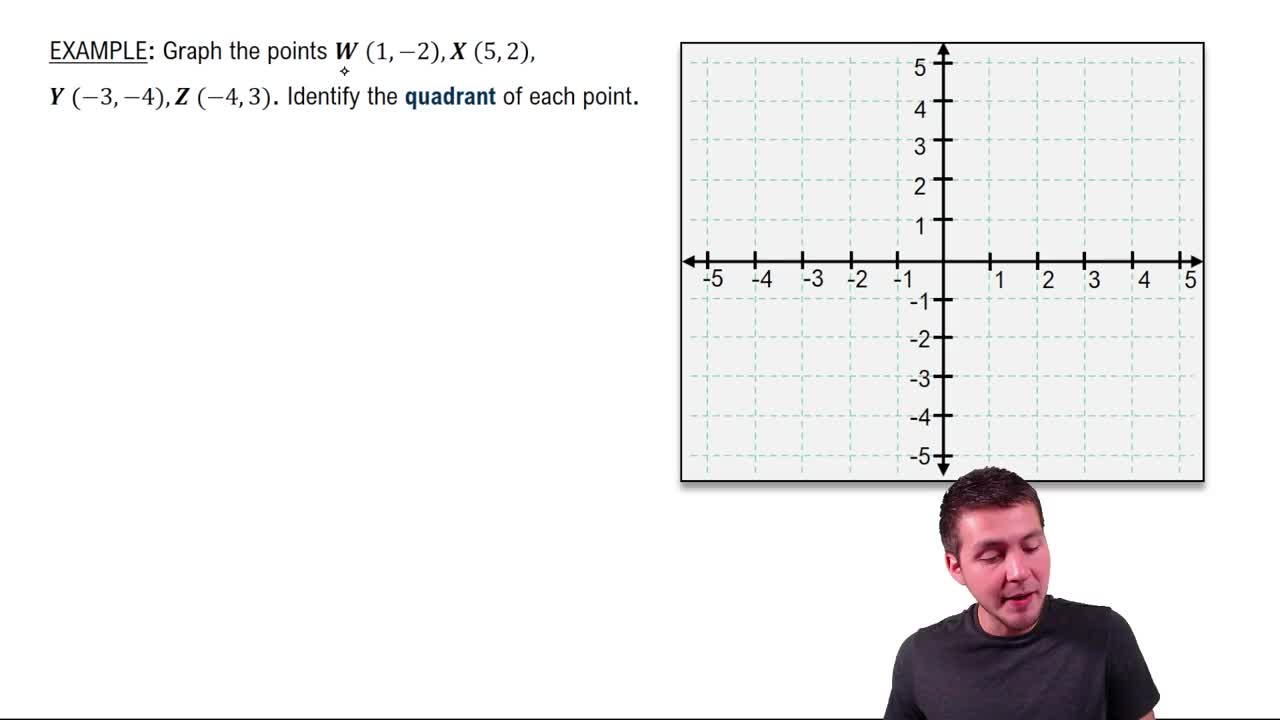
A coordinate system is a two-dimensional plane defined by a horizontal axis (x-axis) and a vertical axis (y-axis). Each point on this plane is represented by an ordered pair (x, y), which indicates its position relative to the axes. Understanding how to plot points and interpret their coordinates is essential for calculating the slope between them.
Linear equations represent relationships between variables that graph as straight lines on a coordinate plane. The general form of a linear equation is y = mx + b, where m is the slope and b is the y-intercept. Recognizing that the slope is a constant value in linear equations helps in understanding how changes in x affect y.