Use the rules for radicals to perform the indicated operations. Assume all variable expressions represent positive real numbers. √11 • √44
Verified step by step guidance
1
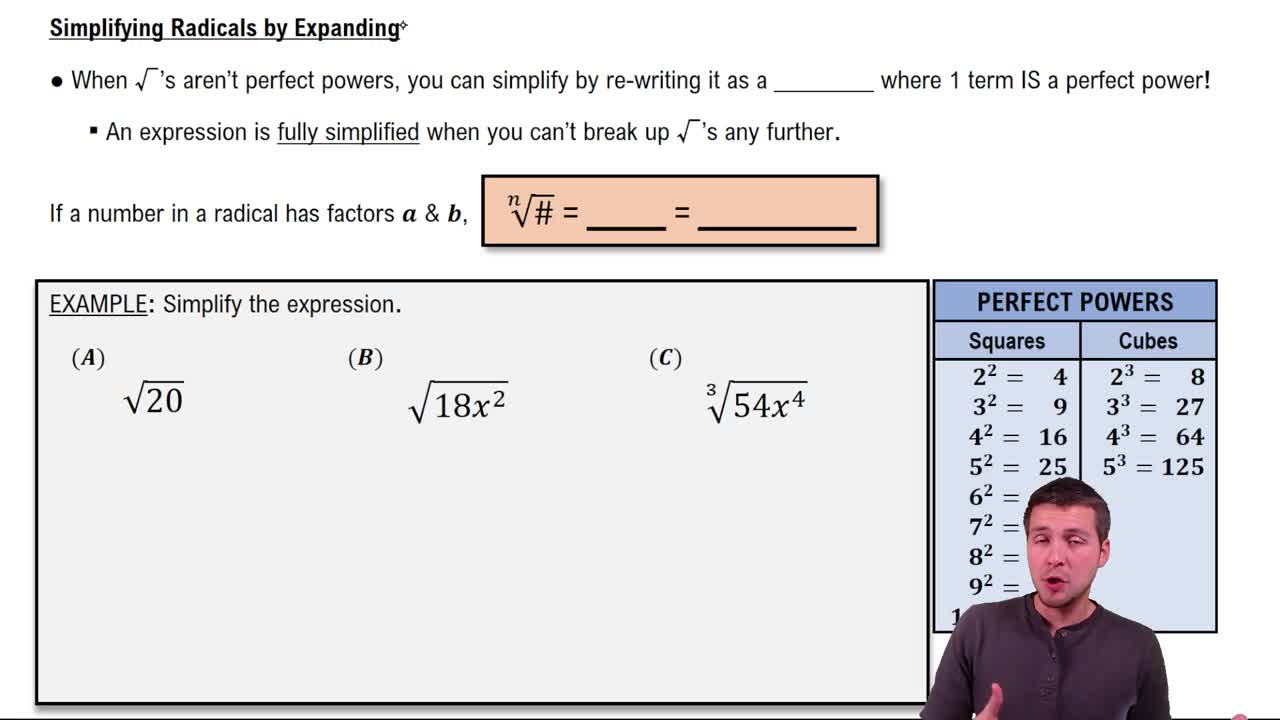
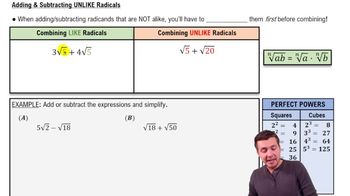
Recall the product rule for radicals: \(\sqrt{a} \cdot \sqrt{b} = \sqrt{a \cdot b}\), where \(a\) and \(b\) are positive real numbers.
Apply the product rule to the given expression: \(\sqrt{11} \cdot \sqrt{44} = \sqrt{11 \times 44}\).
Multiply the numbers inside the radical: \$11 \times 44$.
Express the product inside the radical as a single number: \(\sqrt{484}\).
Simplify the square root if possible by finding the square root of \$484$.
Verified video answer for a similar problem:
This video solution was recommended by our tutors as helpful for the problem above
Video duration:
1m
Play a video:
Was this helpful?
Key Concepts
Here are the essential concepts you must grasp in order to answer the question correctly.
Properties of Radicals
Radicals represent roots, commonly square roots, and follow specific properties such as √a * √b = √(a*b) when a and b are non-negative. Understanding these properties allows simplification of expressions involving roots by combining or separating them.
When multiplying radicals with the same index, multiply the radicands (the numbers inside the roots) directly under a single radical. For example, √11 * √44 = √(11*44), which simplifies the expression and makes further simplification possible.
After combining radicals, simplify the resulting radical by factoring out perfect squares from the radicand. For instance, √484 can be simplified to 22 because 484 is 22 squared. This step makes the expression easier to interpret and use.