Use the product rule to simplify the expressions in Exercises 13–22. In Exercises 17–22, assume that variables represent nonnegative real numbers.
Verified step by step guidance
1
Identify the two expressions being multiplied: \(\sqrt{2x^2}\) and \(\sqrt{6x}\).
Recall the product rule for square roots: \(\sqrt{a} \cdot \sqrt{b} = \sqrt{a \cdot b}\), which allows us to combine the square roots into one.
Apply the product rule: \(\sqrt{2x^2} \cdot \sqrt{6x} = \sqrt{(2x^2)(6x)}\).
Multiply the expressions inside the square root: \((2x^2)(6x) = 12x^3\), so the expression becomes \(\sqrt{12x^3}\).
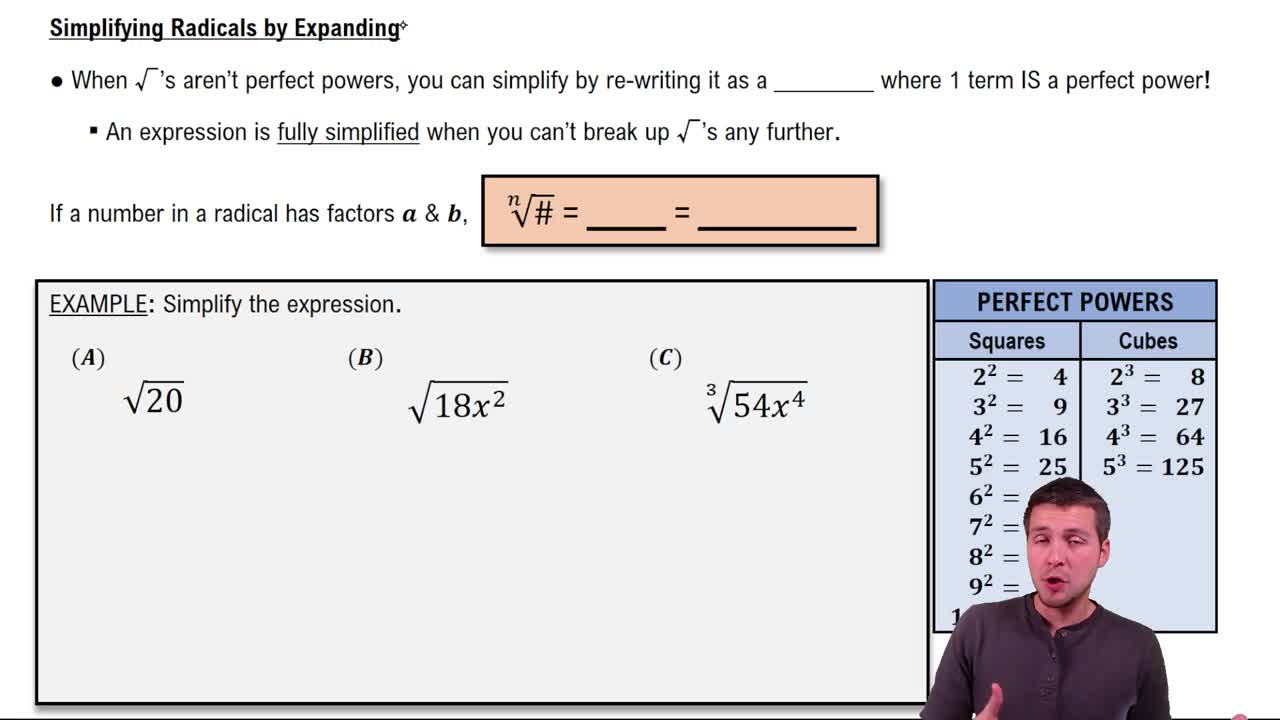
Simplify \(\sqrt{12x^3}\) by factoring inside the root to extract perfect squares, such as \$12 = 4 \times 3\( and \)x^3 = x^2 \times x\(, then rewrite as \)\sqrt{4 \times 3 \times x^2 \times x}$.
Verified video answer for a similar problem:
This video solution was recommended by our tutors as helpful for the problem above
Video duration:
5m
Play a video:
Was this helpful?
Key Concepts
Here are the essential concepts you must grasp in order to answer the question correctly.
Product Rule for Radicals
The product rule for radicals states that the square root of a product equals the product of the square roots, i.e., √a * √b = √(a*b). This allows simplification by combining the radicands under a single square root before further simplification.
When multiplying expressions with the same base, add their exponents: x^m * x^n = x^(m+n). This property helps simplify terms like x^2 * x by combining the powers into a single exponent.
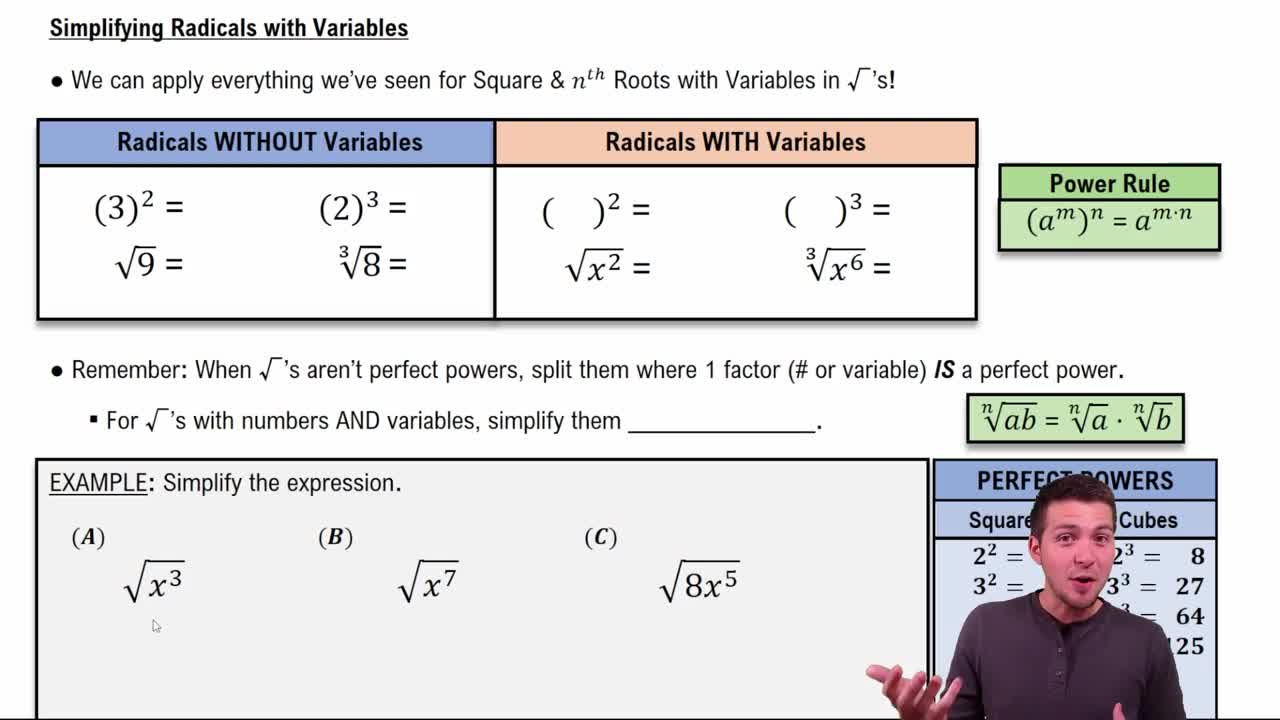
When simplifying radicals involving variables, consider the domain (nonnegative real numbers) to safely apply square root properties. For example, √(x^2) = x if x ≥ 0, ensuring the expression remains valid and simplified.