Use the quotient rule to simplify the expressions in Exercises 23–32. Assume that x > 0.
Verified step by step guidance
1
Identify the given expression as a quotient of two square roots: \(\frac{\sqrt{150x^4}}{\sqrt{3x}}\).
Recall that the quotient of square roots can be combined into a single square root: \(\sqrt{\frac{150x^4}{3x}}\).
Simplify the fraction inside the square root by dividing the coefficients and subtracting the exponents of like bases: \(\frac{150}{3} = 50\) and \(x^{4} \div x^{1} = x^{4-1} = x^{3}\), so the expression becomes \(\sqrt{50x^{3}}\).
Factor the radicand (the expression inside the square root) to simplify further: \$50x^{3} = 25 \cdot 2 \cdot x^{2} \cdot x$.
Use the property \(\sqrt{a^2} = a\) to simplify the square root: \(\sqrt{25} = 5\) and \(\sqrt{x^{2}} = x\), so the expression simplifies to \$5x\sqrt{2x}$.
Verified video answer for a similar problem:
This video solution was recommended by our tutors as helpful for the problem above
Video duration:
5m
Play a video:
Was this helpful?
Key Concepts
Here are the essential concepts you must grasp in order to answer the question correctly.
Quotient Rule for Radicals
The quotient rule for radicals states that the square root of a quotient is equal to the quotient of the square roots, i.e., √(a/b) = √a / √b. This allows simplification of expressions involving square roots in numerator and denominator by separating or combining them.
Simplifying radicals involves factoring the radicand to extract perfect squares and reduce the expression. For example, √150 can be broken down into √(25*6) = 5√6, making the expression easier to handle and combine with other terms.
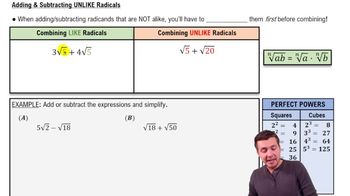
Adding & Subtracting Unlike Radicals by Simplifying
Laws of Exponents
When simplifying expressions with variables under radicals, use exponent rules such as √(x^n) = x^(n/2). Also, when dividing like bases, subtract exponents: x^a / x^b = x^(a-b). These rules help rewrite and simplify the expression efficiently.