In Exercises 1–10, find the slope of the line passing through each pair of points or state that the slope is undefined. Then indicate whether the line through the points rises, falls, is horizontal, or is vertical. (-2, 1) and (2, 2)
Verified step by step guidance
1
Identify the coordinates of the two points: Point 1 is \((-2, 1)\) and Point 2 is \((2, 2)\).
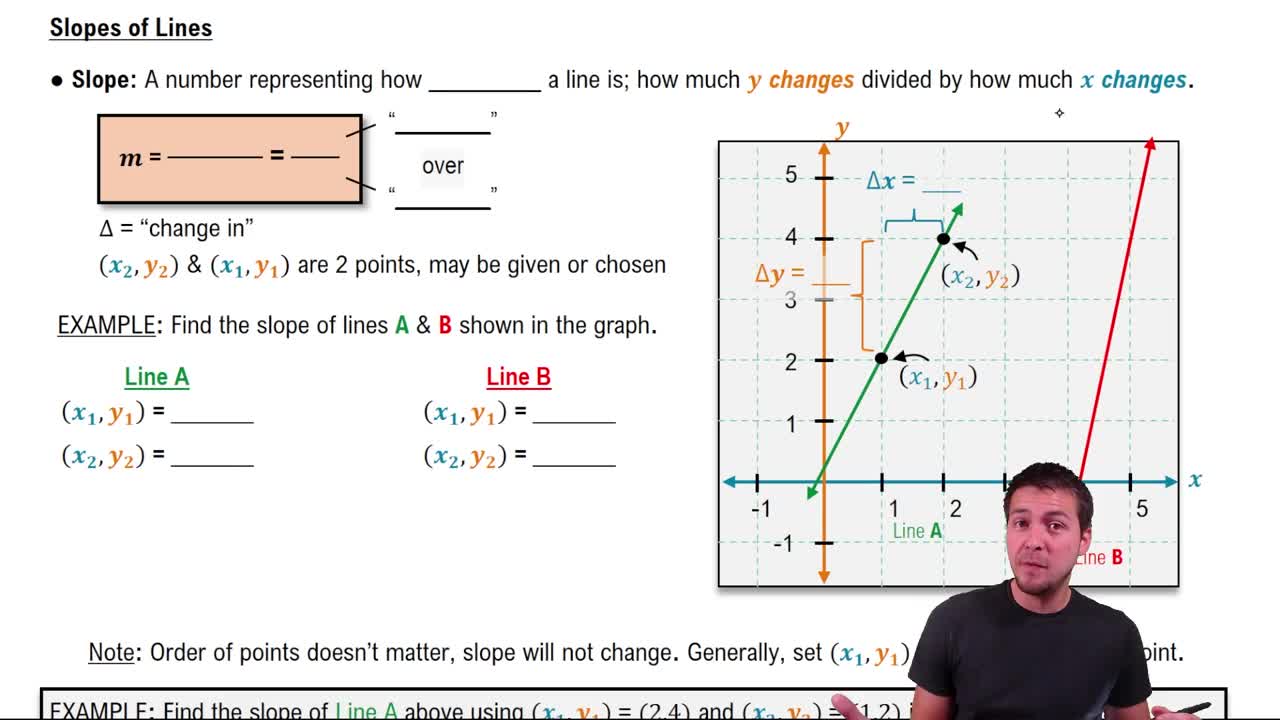
Use the slope formula \(m = \frac{y_2 - y_1}{x_2 - x_1}\) to find the slope of the line.
Substitute the coordinates into the formula: \(m = \frac{2 - 1}{2 - (-2)}\).
Simplify the expression in the numerator and the denominator: \(m = \frac{1}{4}\).
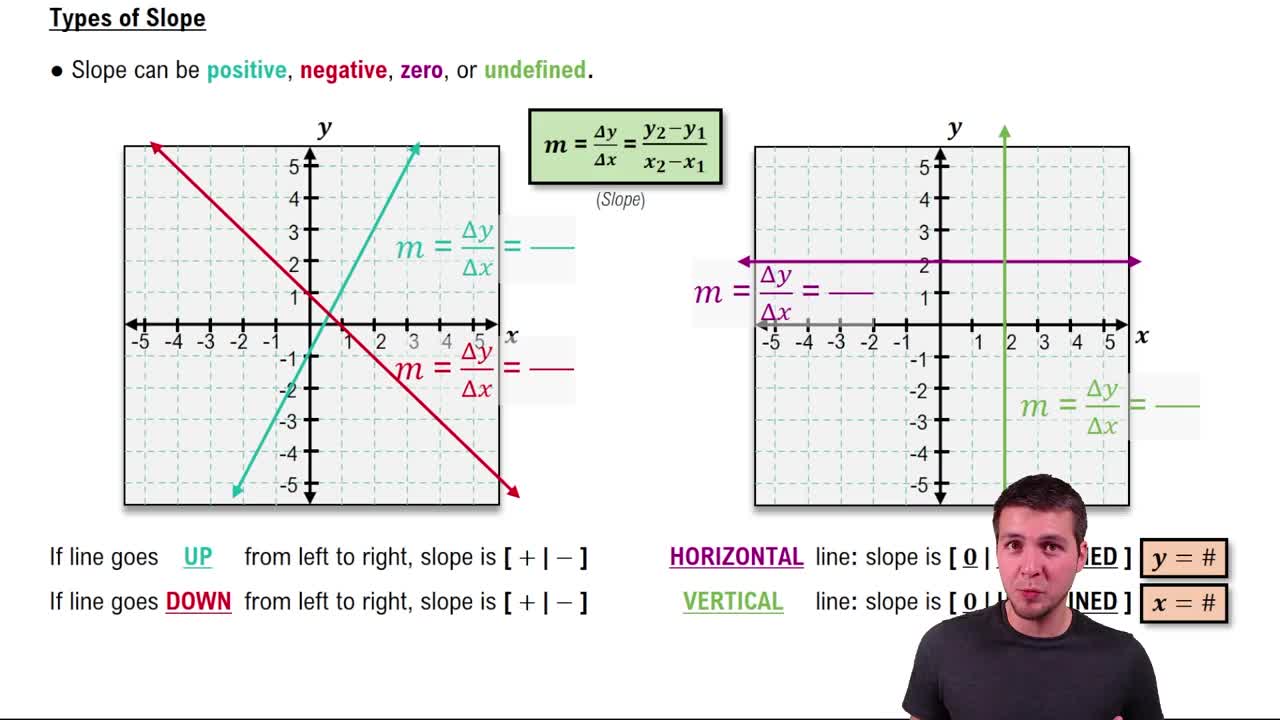
Determine the direction of the line: Since the slope \(m = \frac{1}{4}\) is positive, the line rises from left to right.
Verified video answer for a similar problem:
This video solution was recommended by our tutors as helpful for the problem above
Video duration:
1m
Play a video:
Was this helpful?
Key Concepts
Here are the essential concepts you must grasp in order to answer the question correctly.
Slope of a Line
The slope of a line measures its steepness and direction, calculated as the change in the y-coordinates divided by the change in the x-coordinates between two points. It is represented by the formula m = (y2 - y1) / (x2 - x1). A positive slope indicates the line rises from left to right, while a negative slope indicates it falls.
A slope is considered undefined when the line is vertical, meaning the x-coordinates of the two points are the same. In this case, the change in x (denominator) is zero, leading to division by zero, which is mathematically undefined. Vertical lines do not rise or fall but run straight up and down.
The orientation of a line can be categorized as rising, falling, horizontal, or vertical based on its slope. A rising line has a positive slope, a falling line has a negative slope, a horizontal line has a slope of zero, and a vertical line has an undefined slope. Understanding these orientations helps in visualizing the relationship between the points on a graph.