Write an equation for each line described. Give answers in standard form for Exercises 11–20 and in slope-intercept form (if possible) for Exercises 21–32. through (1,3), m = -2
Verified step by step guidance
1
Step 1: Understand the problem. We are given a point (1,3) and a slope m = -2. We are asked to write the equation of the line that passes through this point and has this slope.
Step 2: Recall the slope-intercept form of a line, which is y = mx + b, where m is the slope and b is the y-intercept.
Step 3: Substitute the given slope and point into the slope-intercept form. We know that m = -2, and the point (1,3) gives us x = 1 and y = 3. So we get 3 = -2*1 + b.
Step 4: Solve the equation for b. This will give us the y-intercept of the line.
Step 5: Substitute the values of m and b back into the slope-intercept form to get the equation of the line.
Verified video answer for a similar problem:
This video solution was recommended by our tutors as helpful for the problem above
Video duration:
3m
Play a video:
Was this helpful?
Key Concepts
Here are the essential concepts you must grasp in order to answer the question correctly.
Point-Slope Form of a Line
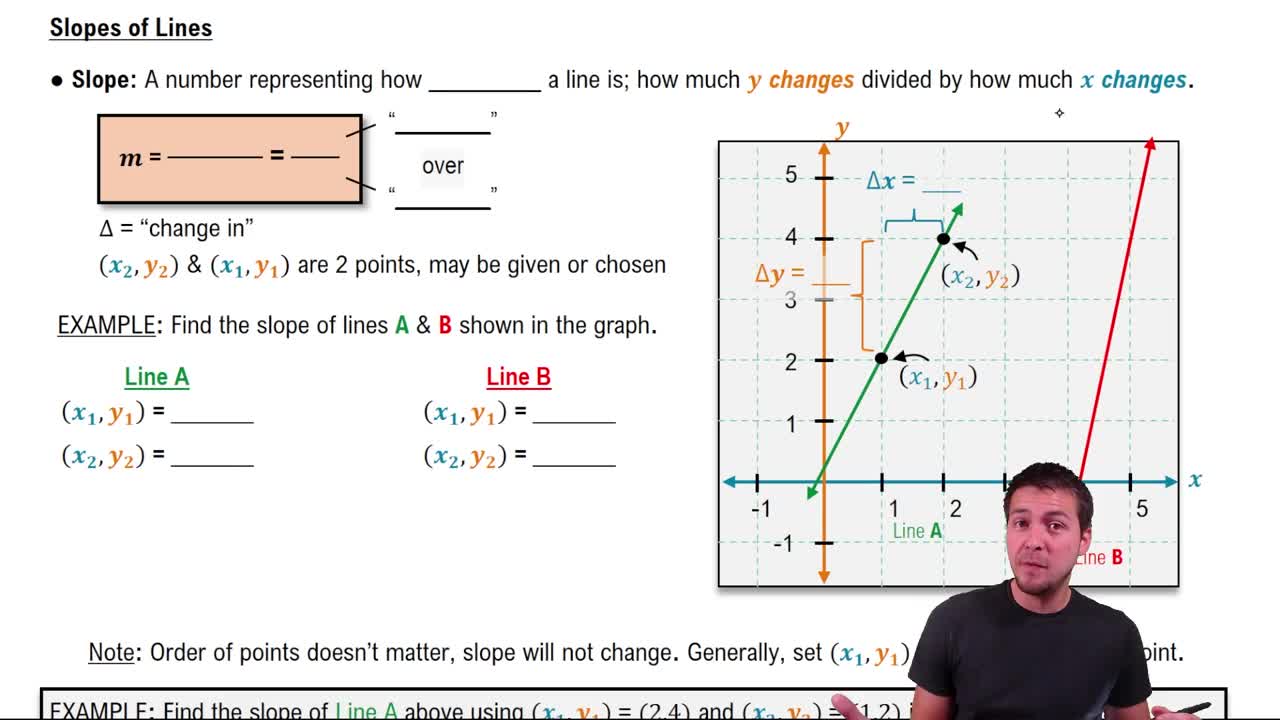
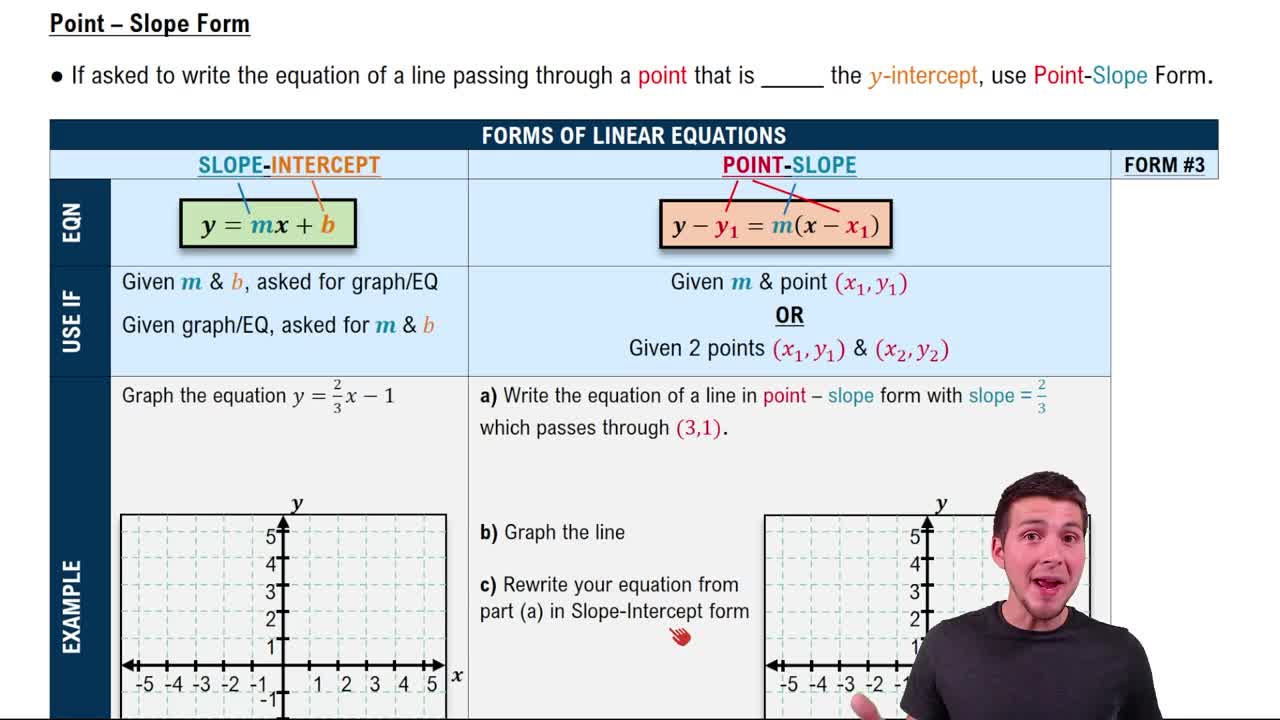
The point-slope form of a line is expressed as y - y1 = m(x - x1), where (x1, y1) is a point on the line and m is the slope. This form is particularly useful when you know a point on the line and the slope, allowing you to easily write the equation of the line.
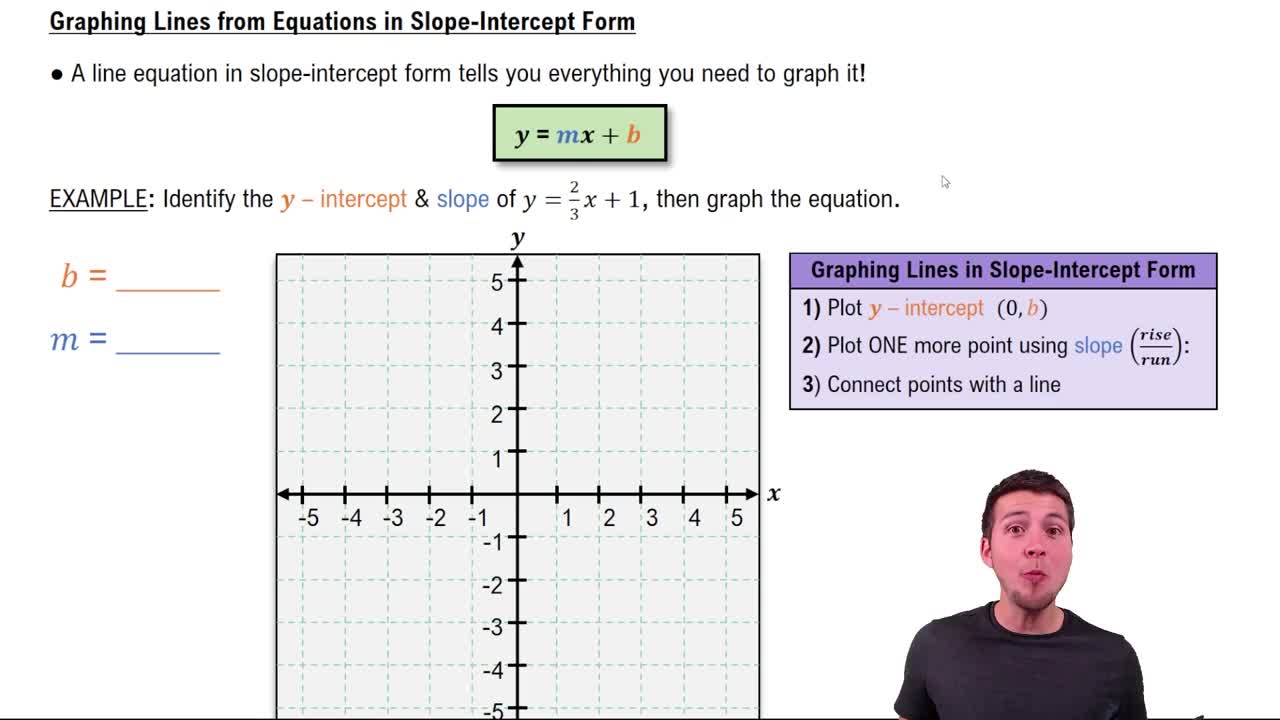
The slope-intercept form of a line is given by the equation y = mx + b, where m represents the slope and b is the y-intercept. This form is advantageous for quickly identifying the slope and where the line crosses the y-axis, making it easier to graph the line.
The standard form of a line is written as Ax + By = C, where A, B, and C are integers, and A should be non-negative. This form is useful for solving systems of equations and can be converted to slope-intercept form for graphing purposes.