Determine whether each function graphed or defined is one-to-one.
Verified step by step guidance
1
Step 1: Understand the definition of a one-to-one function. A function is one-to-one if and only if each output (y-value) corresponds to exactly one input (x-value). In other words, no horizontal line intersects the graph more than once.
Step 2: Observe the graph of the function, which is a parabola opening upwards with its vertex at the origin (0,0).
Step 3: Apply the Horizontal Line Test: Imagine drawing horizontal lines across the graph. If any horizontal line intersects the graph at more than one point, the function is not one-to-one.
Step 4: Notice that horizontal lines above the vertex intersect the parabola at two points (one on the left side and one on the right side), indicating multiple x-values for the same y-value.
Step 5: Conclude that since the horizontal line test fails, the given parabolic function is not one-to-one.
Verified video answer for a similar problem:
This video solution was recommended by our tutors as helpful for the problem above
Video duration:
2m
Play a video:
0 Comments
Key Concepts
Here are the essential concepts you must grasp in order to answer the question correctly.
One-to-One Function
A one-to-one function assigns each input exactly one unique output, and no two different inputs share the same output. This means the function passes the Horizontal Line Test, where any horizontal line intersects the graph at most once.
The Horizontal Line Test is a visual method to determine if a function is one-to-one. If any horizontal line crosses the graph more than once, the function is not one-to-one, indicating multiple inputs produce the same output.
A parabolic function, typically represented as y = ax² + bx + c, is symmetric and shaped like a 'U'. Because it is symmetric, it fails the Horizontal Line Test, meaning it is generally not one-to-one over its entire domain.

 2:44 minutes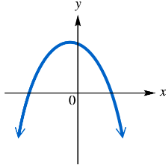
 Verified step by step guidance
 4:07
4:07