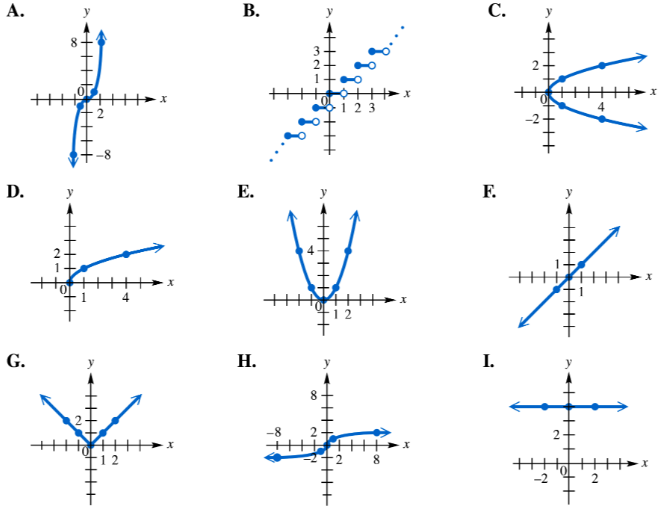
For each function graphed, give the minimum and maximum values of ƒ(x) and the x-values at which they occur.
Table of contents
- 0. Review of Algebra4h 18m
- 1. Equations & Inequalities3h 18m
- 2. Graphs of Equations1h 43m
- 3. Functions2h 17m
- 4. Polynomial Functions1h 44m
- 5. Rational Functions1h 23m
- 6. Exponential & Logarithmic Functions2h 28m
- 7. Systems of Equations & Matrices4h 5m
- 8. Conic Sections2h 23m
- 9. Sequences, Series, & Induction1h 22m
- 10. Combinatorics & Probability1h 45m
3. Functions
Intro to Functions & Their Graphs
Problem 6
Textbook Question
To answer each question, refer to the following basic graphs. Which one is the graph of ƒ(x)=|x|? What is the function value when x=1.5?
Verified step by step guidance1
Recall that the function ƒ(x) = |x| represents the absolute value of x, which means it outputs the distance of x from zero on the number line, always as a non-negative value.
The graph of ƒ(x) = |x| is a V-shaped graph that touches the origin (0,0) and opens upwards, with two linear pieces: one with a positive slope for x ≥ 0 and one with a negative slope for x < 0.
Identify the graph among the given options that has this V shape, with the vertex at the origin and symmetric arms extending upwards on both sides.
To find the function value when x = 1.5, substitute 1.5 into the function: ƒ(1.5) = |1.5|.
Since the absolute value of a positive number is the number itself, the function value at x = 1.5 is simply 1.5.
Verified video answer for a similar problem:This video solution was recommended by our tutors as helpful for the problem above
Video duration:
4mPlay a video:
Was this helpful?
Key Concepts
Here are the essential concepts you must grasp in order to answer the question correctly.
Absolute Value Function
The absolute value function, denoted as ƒ(x) = |x|, outputs the non-negative value of x. It transforms any negative input into its positive counterpart, making the graph V-shaped with a vertex at the origin (0,0). Understanding this function is essential to identify its graph and evaluate its values.
Recommended video:
Function Composition
Graph Interpretation
Graph interpretation involves recognizing the shape and key features of a function's graph. For ƒ(x) = |x|, the graph consists of two linear pieces: one with positive slope for x ≥ 0 and one with negative slope for x < 0. Identifying these characteristics helps in matching the function to its graph.
Recommended video:
Guided course
Graphs and Coordinates - Example
Function Evaluation
Function evaluation means substituting a specific input value into the function to find the corresponding output. For ƒ(x) = |x|, evaluating at x = 1.5 involves calculating the absolute value of 1.5, which is 1.5. This process confirms the function's value at a given point.
Recommended video:
Evaluating Composed Functions
Watch next
Master Relations and Functions with a bite sized video explanation from Patrick
Start learningRelated Videos
Related Practice
Textbook Question
505
views