To answer each question, refer to the following basic graphs. Which one is the graph of ƒ(x)=x2? What is its domain?
Table of contents
- 0. Review of Algebra4h 18m
- 1. Equations & Inequalities3h 18m
- 2. Graphs of Equations1h 43m
- 3. Functions2h 17m
- 4. Polynomial Functions1h 44m
- 5. Rational Functions1h 23m
- 6. Exponential & Logarithmic Functions2h 28m
- 7. Systems of Equations & Matrices4h 5m
- 8. Conic Sections2h 23m
- 9. Sequences, Series, & Induction1h 22m
- 10. Combinatorics & Probability1h 45m
3. Functions
Intro to Functions & Their Graphs
Problem 8
Textbook Question
To answer each question, refer to the following basic graphs. Which one is the graph of ƒ(x)=√x? What is its domain?
Verified step by step guidance1
Recall the definition of the function ƒ(x) = \sqrt{x}, which represents the principal (non-negative) square root of x.
Understand that the graph of ƒ(x) = \sqrt{x} starts at the point (0,0) because \sqrt{0} = 0, and it only includes values where x is greater than or equal to zero, since the square root of a negative number is not a real number.
Identify the graph that begins at the origin (0,0) and increases gradually to the right, forming a curve that rises slowly as x increases; this is the characteristic shape of the square root function.
Determine the domain of ƒ(x) = \sqrt{x} by considering all x-values for which the function is defined. Since the square root requires non-negative inputs, the domain is all real numbers x such that x \geq 0.
Express the domain in interval notation as [0, \infty), indicating that the function includes zero and all positive real numbers.
Verified video answer for a similar problem:This video solution was recommended by our tutors as helpful for the problem above
Video duration:
4mPlay a video:
Was this helpful?
Key Concepts
Here are the essential concepts you must grasp in order to answer the question correctly.
Square Root Function
The square root function, denoted as ƒ(x) = √x, outputs the non-negative value whose square is x. It is defined only for x ≥ 0 because the square root of a negative number is not a real number. Understanding this function's shape helps in identifying its graph.
Recommended video:
Imaginary Roots with the Square Root Property
Domain of a Function
The domain of a function is the set of all input values (x-values) for which the function is defined. For ƒ(x) = √x, the domain includes all real numbers x ≥ 0, since the square root of negative numbers is not real. Recognizing the domain is essential for graph interpretation.
Recommended video:
Domain Restrictions of Composed Functions
Graphing Basic Functions
Graphing basic functions involves plotting points that satisfy the function's equation and understanding their general shape. The graph of ƒ(x) = √x starts at the origin (0,0) and increases slowly to the right, forming a curve in the first quadrant. Familiarity with these shapes aids in matching functions to their graphs.
Recommended video:
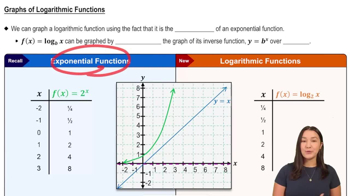
Graphs of Logarithmic Functions
Watch next
Master Relations and Functions with a bite sized video explanation from Patrick
Start learningRelated Videos
Related Practice
Textbook Question
484
views