Determine the largest open intervals of the domain over which each function is (a) increasing. See Example 9.
Table of contents
- 0. Review of Algebra4h 18m
- 1. Equations & Inequalities3h 18m
- 2. Graphs of Equations1h 43m
- 3. Functions2h 17m
- 4. Polynomial Functions1h 44m
- 5. Rational Functions1h 23m
- 6. Exponential & Logarithmic Functions2h 28m
- 7. Systems of Equations & Matrices4h 5m
- 8. Conic Sections2h 23m
- 9. Sequences, Series, & Induction1h 22m
- 10. Combinatorics & Probability1h 45m
3. Functions
Intro to Functions & Their Graphs
Problem 1
Textbook Question
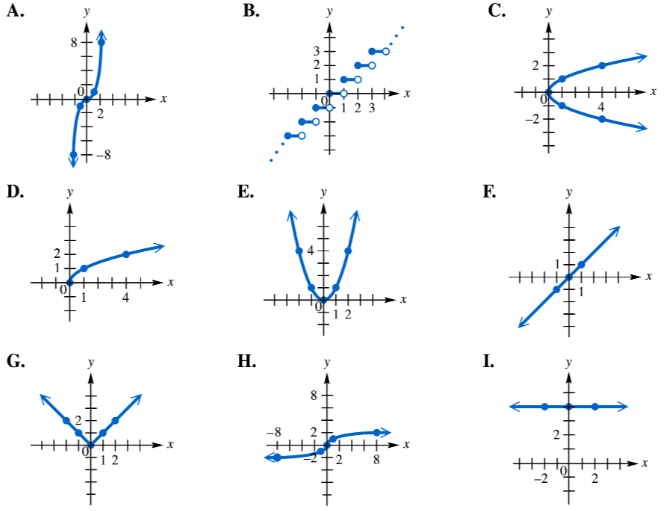
To answer each question, refer to the following basic graphs. Which one is the graph of ƒ(x)=x2? What is its domain?
Verified step by step guidance1
Identify the function given: \( f(x) = x^2 \). This is a quadratic function, which typically graphs as a parabola opening upwards.
Recall the basic shape of the graph of \( y = x^2 \): it is a U-shaped curve symmetric about the y-axis, with its vertex at the origin \( (0,0) \).
To determine which graph corresponds to \( f(x) = x^2 \), look for the graph that has this characteristic parabola shape opening upwards.
Next, consider the domain of \( f(x) = x^2 \). Since you can square any real number, the domain includes all real numbers.
Express the domain in interval notation as \( (-\infty, \infty) \), meaning the function is defined for every real value of \( x \).
Verified video answer for a similar problem:This video solution was recommended by our tutors as helpful for the problem above
Video duration:
2mPlay a video:
Was this helpful?
Key Concepts
Here are the essential concepts you must grasp in order to answer the question correctly.
Graph of a Quadratic Function
A quadratic function like ƒ(x) = x² produces a parabola when graphed. This parabola opens upwards with its vertex at the origin (0,0). Recognizing this shape helps identify the correct graph among options.
Recommended video:
Graphs of Logarithmic Functions
Domain of a Function
The domain of a function is the set of all possible input values (x-values) for which the function is defined. For ƒ(x) = x², any real number can be squared, so the domain is all real numbers, often written as (-∞, ∞).
Recommended video:
Domain Restrictions of Composed Functions
Function Notation and Evaluation
Function notation, such as ƒ(x), represents a rule that assigns each input x to an output value. Understanding how to evaluate ƒ(x) = x² for various x-values helps in plotting points and confirming the graph's shape.
Recommended video:
Evaluating Composed Functions
Watch next
Master Relations and Functions with a bite sized video explanation from Patrick
Start learningRelated Videos
Related Practice
Textbook Question
751
views